In this article, I write about a different kind of research activity, one that has occupied much of my time recently but is rarely discussed in accounts of independent scholarship. It concerns the practical decisions involved in giving a substantial body of work a recognised place within the scholarly record, without compromising the independence through which it was developed. I also reflect on what this process has taught me about the responsibilities of maintaining a research repository, and the possibilities that emerge when its individual contributions become more widely discoverable.
Please refer to the Index of Letters and Articles for related works that may be of interest.
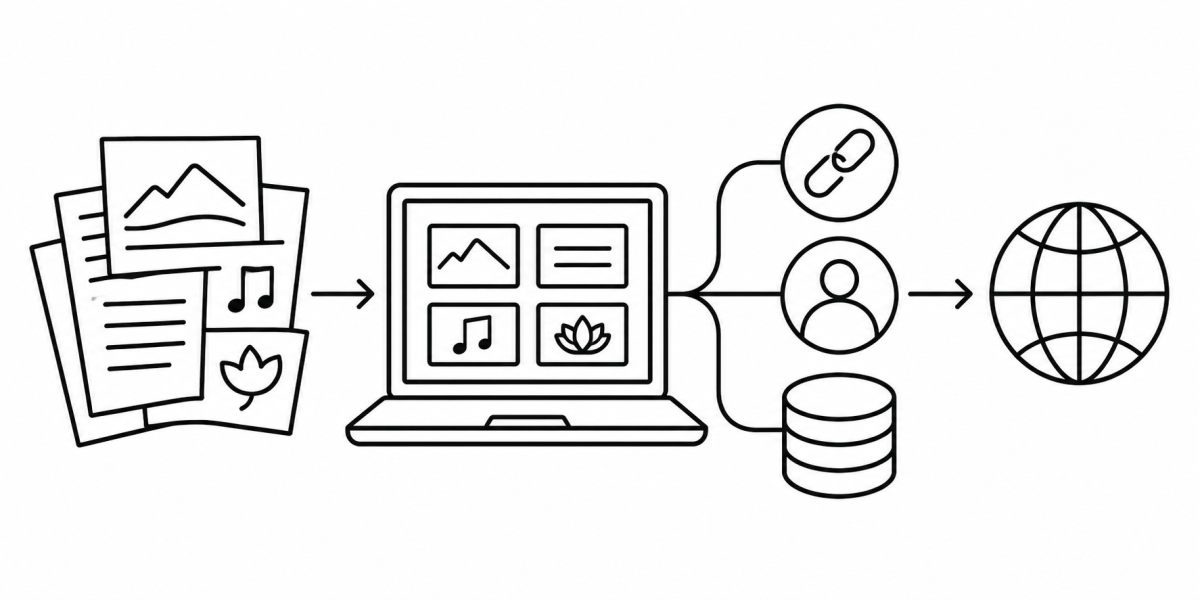
Plate Note: “Closing the Loop”, a minimalist black-line AI-co-created illustration tracing the progression of diverse research materials into an organised digital repository. Interconnected symbols represent persistent identifiers, scholarly attribution, and archival preservation, while the globe suggests the wider accessibility and circulation of independent research. C.Pleteshner for CPinMongolia.com 21 November 2026.
___________________________
CLOSING THE LOOP
Over the past six months, I have been working on the research infrastructure of CP in Mongolia, bringing a further level of scholarly permanence to a longitudinal archive that began in 2004.
This work has involved assigning Digital Object Identifiers (DOIs) to selected scholarly resources within the repository, including ethnographic research, interpretive articles, translations, and soundscapes. A DOI provides a persistent reference for a publication, making it easier to locate and cite even if its website address changes.
I have registered these resources through Humanities Commons, a non-profit, community-governed scholarly network developed to help researchers share their work beyond the boundaries of individual universities and institutions. Its open repository offers a home for a wide variety of scholarly contributions, including work that may not fit neatly into conventional academic publishing formats. I particularly appreciate its commitment to making research freely available and encouraging exchanges across different fields of study.
The records are also linked to my ORCID profile. ORCID, short for Open Researcher and Contributor ID, is a non-profit initiative that provides researchers with a unique, persistent digital identifier. Widely used by researchers across universities and research institutions internationally, an ORCID iD helps distinguish individual scholars, including those who share similar names, and connects them with their publications and other research contributions. It also enables universities, publishers, funding bodies, and research repositories to identify and attribute scholarly work accurately across different systems. Unlike an institutional affiliation, an ORCID iD remains with the researcher throughout their career, regardless of changes in employment or research setting.
For someone pursuing an independent research path, it provides a useful means of maintaining a consistent and verifiable record of authorship within the wider scholarly community.
The process began in late May 2026 with improvements to the repository’s technical foundations. Since then, I have been reviewing and refining its metadata, developing semantic connections between articles, and strengthening the organisation of its interconnected collections. This has also involved examining how readers and researchers engage with the archive, and how its different resources might be more readily discovered and explored.
Of the more than 230 original resources now available through CP in Mongolia, 121 have been assigned individual DOIs. Each represents a distinct contribution to the archive, while remaining part of a larger, evolving body of ethnographic and interpretive work concerned with contemporary Mongolian society and culture.
For me, this is an important stage in a project that has developed independently over more than two decades. The work has always been publicly accessible, but establishing persistent scholarly identifiers and clearer connections between its resources offers a further measure of continuity, attribution, and long-term accessibility. It also makes the research easier to cite and to encounter beyond this website itself.
Much of this recent work has taken place behind the scenes. I have, in other words, been wearing my information design and technical hats!
Yet these developments are closely connected to the ethnographic purpose of CP in Mongolia: to preserve, contextualise, and share encounters, conversations, observations, translations, and creative responses gathered and developed over time.
In this sense, I think of the process as closing the loop. Not because the research itself has come to an end, but because the work accumulated over more than two decades now has a more coherent and durable scholarly framework through which it can remain accessible to future readers and researchers.
_____________________________
FURTHER READING
To provide historical context, Artscape 07: During the socialist times (2018) , an early piece of my post-Soviet art history research, exemplifies one method of interpreting visual representations.
Landscape 09: Modes of Contribution introduces a tool for mapping cultural and social contributions, bringing structure to the “messy ethnography” of fieldwork through ontological positioning.
While this article focuses on the writing of difference, Letter from Mongolia 18: a deliberately interdisciplinary practice considers the practice itself.
Refer to the “ABOUT” page of CPinMongolia for the context and situated core to my ethnographic methodology.
See OTHER STUDIES: Professional and Scholarly Practices for an explanation of my methodology. It bridges my past professional expertise in the Australian Higher Education and Government sectors with my Mongolian fieldwork. It also details the scholarly approaches and specialised skills, such as qualitative analysis and interdisciplinary translation, brought to the project.
End of transcript.
Please refer to the INDEX for other music and articles that may be of interest.
|
© 2013-2026. CP in Mongolia. “Letter from Mongolia 31: Closing the Loop” is licensed under the Creative Commons Attribution 4.0 International License. Open access should not be understood as the absence of attribution. Documents and music linked from this page may be subject to other restrictions. Part of the CPinMongolia Research Archive (Archive DOI: https://doi.org/10.17613/avaty-ayy03). Posted: 21 November 2026. Last updated: 21 November 2026. |