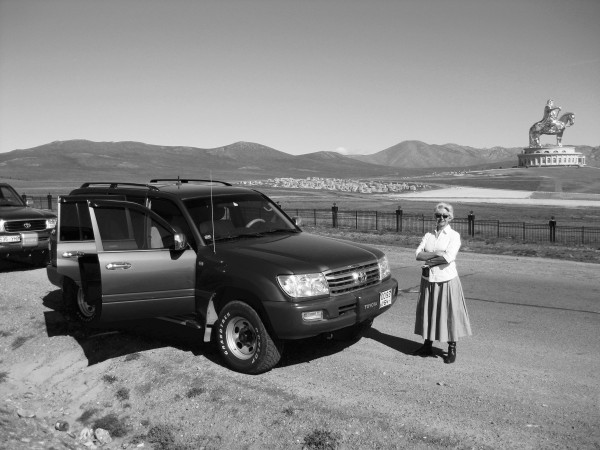
Plate note: CP in Tov Aimag, Mongolia — on the road. CPinMongolia Archive.
INTRODUCTION
Here you will find an overview of my ethnographic practice in Mongolia between 2010 and 2018, grounded in the study of contemporary Khalkha Mongol society and culture. Much of this work emerged through sustained fieldwork, collaboration, translation, and the practical process of learning by doing.
Most people’s adult lives seem to follow an arc of one sort or another. Fortuitously, this has turned out to be an important one of mine.
The projects and publications described here are less a catalogue of completed work than a record of how my ethnographic practice gradually took shape. They trace the development of a way of working that continues to inform the research, translations, and creative practice presented throughout CPinMongolia. Seen together, they also show how each stage of practice opened onto the questions, possibilities, and directions that followed. —CP
_________________________
ENTERING THE MONGOLIAN FIELD
1.1 Independent Scholarship
As a member of the Independent Scholars Association of Australia (ISAA), in addition to previous professional roles at the intersection of the Australian Higher Education and Australian Commonwealth Government sectors (see Other Studies), I have inhabited another social world: that of an independent scholar, someone who independently of traditional university and academic institutions is actively engaged in scholarly work that may offer well-founded studies of society and ideas of cultural significance.
The ethnographic study of the various roles that contemporary Khalkha Mongol people are taking up to maintain and revitalise their cultural heritage and traditions can be considered as central in this respect.
Any grandiose, or misconceived, sense of personal achievement in relation to any of the “works” referred to on this website is tempered by the fact that each reflects a complex of social collaborations with intelligent hard-working other people. Annotated entries fall within the socio-cultural academic research sphere. In my own life I will only get to do a certain number of things. This is what I have done so far. To my way of thinking, all things and tenures are impermanent so best get on with it and just do the best that you can!
1.2 Collaboration in Mongolia
1.2.1 Returning an English work to Mongolia
Coming full circle, translation of the English-language manuscript ‘back’ into Mongolian
The English-language first edition of The Great Nenchen (2015) by Zava Damdin (b.1976) (see below) has now been translated into Mongolian and also published. Both editions were officially launched in Mongolia in February 2015. Surely, there can be no deeper personal satisfaction for me than this? In the fullness of time, the sweet ripening of good fruit.
Please note that the 108 detailed footnotes supporting interpretation of the doha in the english-language first edition) of The Great Nenchen have not been translated across to the first edition rendered in Mongolian Cyrillic.
- See: Зава Дамдин Ренбүчи-“Цогт Очироор Аюулган Үйлдэгч” 2015 оны 2-р сарын 22, 23 нд (16 February 2015) for an interview with Zava Damdin on Mongolian National Television and a discussion of how the English and Mongolian editions of The Great Nenchen were developed.
1.2.2 Publishing with Mongolian Scholars
Publishing a major cross-cultural scholarly work with indigenous-to-Mongolia others.
- The Great Nenchen by Zava Damdin Lama (February 2015). (First Edition). Translated by Catherine Pleteshner and Erdenetsogtyn Sodontogos (Zava Damdin Sutra and Scripture Institute, Ulaanbaatar, Mongolia). ISBN 9778-99962-4-344-8.
The Mongol scholar-poet Zava Damdin (b. 1976) composed the songs selected for this first edition during his Nenchen retreat (2007–2011). Variously translated as ‘Songs of Experience’ (Skt. doha) or ‘Songs of Realisation,’ such compositions are characteristic of a poetic form associated with the Vajrayana Buddhist tantric movement.
To my way of thinking about my own small ethnographic universe in terms of “interculturality”, an important, and in some ways unanticipated, precedent has come to the fore: that is, to ‘”write with’” rather than ‘”write about” Mongolian people at the highest cultural level. Whilst others will have their own perspectives, I would like to think that I am, in some practical way, facilitating the capacity of others to construct and perform in the English language post-Soviet socialist narratives regarding their Mongol-selves.
Here, it seems appropriate to at least mention, if not declare, some of the ‘constraints’ at play in the production of this oral history and similar works. Without doubt, in terms of power relations, Zava Damdin Rinpoche was the senior arbitrator of what did and did not go into the final book. However, having said that,
My own contribution was not that of “ethnographic ventriloquism”, ‘the claim to speak not just about another form of life but to speak from within it’ (Clifford Geertz. (1988). Works and Lives: The Anthropologist as Author. Stanford, Calif.: Stanford University Press. p. 145).
Nor was my contribution to the process an expression of a scholar-ethnographer’s independence (without self-critique). Be in no doubt, there was indeed a great deal of exploratory discussion and, at times, quite animated debate. Interpreting the rich and delicate visual imagery and prose selected for The Great Nenchen into another language for others unfamiliar with Mongol Buddhist culture and society was more complicated than either of these other modalities of scholarly production might imply.
“Different modalities produce different artefacts. Ethnography 101.”
1.3 Collaboration as Ethnographic Practice
Through my yielding to the unfolding creative processes of learning inherent in an intellectual-artistic collaboration navigated by Zava Damdin, the final shape and detailing of this particular artefact of ethnographic scholarly production emerged not only from a multicultural composite of scholarly and literary conventions, but also from an array of disparate (pre-scriptive) themes and motifs.
The Bagsh-student (dominant-subordinate) dyad of power relations, ever-present, receded as we went deeper into interpreting the texts. More importantly, however, in terms of ethnography and its practice, in working on an enterprise proximally and locally,
I too was (re)shaped and taught through the generative and analytical processes in which I was engaged and immersed.
In terms of an inter-culturality of ethnographic practice, we shape and are shaped by the very company we keep. It is this dynamic intra inter-cultural psycho-sociality between contributing “actors” of which I now speak, although modelling this scientifically is well beyond my grasp.
See Artscape 02: The Great Nenchen for further details.
_________________________
2. TRANSLATION AS ETHNOGRAPHIC PRACTICE
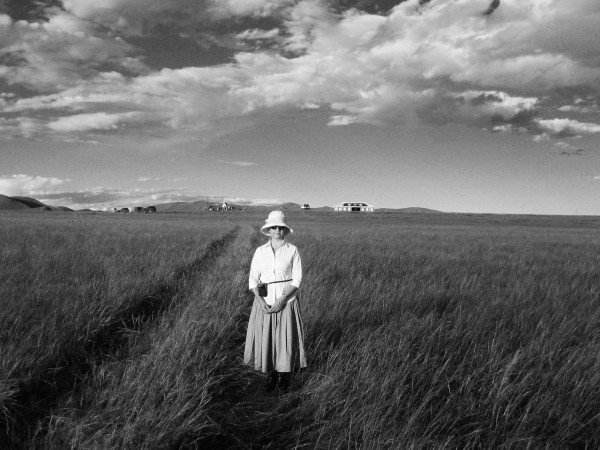
Plate note: CP out on the Mongol steppe — in the anthropological field. CPinMongolia.com
2.1 First Multilingual Translation and Publishing with Mongolian Scholars
Whilst doing fieldwork in Mongolia in July 2013, I had the privilege of assisting with the English translation of an original work that concisely outlines a history of Mongolian Buddhism for scholars and students. My work was closely supervised by the Venerable Zava Damdin, the author. Drawing on authentic Mongolian Gelugpa Buddhist textual sources, this concise scholarly work points to multiple levels of meaning and interpretation that can be developed by scholars with the necessary training, linguistic knowledge, and cultural background.
Such a condensed historical teaching is central to the continuity of a Mongolian religious tradition and therefore salient to the scholarly study of the Mongol-Tibetan interface within contemporary Mongolian society and culture.
The original treatise was composed according to the conventions and formulae of Tibetan poetic forms. The history was then translated by the author into Mongolian, first into traditional Mongolian vertical script (Mongol Bichig) and then into Mongolian Cyrillic. Returning to the original Tibetan composition, an English-language interpretation was then prepared. The final step was to assemble a composite digital document bringing together each translation with original artwork by the author.
A small group of capable people worked collaboratively, and mindfully, from beginning to end on this first multilingual literary project. The completed booklet was printed locally in Ulaanbaatar.
- Zava Damdin Lama Lovsangdarjaa. 2013. Echo of the Snow Land (a distributed formal address in booklet form, including original artworks by the author, to all participating delegates of the Thirteenth Seminar of the International Association of Tibetan Studies [IATS] in Ulaanbaatar, 21–27 July 2013). Ulaanbaatar, Mongolia: Zava Damdin Sutra and Scripture Institute, Delgertsogt Mountain, Mongolia.
2.2 Transcribing Learned Commentaries
A (now) traditional (euro-western) approach
During a three-week residency at Delgeruun Choira in July 2013, I developed an edited English-language transcript from authorised recordings of a Burhan Ayush Commentary by Lobsang Darjaa Zava Damdin Lama, in the Tradition and Unbroken Lineage of Venerable Rachungpa. July 2013. (Unpublished manuscript, Zava Damdin Sutra and Scripture Institute, Delgertsogt Mountain, Mongolia).
The Mongolian Burhan Ayush (Skt: ‘amita’ boundless; ‘ayus’ life; Ch: ‘Amituo Fo’; ‘Wuliangshou’) is one of the three long-life Buddhas in the Gelugpa Buddhist pantheon. This particular lineage of Mongolian Burhan Ayush practice, an unbroken oral transmission from Teacher to student, can be traced back to Venerable Rachungpa (Rechung Dorje Drakpa. Wylie: Ras-chung Rdo-rje Grags-pa; 1083/4–1161). Refer to the Burhan Ayush initiation transcript for the specific lineage of oral transmission.
Small religious paintings known as ‘zaghali’ are used by a Gelugpa Lama (Wylie: bla-ma) during such an initiation ritual. The zaghali used on this occasion for Burhan Ayush is said to have been painted by one of the Mongol lama-artists at Delgeruun Choira in the Dundgovi before the socialist era and the monastery’s destruction in 1937–38.
The careful, phrase-by-phrase rendering of audio recordings of Gelug lamas’ spoken discourses into text-based digital artefacts is a well-established and widespread practice among students of (Tibetan) Buddhist philosophy and their lama-tutors in the euro-west. (I am not sure if ethnic Mongol Gelugpa lamas in the west do a similar thing. Maybe someone else knows?)
My participant-observation experience has taught me that Gelug lamas give discourses on requested topics in the homes of their hosts and at their centres. In Australia, this practice began in the 1970s and continues to this day. I began transcribing such commentaries in 1990 and have continued to return to this form of careful listening and textual rendering ever since.
When I first wrote this page in 2014, people around the world, more often than not ‘western’ women-practitioners, continued to engage in this transcribing practice. Solitary and voluntary, in conducive contexts and circumstances, such transcription can be deeply satisfying and illuminating work.
By 2026, however, this practice appears to be changing. AI-assisted transcription services may now be taking over some of the more mechanical aspects of the work, while in some Tibetan Gelug Buddhist settings transcription has also developed into a collaborative group practice that helps build cohesion among lineage devotees. From my recent observations, this may also be one strategy contributing to the development of a more globalised, interconnected, and multilingual organisational structure. So far, I have observed this as a Tibetan Gelug Buddhist modality rather than a Mongolian one.
2.3 Oral Transmission Across Languages
Post-Soviet socialist modernity and innovation, adding another language to the discourse
It may be of interest to readers to know that the Burhan Ayush Initiation and Commentary (abbrev., see above) was the first initiation commentary to be given by Zava Damdin Lovsangdarjaa in the English language. This important event took place on 24 June 2013 at his monastery, Delgeruun Choira, colloquially referred to as ‘The Mountain’, in Delgertsogt Sum, Mongolia.
The oral recitation of the traditional text-based liturgy was performed in the usual manner: in Tibetan, though, as is customary in Mongolia, it was imbued with the familiar Mongolian pronunciation and accent.
On this particular occasion, however, Zava Damdin Rinpoche’s translation of the commentarial text was delivered primarily in English. Spoken Mongolian was used mainly to facilitate an understanding of the initiation process for the many local and visiting Mongolian participants, and for other pragmatic and procedural instructions.
The preparations for this ritual performance by everyone involved were, as had come to be expected, meticulous. With everything assembled and in place, participants settled into their positions, and the event unfolded without interruption to either the ritual performance itself or the authoritative commentary that accompanied it.
Beginning in the afternoon, the Burhan Ayush initiation and English-language commentary continued well into the evening. Looking back,
What remains with me is a sense of wonder at how such a skilled orator (Zava Damdin) could move so fluently across not only multiple languages, but also a myriad of eloquently performed, not merely spoken, ritual tasks.
This complex Gelugpa ritual performance was nevertheless completed within a reasonable time and within the other commentarial constraints selected by the orator.
_________________________
3. BUILDING THE MONGOLIA PROJECT
3.1 The Zava Damdin Medallion
On 10 November 2011, I was awarded the Zava Damdin Medallion for my scholarly contribution to the study of contemporary Mongol culture. The ceremony took place inside the Majestic Shining White Palace ger at Delgeruun Choira, on Delgeruun Mountain in Delgertsogt Sum, Dundgovi, Mongolia. I understand that I was the first woman and Australian to receive this honour publicly in Mongolia.
In the context of post-Soviet socialist cultural regeneration, the medallion was first presented to Mongolian scholars at a 2007 conference held at the National Library of Mongolia in Ulaanbaatar. Professor Shagdaryn Bira, Secretary General of the International Association for Mongol Studies, chaired the proceedings. The conference was convened and sponsored by Zava Damdin Luvsangdarjaa (b. 1976).
I had the good fortune to attend this important cultural event, the first of its kind in Mongolia to bring together local scholars of Mongolian Buddhism with invited specialists from Europe and the Baltic States. The two-day conference was held alongside celebrations marking the 140th anniversary of the great pre-socialist Mongol-Gelug Buddhist historian Zawa Damdin bLo bzang rta dbyangs (1867–1937). All events, including the conference, were open to the public and admission was free.
3.2 Nomadic Temple
A collection of contemporary Mongol women’s stories
- Pleteshner, C. 2011. Nomadic Temple: Daughters of Tsongkhapa in Mongolia. (Unpublished manuscript, 365 pp.). A collection of narratives about contemporary Mongol women and the cultural and social worlds in which they are individually situated. Each of the thirty-four essays is grounded in participant-observation fieldwork and interviews with the person about whom I write.
To read an illustrative example, please go to the Vignettes branch of my blog. All of the people in this assemblage are Khalkha Mongols, the largest group of the ethnic Mongol peoples living in Mongolia today. As a community-specific collection, these narratives stand as testimony to the rapidity of local social and cultural change.
3.3 Multi-sited Ethnography
3.3.1 Digital Infrastructure and Privacy
On 25 May 2018 the GDPR legislation came into force across Europe. It requires website owners to comply with European Privacy Regulations. Improving privacy in the wider online community, through implementing a range of ‘opt-in’ consent protocols that empower contributor and end-user control over their personal data is the primary goal of this legislation. The wider-promulgation of these important principles is long overdue.
3.3.2 Intermedia Scholarship
Educational Inter-cultural Multimedia
In December 2017 I completed the curatorial essay that maps out the conceptual and technical development of the multimodal and multi-platform work Soundscape 05: Fluxus in F.
Experiences associated with studying Mongol culture in Mongolia for more than a decade cascade into what I am working on elsewhere. The You Tube video Soundscape 05: Fluxus in F for Adriana was composed In October 2017. A musical meditation on ‘scholarship’ and ‘Emptiness’ it draws on an English translation of 20th Century Mongol poetry and its associated enculturated perspective to set the scene.
3.3.3 Continuing Higher Education
Higher Education
- For a week (5‑12 August 2017) I attended the annual ‘intensive’ meditation and Buddhist philosophy study course taught by the Venerable Gonsar Rinpoche at the Centre des Hautes Etudes Tibétaines at Le Mont-Pèlerin near Lake Geneva, Switzerland.
3.3.4 Designing CPinMongolia
ICT design and implementation
In close online consultation with the Mongolian community elders with whom I work, an integrated concept for the CPinMongolia.com initiative and its sister YouTube channel, CP in Mongolia, evolved over three months from November 2013 to January 2014. Both online repositories were populated and technically implemented without outsourcing. By the first day of the Mongolian Lunar Calendar New Year (31 January 2014), each branch of the website’s information design hosted one or more detailed entries, some providing background stories to performances posted on YouTube.
In addition to my own ethnographic writing, research, and performances, selected works by Mongolian scholars and artisans were also included. Written authorisation was obtained from each author.
With the CPinMongolia online infrastructure and content management protocols in place, additional substantive material relating to contemporary Mongolian culture and society could then be progressively added within this multimedia framework: artefacts, artscapes, landscapes, motifs, soundscapes, and vignettes. In terms of capacity building, everyone involved became familiar with how such initiatives and their implementation work.
3.3.5 Conferences and Scholarly Dialogue
Conference presentation, Q & A
-
Women and the Replacement of Mongolian Buddhism. Presentation of a working paper at the Place and Displacement Conference, 21–23 November 2012, convened by the Community Identity Displacement Research Network (CIDRN) at Victoria University, Melbourne, Australia.
The CIDR Network of scholars is a public intellectual space where innovative research is encouraged and promoted. Here, ‘new questions of indigeneity, racism, refugees, sense of place, social inclusion, social justice, transnationalism and xenophobia (an unreasonable fear of foreigners or strangers) can be raised, debated and discussed.’
A primary stated aim of the CIDR Network is:
‘To encourage creative, performative and visual responses to challenges of displacement, identity and community transformation.’
My study of contemporary Mongolian culture and society, together with the creative work presented through CPinMongolia, sits comfortably within this frame.
3.3.6 Teaching, Learning, and Scholarly Formation
Teaching and Learning
-
Sessional Lecturer and Tutor (AAA2011 Cultural History of Tibet: The Tibetan Empire). May 2012. Convened by Asian Studies Coordinator Mark Stevenson (Victoria University, Melbourne).
At the Mongol-Tibetan interface of existing course content, supplementary teaching and learning materials developed for Asian Studies undergraduate students at Victoria University include: (a) Dimensions of Tibetan Religion in Mongolia: Convergence; (b) Dimensions of Tibetan Religion in Mongolia: Cross-cultural Infrastructure; (c) Dimensions of Tibetan Religion in Mongolia: Honour and Protection; and (d) Dimensions of Tibetan Religion in Mongolia: Enacting and Creating a Buddhist World.
Finding and contributing my own voice to such discourses has not been singularly dependent on working with learned scholars within (western) institutions of higher education and their modalities.
From the late 1980s, I had already begun to seek out learned masters of philosophy beyond the boundaries of such enclaves. I have been both drawn to and intellectually challenged by engaging with their ‘traditional’ and preferred Teacher-Disciple oral transmission-of-lineage learner-centred pathways.
Since 2004, I have studied with such masters not only in Mongolia but in Germany, Austria and Switzerland.
Just one more reflexive step ‘backwards’ before moving on… By 1993, I had already begun consolidating what I was learning through my parallel study of Buddhist philosophy into some form of writing, not just for myself but for others as well. So it was that between 1993 and 1997, I edited and produced the quarterly Lalita Newsletter, mailed to interested readers in countries around the world. There is no substitute for ‘articulation work’ (in black-and-white writing) to help hone one’s own synthesis of learning and what one thinks one knows. Lalita Newsletter served as a philosophical adjunct to an otherwise institution-specific professional thread.
Globalising modernity is not only a theoretical subject to be studied (I remain a great admirer of the British scholar-sociologist Anthony Giddens (1938–)), but also a progressive developmental process by which one can make one’s own way. My own journey has drawn me into and through communities of (preoccupied) scholars and their socio-cultural nodes: in Bourdieusian field research terms, their habitus. To my way of thinking, there is simply no substitute for ‘being there’ with people to better understand who they are, relationally, and how things work socially and culturally. In this context, and in relation to other social anthropologists’ analyses of post-Soviet socialist Mongolian culture and the re-creation of identity, the insightful, early post-Soviet socialist scholarship of Christopher Kaplonski is a standout.
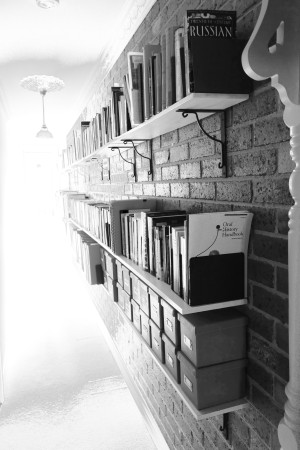
Plate note: A section of my Mongolian fieldwork data and research archive-library. It’s been a steady accumulation over many years. Whilst some prefer Chanel handbags, I am drawn more to ‘well-researched’ commentaries, manuscripts and books.
_________________________
4. ARTEFACTS AND SCHOLARLY PRACTICE
4.1 Scholarly Artefacts and Lineage
Scholarly artefacts as reflections of innovation in a lineage of teacher-to-student transmission
To provide readers with an arc to the design of my Artefacts page, there are two main points I would like to make. Both concern artefacts and how lineages of practice relate to them. The first is straightforward: scholarly artefacts in the form of publications, and where they can be found through open access. The second is more complex, in fact an entire discourse in itself. However, I would like to at least touch on this important subject, as it concerns the practice of teaching, learning, and lineage, and how these relate to my own work.
4.2 Publications, Provenance and Open Scholarship
Publications are artefacts of literary and cultural production. They come from somewhere and someone. Contextualising their published forms within a provenance, the who, how, and where of their origins, provides additional and relevant information that would otherwise be lost were such artefacts dislocated from their social contexts and left to float in an otherwise disembodied virtual sphere. In my own ethnographic writing, I seek to emulate the ‘articulation work’ of cultivated scholars who reflect this practice and whom I hold in high regard. Whilst some may consider all this a bit of a storm in a teacup, given the ubiquity of online information, and whilst it may take the reader a little longer to move from the top to the bottom of a particular page, surely this is good, if not best practice, where cross-cultural ethnography is concerned?
Many of my publications can be found in WorldCat, a global multilingual catalogue of research held in library collections. Some are organisational change-management programme and project ‘evaluation’ reports commissioned by Australian university and government departments. Others were Commercial-in-Confidence and therefore have no ongoing digital archive life.
WorldCat, built and maintained collectively by participating libraries, itemises the collections of 72,000 libraries in 170 countries and territories (at last count). Anyone interested, not just people who work in universities, can use this powerful search tool to find out what research has been done on a topic and by whom. Free of charge, you can search for particular published works and identify the libraries where they are held. Not all valuable knowledge is available for free on the Internet. If you have read this far and are still curious, you may like to do a quick Google or Bing search. Using ‘pleteshner’ may yield other published artefacts recorded in open-access digital archives and repositories.
4.3 Thick Description and Relational Scholarship
And finally, in regard to the transmission of lineage within Artefacts, the concluding, and probably one of the more important, stories I would like to share with you is this:
For some of you, an abridged listing of my artefact output may have sufficed. Having glossed it, you could then quite quickly have drawn conclusions and made assumptions about who I am and what I do.
However, such a presentation of self is less than ideal. Why? Because complex work, within, across and between sectors, and now countries and cultures, is relational. We have to get on well with each other in order to get it right. ‘Thick description’ (cf. the illuminating work of social anthropologist Clifford Geertz) allows for the inclusion of meaningful, and many would say more interesting, information about the how, from whom, and with whom of developing one’s own capacity to do things along the way.
4.4 Teachers, Mentors, and Cultural Transmission
Through ongoing working relationships with Mongolian scholars and friends, I am constantly reminded of something I also hold to be true: we each look to particular teachers, mentors, and colleagues to learn how to work well and creatively with the tools and skills of our chosen practice. In Mongolia, someone known as a skilled musician, poet, or artist may also be a serious scholar of history, traditional practice, or a custodian of other oral transmissions of local knowledge. Such teachers and mentors contribute enormously to a shared, rather than individualist, accumulation of cultural and social capital (cf. anthropologist-philosopher Pierre Bourdieu 1930–2002) that, although local, can extend well beyond a single community or form.
One of the realities of living and ‘doing’ in Mongolia is that nothing can be achieved on one’s own! That applies not only to Khalkha Mongol people, but also to their invited overseas guest.
4.4.1 Respect for Teachers and Mentors
In Mongolia, respect for teachers, mentors, and scholars is not feigned. It is heartfelt and often reverential. The investment of teachers in their students, whatever the particular thread, is not yet taken for granted. It may be a legacy of the Soviets, or of Mongol culture and its people. For me, the answer remains unclear. But the practice, oh, the practice of honouring one’s teachers and important others, well, it just feels so wholesome, so healthy, and so right!
Displays of respect are performed publicly and privately, at least within the social spheres and communities to which I am drawn. Contemporary Khalkha Mongols can also be somewhat flamboyant. They are not shy about singing a spontaneous song (or two) in public with a large bowl of airag (fermented mare’s milk) held elegantly and respectfully before them, cupped in both hands, or about expressing heartfelt yearnings to others when the context is conducive and feels right. Here in Australia, a teacher may once have been offered a handpicked apple as a gesture of respect. Increased regulation of what is deemed suitable behaviour between students and teachers now generally discourages such spontaneous yet publicly performed acknowledgements of respect and affection.
In Mongolia, however, the situation is somewhat different. Most students and teachers still live proximally, so everyone knows who is who. Students are still free to give their local teachers gifts, spontaneously, modest or grand depending on the family’s circumstances, when they feel they have learnt something new or achieved something special, in their own minds at least. Students get to express the sheer joy of their accomplishments, considerable or small though they may be, and the teacher is acknowledged for the instruction that helped make something well done possible.
Awards are often accepted through the expressed honouring of elders and teachers directly involved.
Personal achievement is understood as an accumulation of merit in which both the passage of time and other people are always involved.
Such micro-displays are spontaneous arisings. They happen across Mongolia all the time, in many different places. Fresh flowers, homemade goat and sheep cheeses, and other gifts are presented as offerings of heartfelt respect to teachers, whatever the subject, age, or occasion. If someone has an honourable reputation for a serious commitment to teaching others, they are likely to attract such acknowledgement, accolades, and other wholesome things.
4.4.2 Teaching, Learning and Continuity
It may not be enough simply to excel at doing something. In certain Mongolian community settings, it is also expected that one begins teaching, sometimes from an early age, what one has learnt from others and already knows. This allows such jewels, whatever the size or extent of their sparkle, acquired from elders, teachers, and one another, to continue circulating through the wider community.
I have spent a great deal of time with Khalkha children and adults of all ages, across up to five generations of interlocking extended families. It is from this participant-observer position that I offer these observations on Khalkha practices of teaching and learning. I leave their veracity for others to consider and judge.
In early post-socialist Mongolia, this practice of acknowledgement still appears to be ungendered. Beautifully assembled bunches of fresh flowers, imported from growers in China, are offered by and to both women and men. The connotations in the Mongolian context differ markedly from the prevailing gendered and commercial modelling of such behaviour in the west. The closest equivalent I can think of is the presentation of flowers to a diva after her performance, although in Mongolia flowers may just as readily be presented by an enthusiastic admirer to a male teacher.
You see, I really like the way Mongol people openly perform their respect for certain teachers, artists, performers, mentors, and friends. There is no need to go on and on about it: once it has been done, it is done. People do not dwell on it because it is an established, normalised practice rather than an occasional exception. But making that moment, and deliberately and mindfully preparing for it, I really like what I see.
4.4.3 Continuity Across Generations
I like the continuity reflected across generations, as students strive to embody what they have been taught while integrating what they have learnt into their own innovations of previous practice, creating new, unossified, and expressive forms.
There is nothing static or fossilised about this process of teaching and learning as it unfolds across the wider community. Whatever students’ actualisation of their own potential, honour and respect, particularly towards one’s elders and teachers, continue to play a pivotal role in the local transmission of tutelary lineages. Ongoing reciprocity of responsibility and effort lies at the heart of the task.
With good teachers and good teaching, ‘sometimes it is the very people who no one imagines who do the very things people cannot imagine.’ (A quote from the 2014 film The Imitation Game about the Cambridge-trained mathematician Alan Turing, spoken by Benedict Cumberbatch.) Such an inspiring thought, don’t you think?
4.5. Concluding Reflection
I have always placed a high value on quality teaching, most likely because I have had the good fortune to study and work with some of the best. In the preceding narrative about Artefacts, the more tangible outcomes of a scholarly process of production, and throughout this website, I have also chosen to honour my teachers, mentors, friends, and colleagues. For without them, where would this particular collection of Artefacts and my Other Studies be?
In the simplest of terms, a vast array of important and interlocking ethnographic narratives of post-socialist Mongolian life are still unfolding. Sometimes, one also has to work at the nexus of multiple institutions and their organisational orthodoxies for innovation not only to be possible, but to be actualised and performed. Through my small but focussed multi-sited contribution, I hope to shed additional light on this highly complex cultural and social anthropological field.
_________________________
OTHER STUDIES
For a broader view of the research, teaching, technology, and professional projects that preceded this work, see OTHER STUDIES. It traces some of the skills, methods, and approaches I later brought to my ethnographic research in Mongolia.
_________________________
ABOUT
For the wider context of how this ethnographic practice developed into the interconnected research, translation, visual documentation, and creative work of CPinMongolia, see ABOUT. It brings these strands together within the broader scholarly and intermedia framework of the project.
End of transcript.
Please refer to the INDEX for other articles that may be of interest.
© 2013-2026. CP in Mongolia. This post is licensed under the Creative Commons Attribution 4.0 International License. Open access should not be understood as the absence of attribution. Documents linked from this page may be subject to other restrictions. Posted: 14 January 2014. Last updated: 211 September 2026.