My final research article for 2024 is a photo essay about some books. It’s a very long read, detailed and specific, and more like a chapter than an article perhaps. For us, this is not just another story about some books on some shelves somewhere: digitised, paperback or in hardback form. Our story begins here…
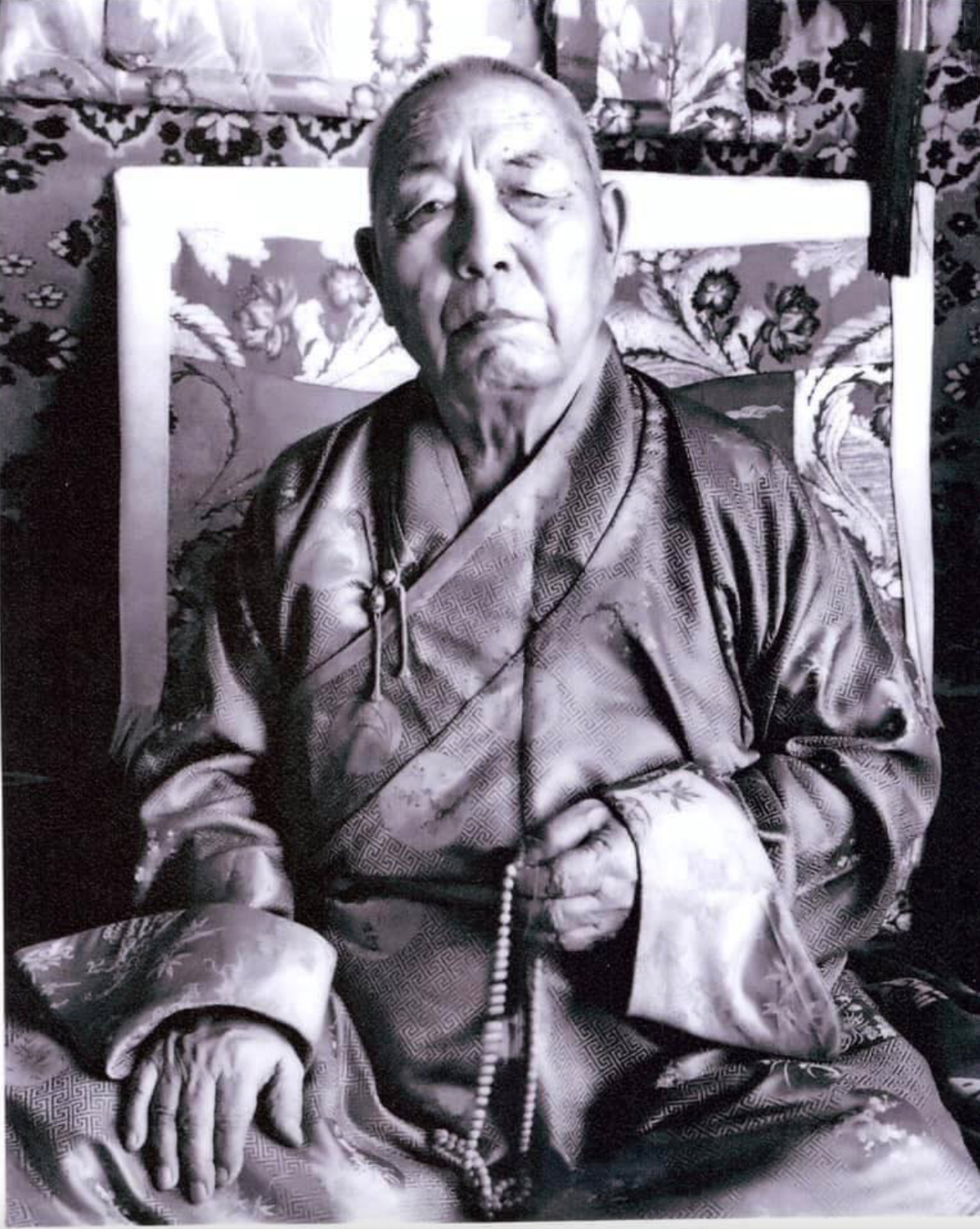
The 16th incarnation, Lobsang Tenzin Gyatso Pal Sangpo Guru Deva Rinpoche (1910 – 7 April 2009) was born in Khangin Hoshuu/Sum (Ordos Aimag), in what is now Inner Mongolia. Whilst his first incarnation’s name was “Dubchin” each subsequent incarnation title was that of “Guru Deva.” His father was a descendant of the Borjigid Mongol tribe, and his mother of the Durvud. Photo source: Zava Damdin Sutra and Scripture Institute of Mongolia. Archival image reprinted with permission on CPinMongolia.com. 30 December 2024.
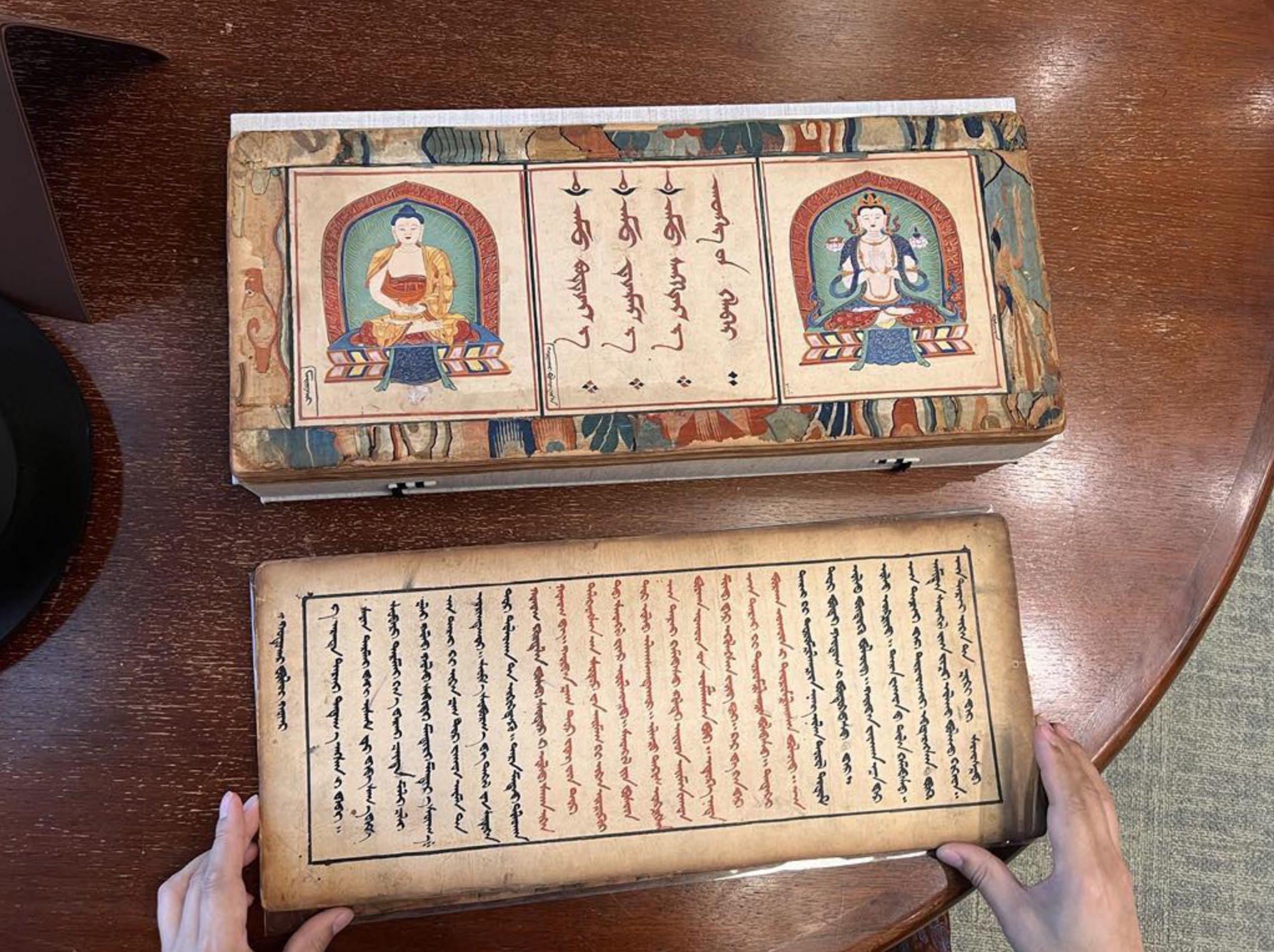
From 1964, Guru Deva began adding hundreds of texts (sutras, scriptures, commentaries) of which he was custodian to the American Library of Congress collection in Washington D.C. and other important libraries around the world. The writing systems of these exquisite and invaluable texts are primarily Classical Mongol Bichig with Tutelary images and formal Tibetan Uchän. This is just one example (Classical Mongol Bichig with Tutelary images) from the Guru Deva collection in the Rare Books catalogue of the Library of Congress in Washington D.C.. Factual information and photograph (taken in December 2024) courtesy of the Zava Damdin Sutra and Scripture Institute of Mongolia. Image reprinted with permission on CPinMongolia.com. 30 December 2024.
This story is about serious academic study and rigorous scholarship. It is also about the preservation of a collection of vitally important literary texts at the very heart of an unbroken lineage of gelug and nomadic Buddhist philosophy and tradition in one of the world’s most important repositories for such texts, the Thomas Jefferson Building, the Main Library of the American Library of Congress in Washington D.C.
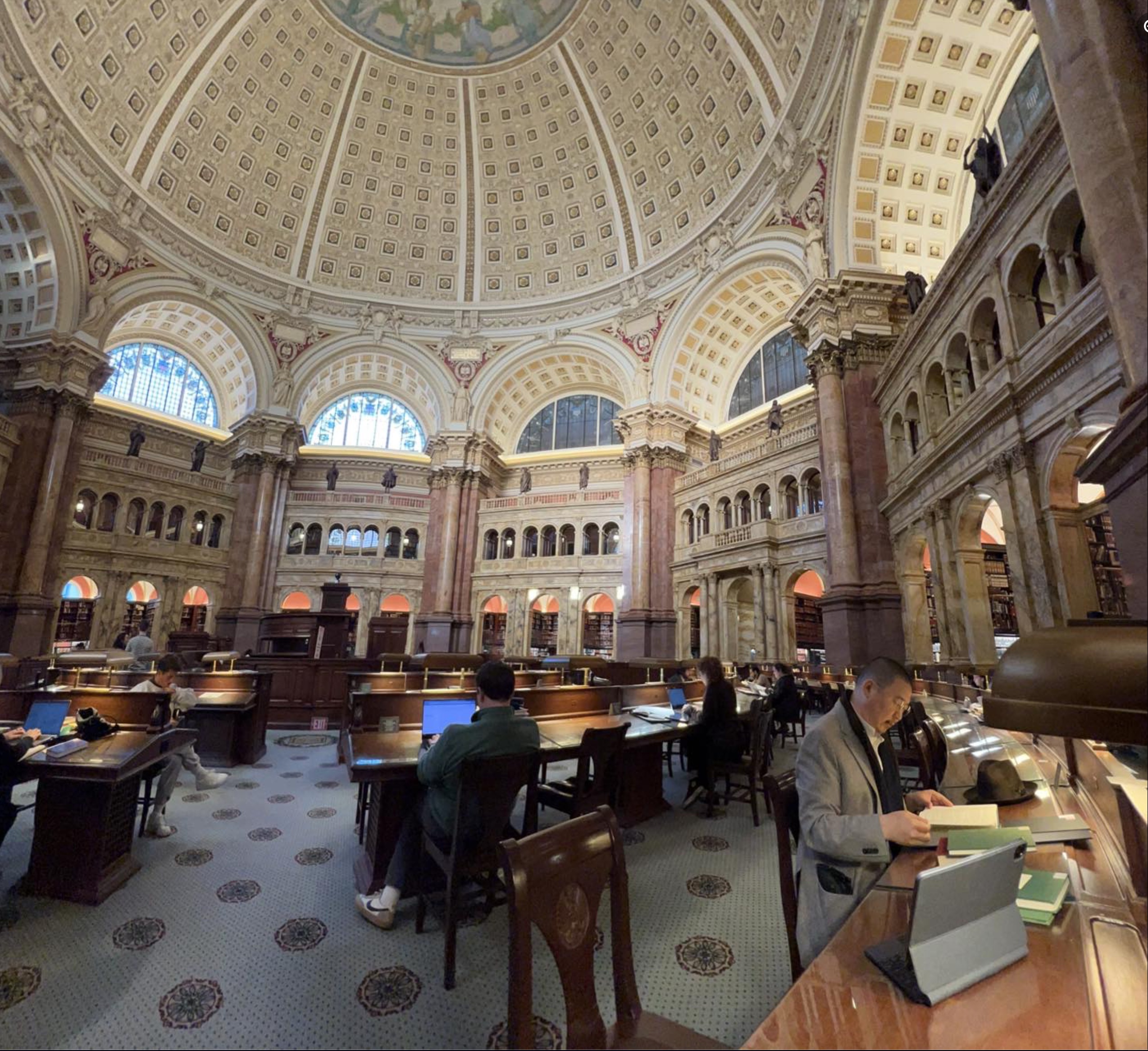
PHOTO 01: For 10 days in December 2024, Zava Damdin Bagsh (b.1976) joined other research scholars to continue his own studies, drawing from the Guru Deva collection and other important texts held by the Library of Congress in Washington D.C. He is pictured here (front right) at work at a desk in the Reading Room of the Main Library. It has taken a lot of time and effort by many people to organise this important event in Zava Damdin Luvsandarjaa’s journey. So many international and other protocols … We whole-heartedly thank everyone who was involved. Photograph courtesy of the Zava Damdin Sutra and Scripture Institute of Mongolia. Image reprinted with permission on CPinMongolia.com. 30 December 2024.
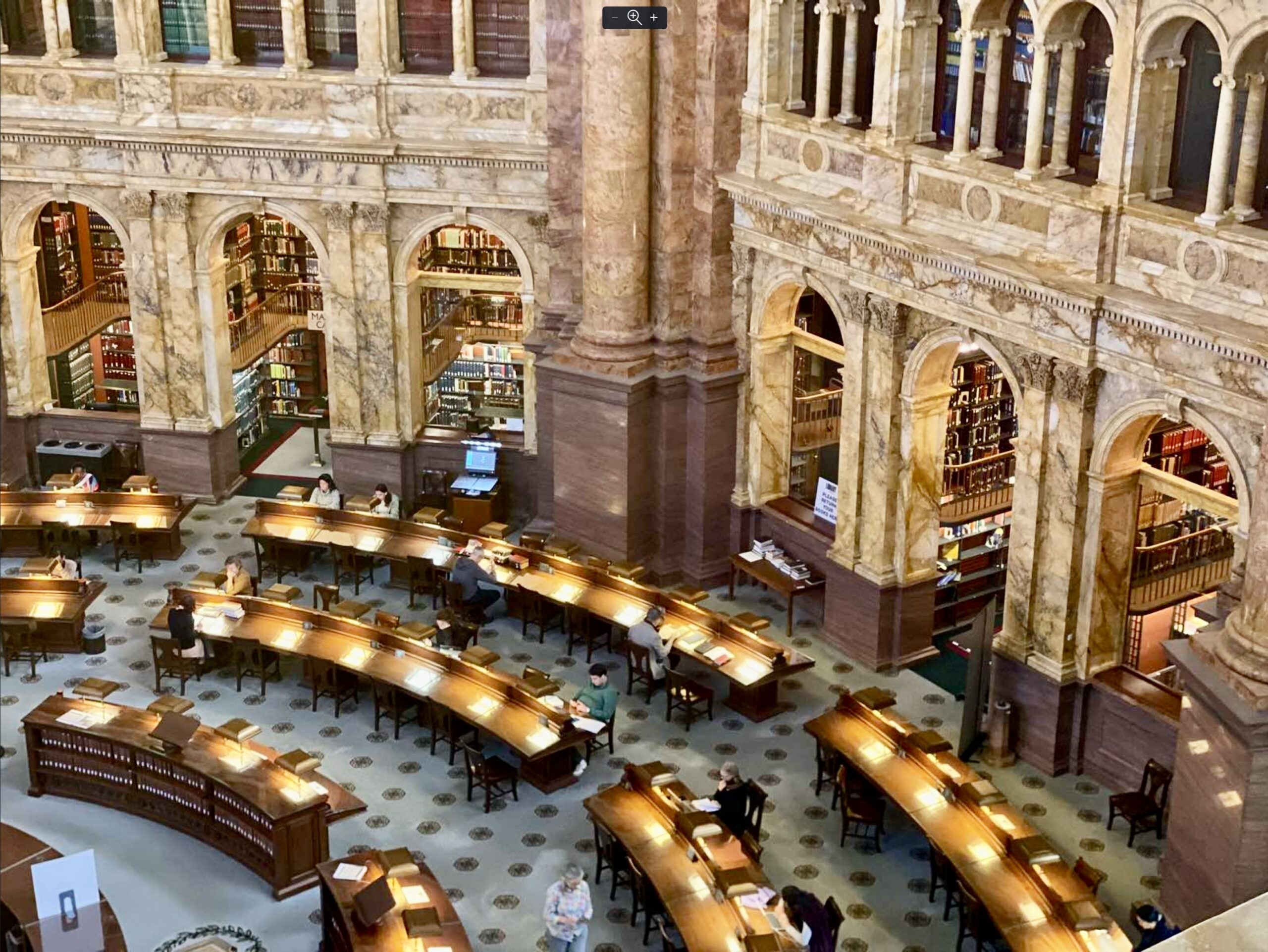
PHOTO 02: For 10 days in December 2024, Zava Damdin Bagsh (b.1976) joined other research scholars to continue his own studies, drawing from the Guru Deva collection and other important texts held by the Library of Congress in Washington D.C. He is pictured here (centre) from above in “the stacks” with other research scholars in the Reading Room of the Thomas Jefferson Main Library. Photograph courtesy of the Zava Damdin Sutra and Scripture Institute of Mongolia. Image reprinted with permission on CPinMongolia.com. 30 December 2024.
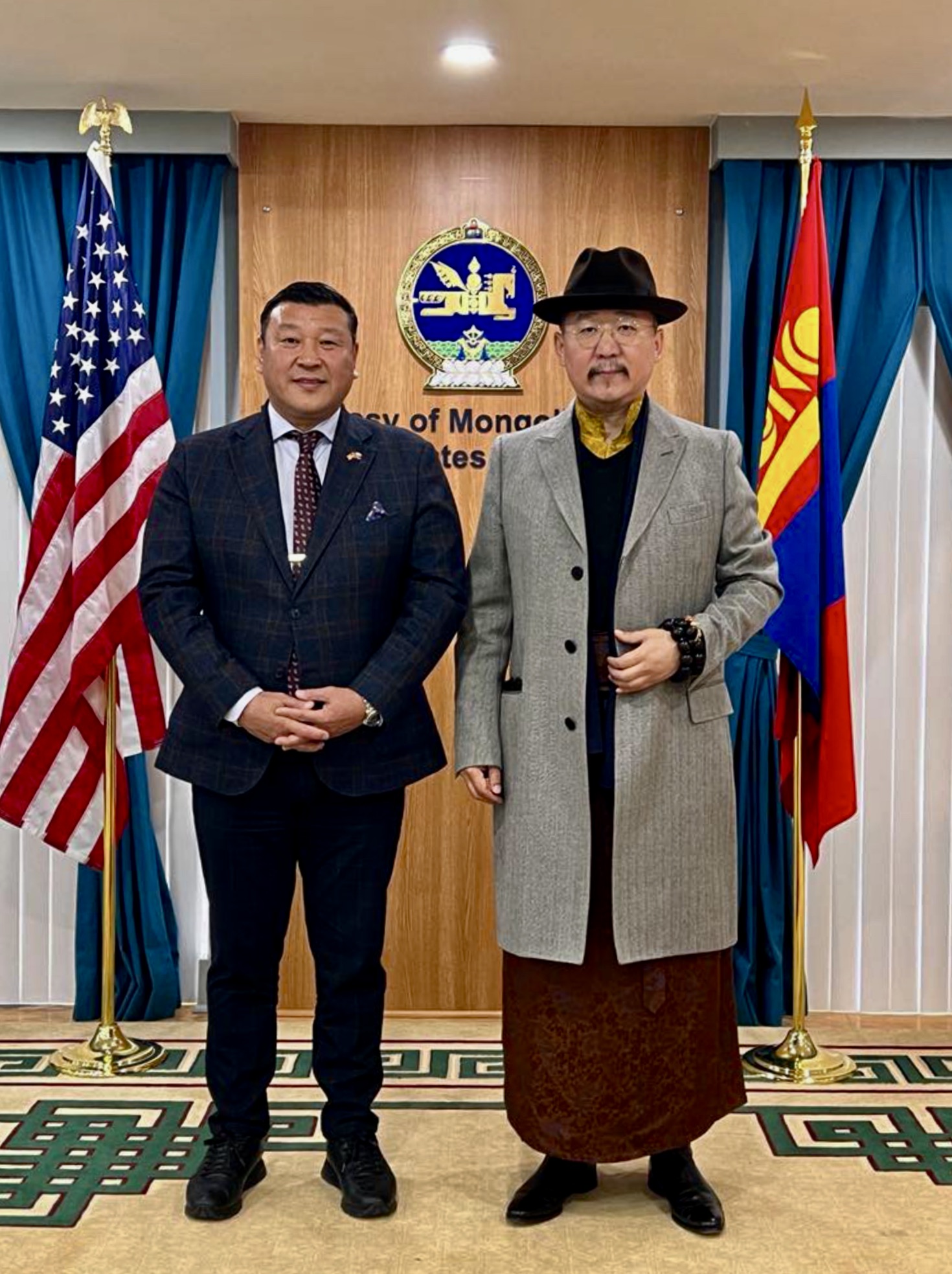
The Honourable Batbayar Ulziidelger (Foreign Affairs Ministry of Mongolia since 2021 and currently Ambassador Extranordinary and Plenipotentiary of Mongolia to the USA)(left) pictured with Zava Damdin Luvsandarjaa (b.1976) (right), after a meeting at the Mongolian Embassy in Washington D.C. in early December 2024. Photograph courtesy of the Zava Damdin Sutra and Scripture Institute of Mongolia. Image reprinted with permission on CPinMongolia.com. 30 December 2024.
___________________________

Zava Damdin Bagsh and a specialist research librarian unpacking one of the precious texts (for which he requested access) from the Guru Deva collection established in 1964. Location: Rare Books Collection Reading Room, Thomas Jefferson Library of Congress in Washington D.C. Photograph courtesy of the Zava Damdin Sutra and Scripture Institute of Mongolia. Image reprinted with permission on CPinMongolia.com. 30 December 2024.
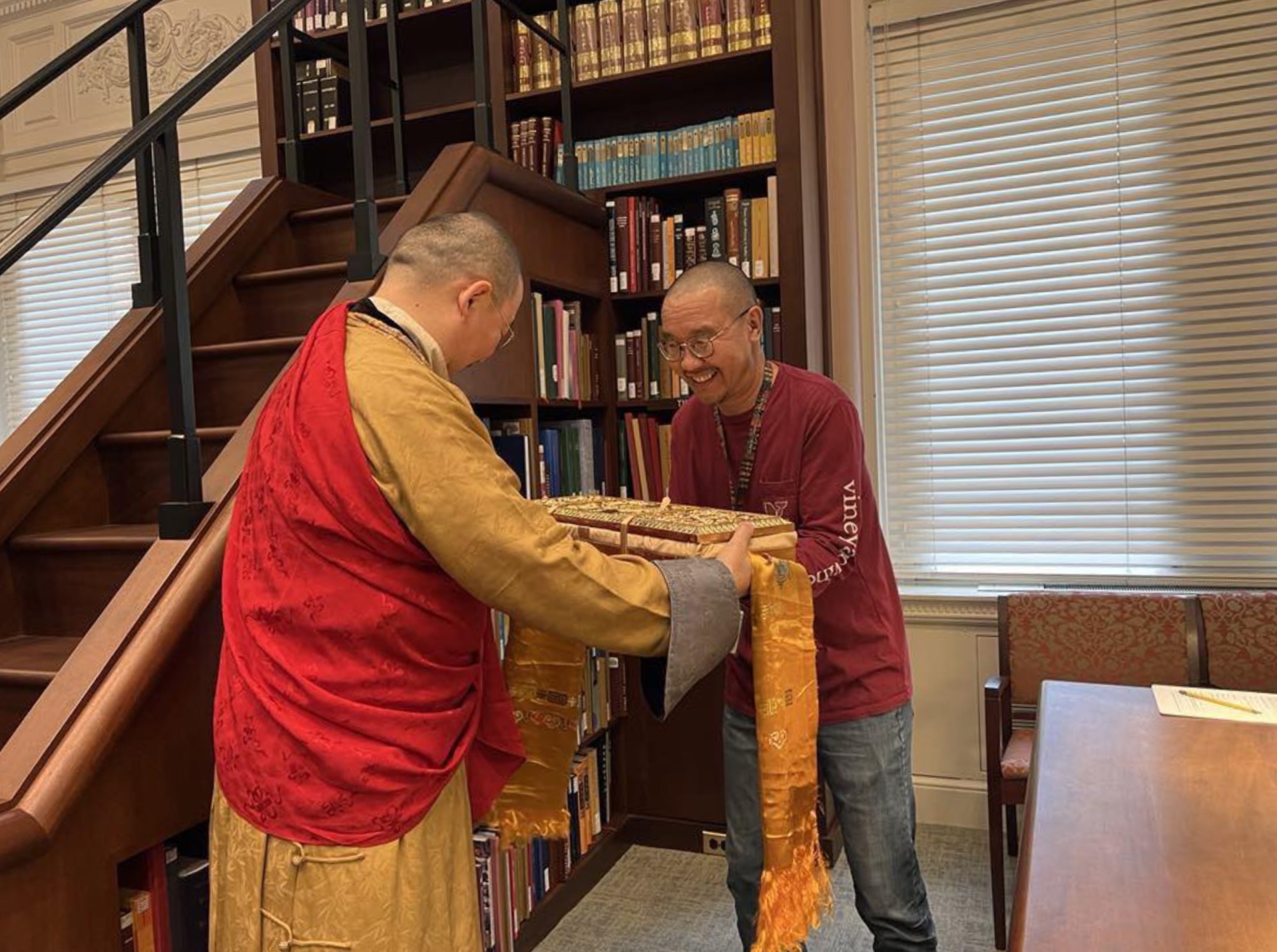
The Mongolian archive research librarian taking receipt of The Golden Book from Zava Damdin Rinpoche, now added to the collection his Teacher and mentor Guru Deva Rinpoche initiated back in 1964. Location: Rare Books Collection (Reading Room) Thomas Jefferson Library of Congress in Washington D.C. Photograph courtesy of the Zava Damdin Sutra and Scripture Institute of Mongolia. Image reprinted with permission on CPinMongolia.com. 30 December 2024.
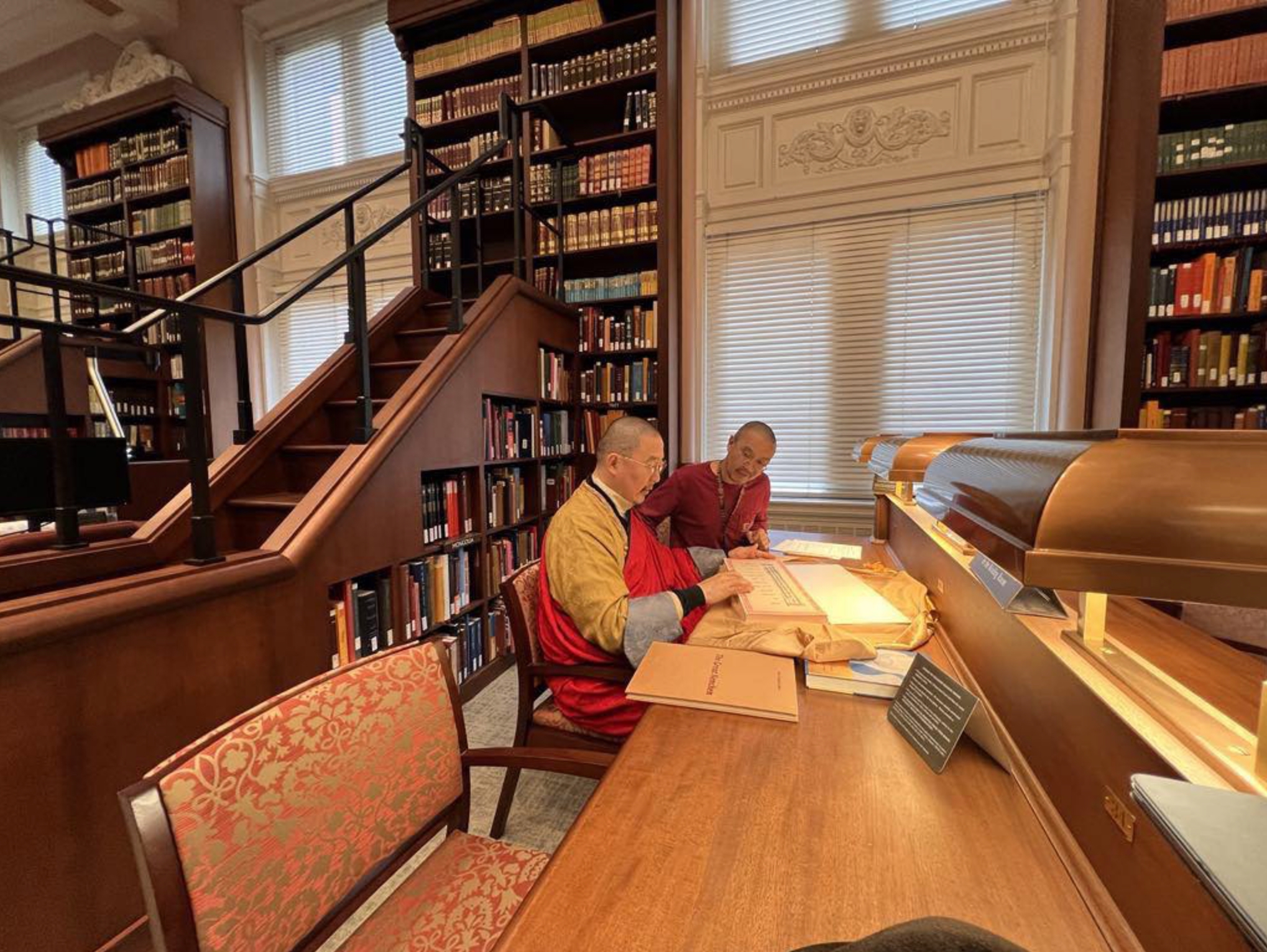
Zava Damdin Rinpoche describing aspects of the style and features of The Golden Book to the Mongolian archive research librarian. Location: Rare Books Collection Reading Room, Thomas Jefferson Library of Congress in Washington D.C. Photograph courtesy of the Zava Damdin Sutra and Scripture Institute of Mongolia. Image reprinted with permission on CPinMongolia.com. 30 December 2024.
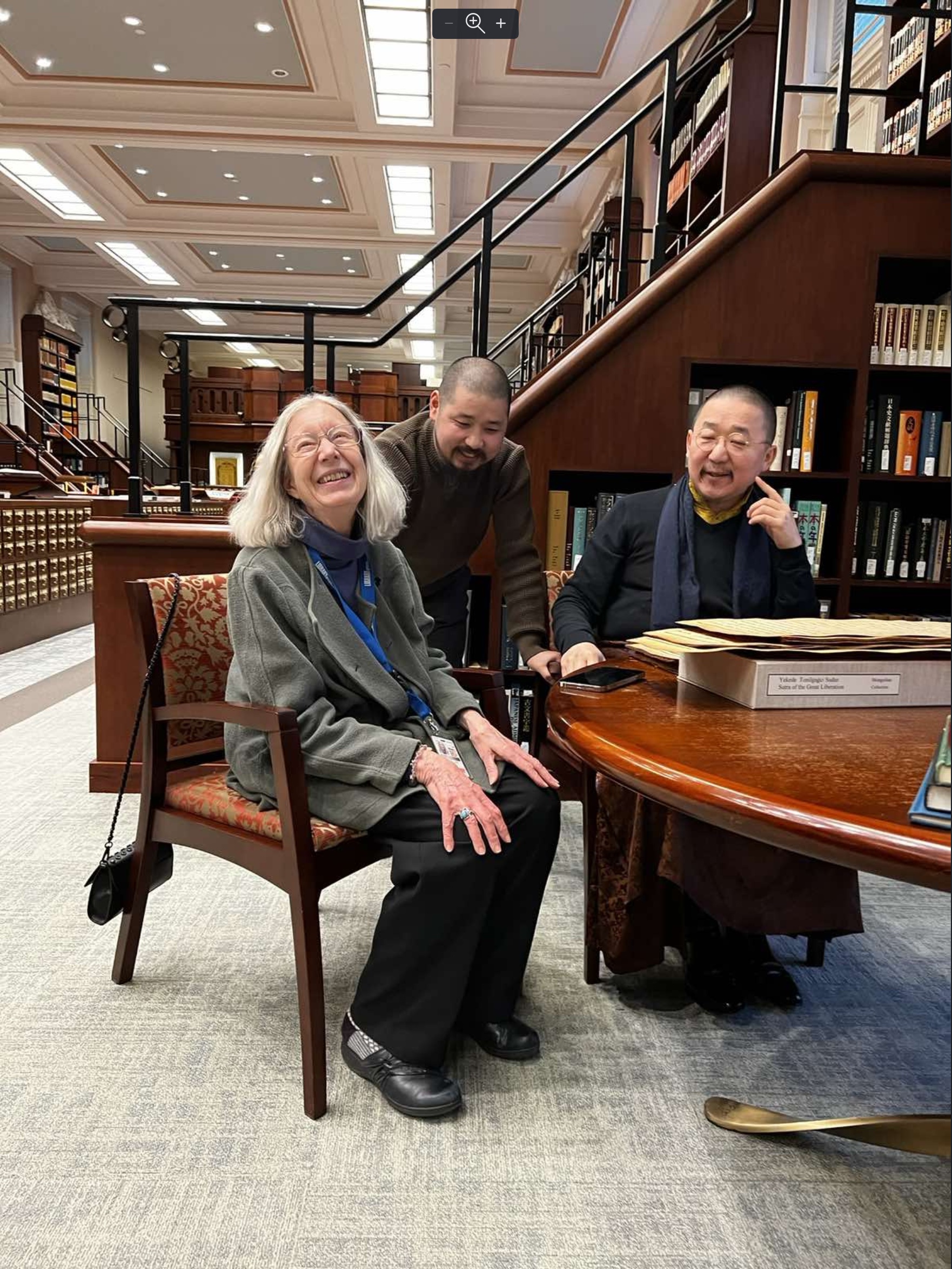
During their 10 days in Washington, Zava Damdin Bagsh and Lobsang Sampel spent time in the national library every day, working away, as usual, sharing their particular sense of humour with whomever they are working with, wherever they go. This is one of my favourite photos! Serious scholarship (and the problem solving it involves) should be fun right? Location: Rare Books Collection Reading Room, Thomas Jefferson Library of Congress in Washington D.C. Photograph courtesy of the Zava Damdin Sutra and Scripture Institute of Mongolia. Image reprinted with permission on CPinMongolia.com. 30 December 2024.
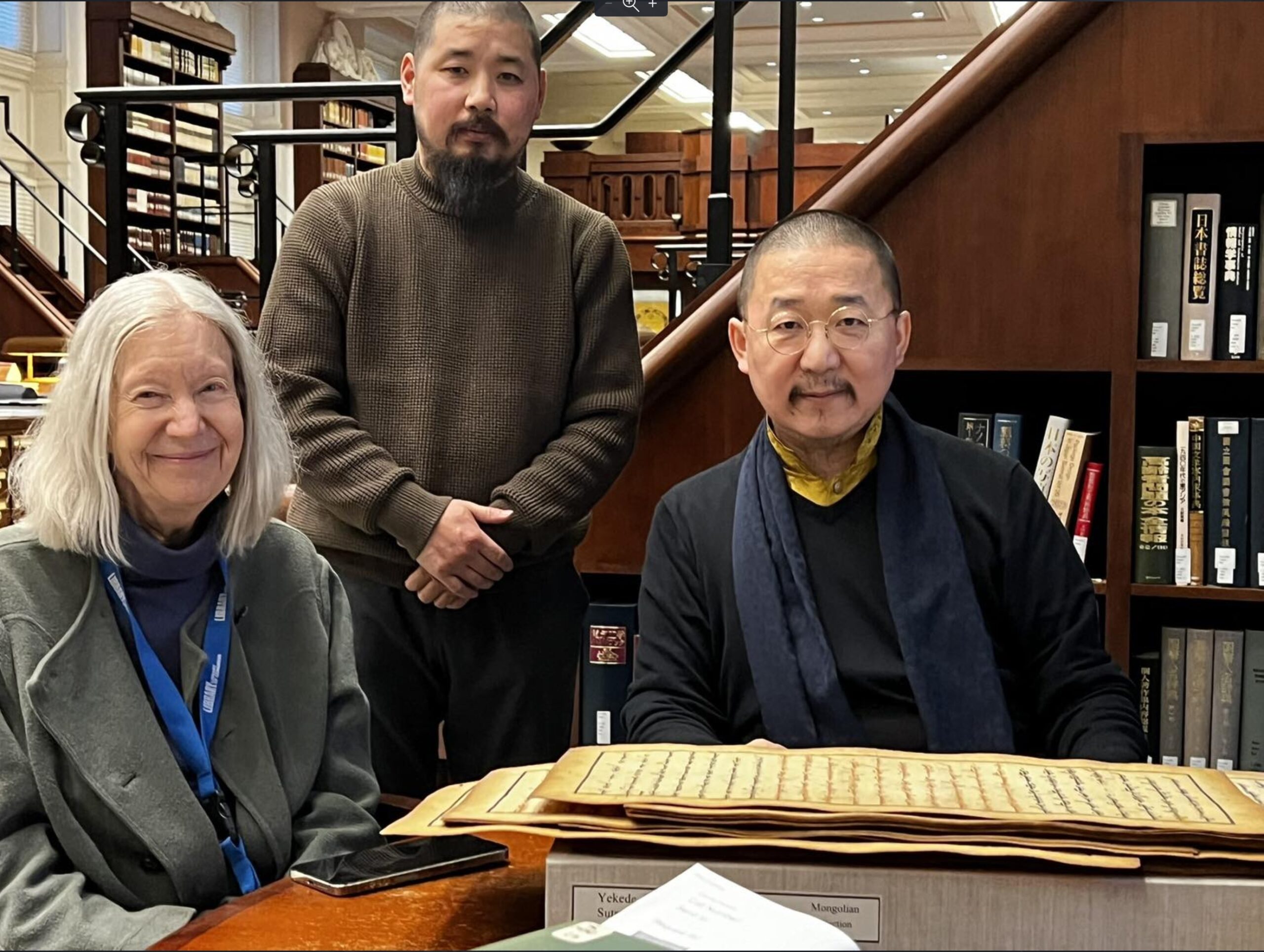
R to L: Zava Damdin Bagsh, Lobsang Sampel and the wonderful research librarian who assisted them. Thank you so much! Location: Rare Books Collection Reading Room, Thomas Jefferson Library of Congress in Washington D.C. Photograph courtesy of the Zava Damdin Sutra and Scripture Institute of Mongolia. Image reprinted with permission on CPinMongolia.com. 30 December 2024.
___________________________
Зава Дамдины алдрыг баригч (“the one who holds the glory of Zava Damdin”, a name Zava Damdin Luvsandarjaa uses when referring to himself in a literary and lineage custodian context, such as we see here, has thus far contributed three new texts to the American Library of Congress collection in Washington D.C. These are:
THE GOLDEN BOOK
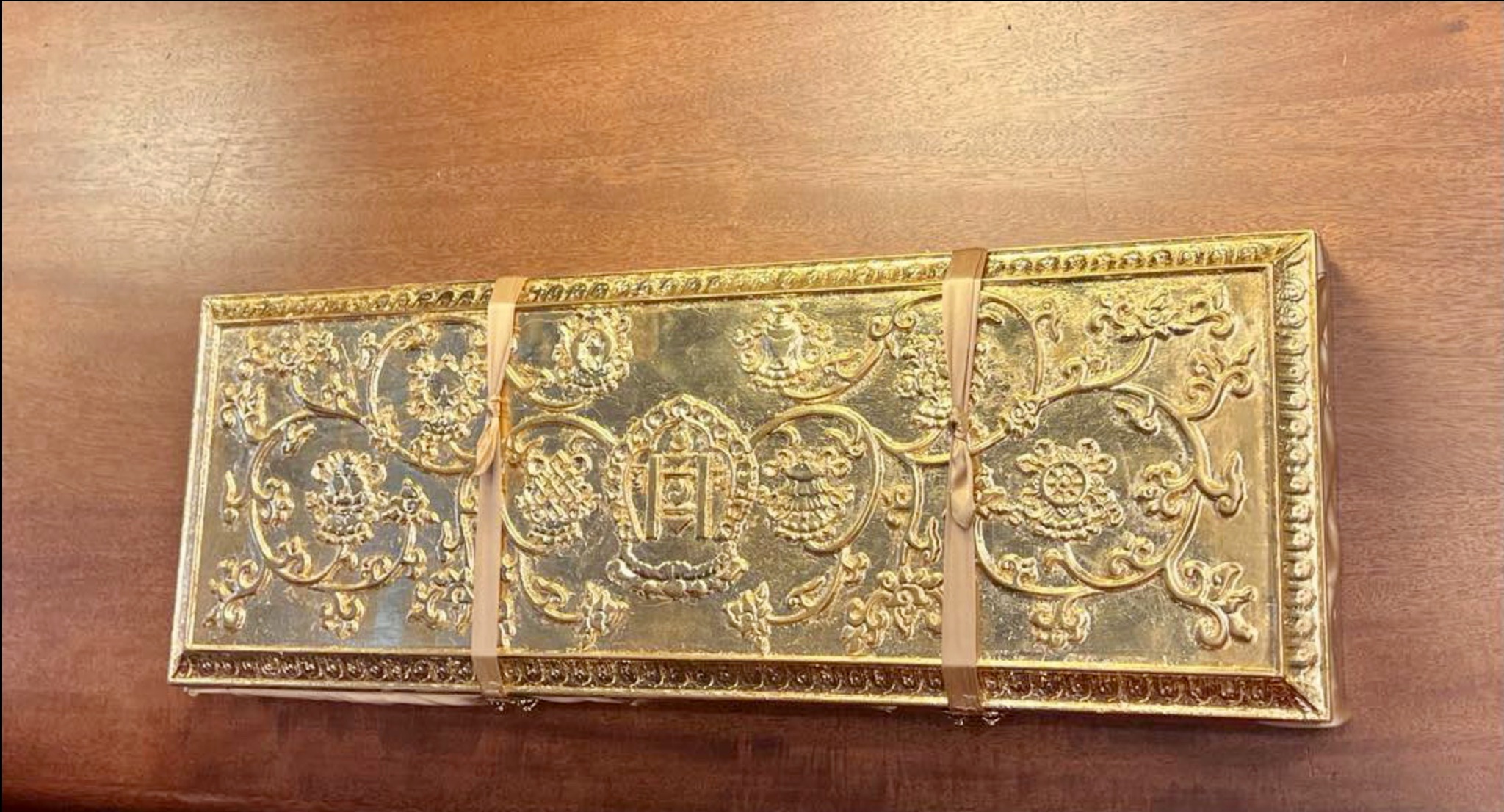
THE GOLDEN BOOK. Writing systems: Classical Mongol Bichig, Tutelary images and formal Tibetan uchän. Pecha cover embossed (repoussé) with the Mongolian Soyombo (centre) and the Eight Auspicious symbols ( The Precious Parasol that offers protection from unwholesomeness, The White Conch Shell that represents hearing the mellifluent sound of the Teachings, The Two Golden Fish, The Knot of Eternity, The Vase of Great Treasures, the Victory Banner and The Lotus Flower. Thomas Jefferson Rare Books Collection, Library of Congress in Washington D.C. Photograph courtesy of the Zava Damdin Sutra and Scripture Institute of Mongolia. Image reprinted with permission on CPinMongolia.com. 30 December 2024.
ТОМЪЁОЛШГУЙ (NO FORMULA)
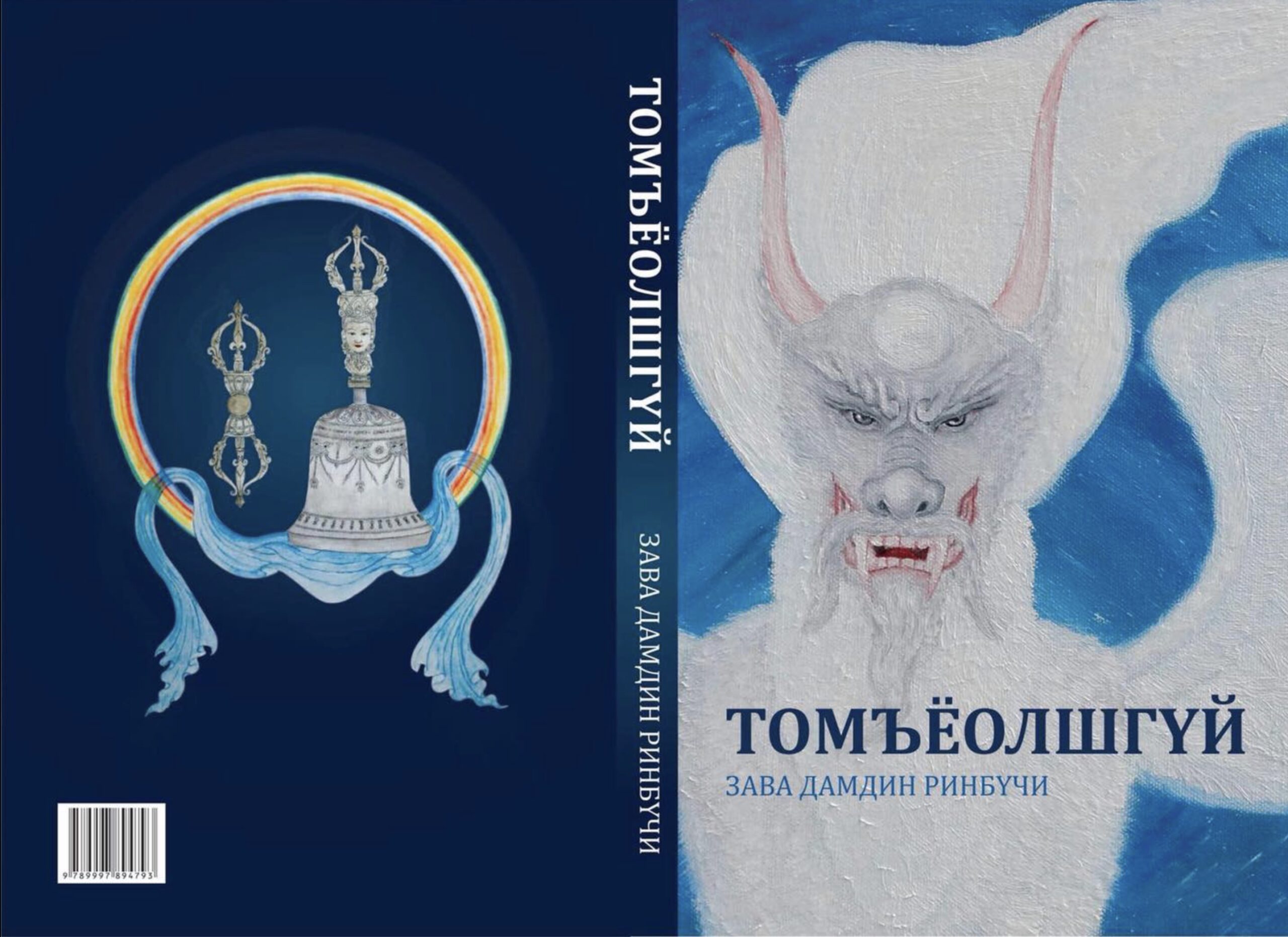
ТОМЪЁОЛШГУЙ (TOMIYoOLShGUI)
Published in 2019, a book by Zava Damdin Rinpoche about Guru Deva Rinpoche, his life’s biography. Writing system: Mongolian Cyrillic. Image: front and back jacket cover, hardback edition (original illustrations (oil paintings) also by Zava Damdin). Location: Thomas Jefferson Library of Congress catalogue, Washington D.C. Photograph courtesy of the Zava Damdin Sutra and Scripture Institute of Mongolia. Image reprinted with permission on CPinMongolia.com. 30 December 2024.
THE GREAT NENCHEN

The Great Nenchen (2015) by Zava Damdin Lama. Translated into English by C.Pleteshner and E.Sodontogos (Zava Damdin Sutra and Scripture Institute of Mongolia). Writing systems: English from the original classical Mongol Bichig and Tibetan umê script, the hand-written cursive form. Mongolian Cyrillic and the Wylie method of transliterating Tibetan umê script as preparation for translation into English. Relevant Sanskrit terminology is also transliterated, translated and interpreted into the English language, a practice that began not all that long ago, with the ‘orientalist’ Sir Charles Wilkins (1749-1836) translating the Bhagavad Gita and publishing it in London in 1785. Image: Hardcover edition. Front and back cover Mongol Bichig and English (Latin alphabet) embossed in red on golden-hued silk. Location: Thomas Jefferson Library of Congress catalogue, Washington D.C. 30 December 2024.
___________________________
Most of the photographs in Washington D.C. were taken by L.Sampel in December 2024. They document in visual form this important culmination, the point at which a complex and inter-dependent series of events coalesced to reach a shared objective, one in which so many of us, including Sodontogos E. (Director-General, Mongolia’s Montsame National News Agency since 2022), Sonintogos E., PhD (President and Rector, Mongolian University of Art and Culture) and I have been, for many years, involved. We’d also like to acknowledge Ambassador Batbayar Ulziidelger, Minjing Bolortsetsetseg and Altankhuyagi Otgon for their invaluable assistance for the Washington D.C. and New York sections of Zava Damdin Rinpoche’s 2024-5 North American tour. What an honour and privilege. The work continues … of course it does …
As an ongoing collaborative endeavour, the sweet fruit of this accomplishment is shared and now flows through our community of practice in Mongolia and elsewhere around the world. Such a precious gift to receive at this time of year.
In terms of our post-soviet socialist cultural reconstruction and revitalisation efforts in Mongolia, what was once imagined, now continues to manifest in scholarly, literary and a growing range of other contemporary artistic forms of cultural production.
___________________________
In terms of literary production, for Sodon and myself, co-translators of Zava Damdin Lama’s first book The Great Nenchen into the English language, such personal validation and acknowledgement is particularly sweet, encouraging and a little overwhelming to say the least, especially when considered in terms of the contribution to authoritative (rather than commentarial) published sources of our lineage and its transmission.
It’s one thing to be invited to work on translating a book with and for Zava Damdin Bagsh, but it’s a completely different matter to now see the context, the bigger picture within which it resides!
To be clear, when you study with Zava Bagsh, although there’s lots of shared joy and laughter, at the very same time there is simply no mucking around. Working with Bagsh is an intensely considered and reflective practice. Why? Because he is a formidable multi-lingual scholar. The standards he sets in terms of accomplishment and any subsequent acknowledgement thereof, are indeed very high. And so, it must be said, and put on record, for Sodon and I to share with others:
With our hearts overflowing with gratitude, we would like to thank you Bagsh, for your considerable personal investment in our scholarly, personal and intellectual cultivation, the outcomes of which inspire and flow through all spheres of our own small lives.
May your kindness and generosity to us and so many others come back to you a thousand fold!
With ever-deepening respect,
Sodon and Catherine
_______________________________
FURTHER READING
Letter from Mongolia 08: Honouring the Past
The connection between these two articles lies in the life, legacy, and preservation of the works of Guru Deva Rinpoche (1908–2009), an influential figure in Mongolian Buddhism. Together, they offer visual and historical documentation of two distinct but closely related dimensions of his contribution to Mongolian culture and Buddhist scholarship. Artscape 09 focuses on the Guru Deva collection of Mongolian and Buddhist literary texts now held in the Rare Books catalogue of the Library of Congress in Washington, D.C., highlighting the collaborative scholarly work involved in bringing these nomadic philosophical traditions into public care. letter from Mongolia 08, by contrast, documents Guru Deva Rinpoche’s 2009 cremation ceremony, preserving a rare visual record of his funeral procession and the rites performed in the Mongolian countryside. One article therefore traces the preservation of his intellectual legacy through books and archival stewardship, while the other preserves the memory, ritual, and historical circumstances of his passing. Read together, they illuminate the continuity of Mongolian Gelug Buddhist life across the twentieth and twenty-first centuries and demonstrate the role of photo-ethnography in documenting significant moments in Mongolia’s religious and cultural history. While the later article considers the enduring institutional home of Guru Deva Rinpoche’s intellectual contributions, the earlier record looks back to the final physical farewell to the person whose life and work shaped that legacy.
Out and About 06: Zava Damdin 150th Anniversary Conference
The connection between Artscape 09: Gratitude and the Zava Damdin 150th Conference lies in their shared focus on the continuity of the Zava Damdin lineage and the preservation of its scholarly traditions. The conference documents the commemoration of Zava Damdin (1867–1937) and the revitalisation of Buddhist scholarship through the Zava Damdin Scripture and Sutra Institute, while Artscape 09 follows the current Zava Damdin Rinpoche (b. 1976) as he reconnects with the Guru Deva collection at the Library of Congress. Together, they trace the continuity of this Buddhist intellectual tradition from its historical foundations in Mongolia to its ongoing preservation and international scholarly engagement.
Soundscape 04: Creative Distanciation: Etude for Naro
The connection between Artscape 09: Gratitude and Soundscape 04: Etude for Naro lies in their shared place within the CP in Mongolia intermedia project and their different sensory approaches to Mongolian cultural continuity. Both are closely connected to Zava Damdin Rinpoche: Soundscape 04 acknowledges his contribution as a point of reference, while Artscape 09 reflects on the preservation of the lineage’s books and wider cultural inheritance. One works through sound and musical form, the other through photography, texts, and material objects. Read together, they show how the project uses different media to document the survival, renewal, and transmission of this stream of Mongolian tradition in the contemporary world.
The connection between Artscape 09: Gratitude and the CP in Mongolia Artefacts page lies in their shared role within a long-term visual and scholarly archive of Mongolian Buddhist cultural heritage. The Artefacts page presents the broader body of ethnographic material gathered between 2010 and 2018, while Artscape 09 offers a focused study of the Guru Deva Rinpoche collection within that larger project. Both draw on visual ethnography to interpret the cultural and religious significance of material objects and reflect sustained collaboration with a Mongolian Buddhist institution (Zava Damdin Scripture and Sutra Institute of Mongolia). Read together, the Artefacts page provides an illustration of the channel’s wider archival framework, while Artscape 09 foregrounds the preservation and significance of one particular collection.
Artscape 02: The Great Nenchen
“Зава Дамдины алдрыг баригч” is not a pseudonym for Zava Damdin (b.1976). If you are less familiar with Mongolian society and culture, and would like to gain a greater appreciation of the complexities of such nomenclature, see: Names and Honorific Titles in The Great Nenchen, pp113-116. Here you’ll find an explanation of a dozen or so other names. In this article, and the publication to which it refers, I have intentionally used a number of different names for the same person we know as Zava Damdin (b.1976), each usage of which is context dependent.
For a whirlpool chronology and (relevant) summary of events impacting Mongol history (1635-2011), see: Landscape 02: a Social Matrix for Local Reconstruction
For an introductory explanation of the Soyombo symbol, see: Artscape 05: Invoking Cultural Scriptural Continuities
To continue the art narrative, see: Artscape 14: Эрхи
end of transcript.
Refer to the INDEX for other articles that may be of interest.
 |
© 2013-2026. CP in Mongolia. “Artscape 09: Gratitude” is licensed under the Creative Commons Attribution 4.0 International License. Documents linked from this page may be subject to other restrictions. Posted: 30 December 2024. Last updated: 6 August 2026. |