Hello! and thank you for taking the time to visit my channel. —CP

Plate note: I have very few photographs of myself. This is one of them. Here, I’m standing at the doorway to the Zuu Temple in the Choijin Lama Complex in Sükhbaatar District, Ulaanbaatar. The complex consists of one main and five branch temples (begun in 1904 and completed in 1908). Now a museum, it preserves a rich heritage of Mongol Gelug Buddhist artifacts. This image is derived from a photograph taken by Sampel Lam in 2019. Digital rendering by C.Pleteshner for CPinMongolia..
1. INTRODUCTION
My work combines long-term ethnographic field research, translation, visual documentation, and creative practice to explore Mongolian Buddhist life, cultural heritage, and contemporary revitalisation.
My methodology combines longitudinal fieldwork, participant observation, archival research, qualitative analysis, translation, photography, and creative practice.
As an independent scholar, my aim is to preserve, interpret, and share some of these traditions through accessible, research-grounded articles that connect academic scholarship with wider public audiences.
Taken as a whole, the channel brings these interconnected threads together as a single ethnographic–intermedia archive and evolving knowledge system.
_________________________________
2. MISSION
To provide an independent, scholarly perspective on contemporary Mongolian ethnographic discourse that bridges local knowledge with international research and its standards.
_________________________________
3. CURRENT FOCUS
(September 2026)
Optimising the research infrastructure of CPinMongolia through semantic cross-linking, metadata development, and content architecture, ensuring the repository functions as an interconnected body of ethnographic scholarship.
In other words, I’ve got my “information design” and “technical” hat on!
_________________________________
4. KEY FEATURES
(scholar’s voice)
The CPinMongolia Project sits at the intersection of Ethnography, the Literary Arts and Religious Studies, forming a hybrid scholarly-artistic channel. Through multimodal ethnographic practice and poetic engagement, it explores Mongolian Buddhist lifeworlds and their contemporary expression.
-
The site brings together ethnographic research, creative writing, music, translation, and Buddhist practices associated with one lineage and its traditions.
-
It offers open-access, public-facing resources, including articles, essays, creative works, intermedia, music, and studies of Mongolian society and culture.
-
The content combines ethnographic research, translation, reflection, and multimedia relating to Mongolian culture in Mongolia.
-
It also connects ethnographic study with my musical, compositional, photographic, and visual practice.
_________________________________
5. TOPICS COVERED
- Mongolian society and culture, especially Khalkha Mongol communities.
- Buddhist poetry (especially the doha form) and translations of works by Mongolian poets, especially the scholar-poet Zava Damdin (b.1976).
- Musical works and intermedia (music + visuals) tied to Mongolian and Buddhist themes.
- Ethnographic and anthropological essays regarding contemporary Mongolian culture.
_________________________________
6. PURPOSE
- To share knowledge, creative work, and translations connecting Mongolian cultural heritage with English-language audiences.
- To provide a repository and INDEX of articles and multimedia on Mongolian culture, language, Buddhism, and the arts.
- To offer original scholarly and creative content under a Creative Commons licence.
_________________________________
7. INFORMATION DESIGN
- CPinMongolia.com is primarily the text-based component of an interconnected digital, multi-platform presentation.
- Sub-headings help you navigate this ocean of words and locate what you are looking for.
- The INDEX lists every article in the collection.
- The SEARCH function on the HOME PAGE, also where the most recent article is posted, is a useful tool.
- For readers whose first language is not English, italicised and bold text is used throughout the site to help broaden technical and other vocabularies, offering more precise ways to express what we think, say, and do.
- Some articles are introductory, while others examine the finer details of a particular subject or theme.
- The music compositions on my YouTube channels @cpleteshner and @cpleteshner21 serve as digital repositories and artefacts of my intermedia performance and production.
_________________________________
8. RESEARCH FOCUS
Contemporary Mongolian society & culture: I have undertaken participant-observation fieldwork in Mongolia since 2004. Many articles examine contemporary cultural practices, changing social norms, kinship, ethnic identity, and post-Soviet transformations.
Ethnographic research into Mongolian spiritual life: A major theme is how Mongolian Buddhism, particularly the Gelug tradition, spiritual poetics such as doha, and local religious practices are lived, embodied, and revitalised. I also maintain a strong interest in ritual, temple life, and religious roles, including women in Mongolian Buddhism.
Poetry, language, and literary translation: The site engages with Mongolian poetry and translation, especially the work of Buddhist scholar-poets, with attention to language, meaning, and style. The INDEX includes a dedicated “Mongolian Poetry” section and a growing collection of translations.
Cultural production, performance, intermedia work: I work across multimodal and multi-platform media, combining ethnography, music, video, soundscapes, artscapes, and other forms of cultural production. Particular attention is given to how artefacts, visual and musical works, performance, and digital media intersect with cultural identity and tradition.
Methodology and qualitative research: The site also includes work on qualitative research design, ethics, participant observation, and the presentation of ethnographic data, often in relation to Mongolian communities and social dynamics.
_________________________________
9. DISCIPLINARY CONTEXT
9.1 Primary Discipline: Anthropology/Ethnography
- Department fit: Anthropology; Social Sciences; Asian Studies
- Core methods: Participant observation, fieldwork, qualitative analysis, and reflexive writing.
- Focus: Lived experience, ritual, meaning-making, embodiment, identity, and everyday life in Mongolian contexts.
- Evidence from the site: “Letters from Mongolia“, “Vignettes“, “Landscapes” and “Ethnographic fieldwork” posts on research design and field methods, alongside accounts of lived Buddhism, cultural transmission, and local cosmologies.
Comparable scholars: Clifford Geertz or more regionally, Caroline Humphrey and Uranchimeg Tsultem (for Mongolian contexts).
_________________________________
9.2 Secondary Discipline: Comparative Literature/Translation Studies
- Department fit: Literature; Languages & Cultures; Translation Studies
- Focus: Translation of Mongolian poetry and philosophical prose into English while preserving rhythm, symbolism, and spiritual semantics.
- Evidence: The “Mongolian Poetry” section and bilingual translations, attention to rhythm, meaning, and tone across languages, and analysis of literary form as a vehicle for Buddhist thought.
Comparable approaches: Walter Benjamin (on translation as re-creation).
_________________________________
9.3 Cross-Disciplinary Fields: Visual/Sonic Anthropology & Intermedia Cultural Production
- Department fit: Digital Humanities; Media Arts; Performance Studies
- Focus: Integrating ethnographic documentation with artistic practice through soundscapes, photography, film, and mixed-media storytelling.
- Evidence: “Letters from Mongolia”, “Soundscapes“, “Intermedia“, “Out and About” “Artscapes“, “Video and Film” sections showcasing multimedia works, reflexive discussion of research as art and art as ethnography, and intersections of ritual performance, music, and aesthetics.
Comparable frameworks: Sarah Pink (visual anthropology), Anna Tsing (multimodal ethnography), Michael Taussig (performative ethnography).
_________________________________
9.4 Summary: Disciplinary Fields
| Disciplinary Field | Core Concerns | Academic Department |
| Cultural Anthropology | Lived experience, ritual, and meaning | Anthropology |
| Religious Studies (Buddhist Studies) | Practice, doctrine, and poetics | Religious Studies |
| Comparative Literature | Translation and literary aesthetics | Literature / Languages |
| Visual & Sonic Anthropology | Multimedia and ethnographic art | Media / Digital Humanities |
| Mongolian & Inner Asian Studies | Region, history, and culture | Asian Studies |
_________________________________
10. NOTES
(personal voice)
My first post to CPinMongolia was back in January 2014. More than a decade has flown by, and I still enjoy the technical work of building and maintaining these intermedia channels, alongside the challenge of composing articles, visuals, and music for the collection.
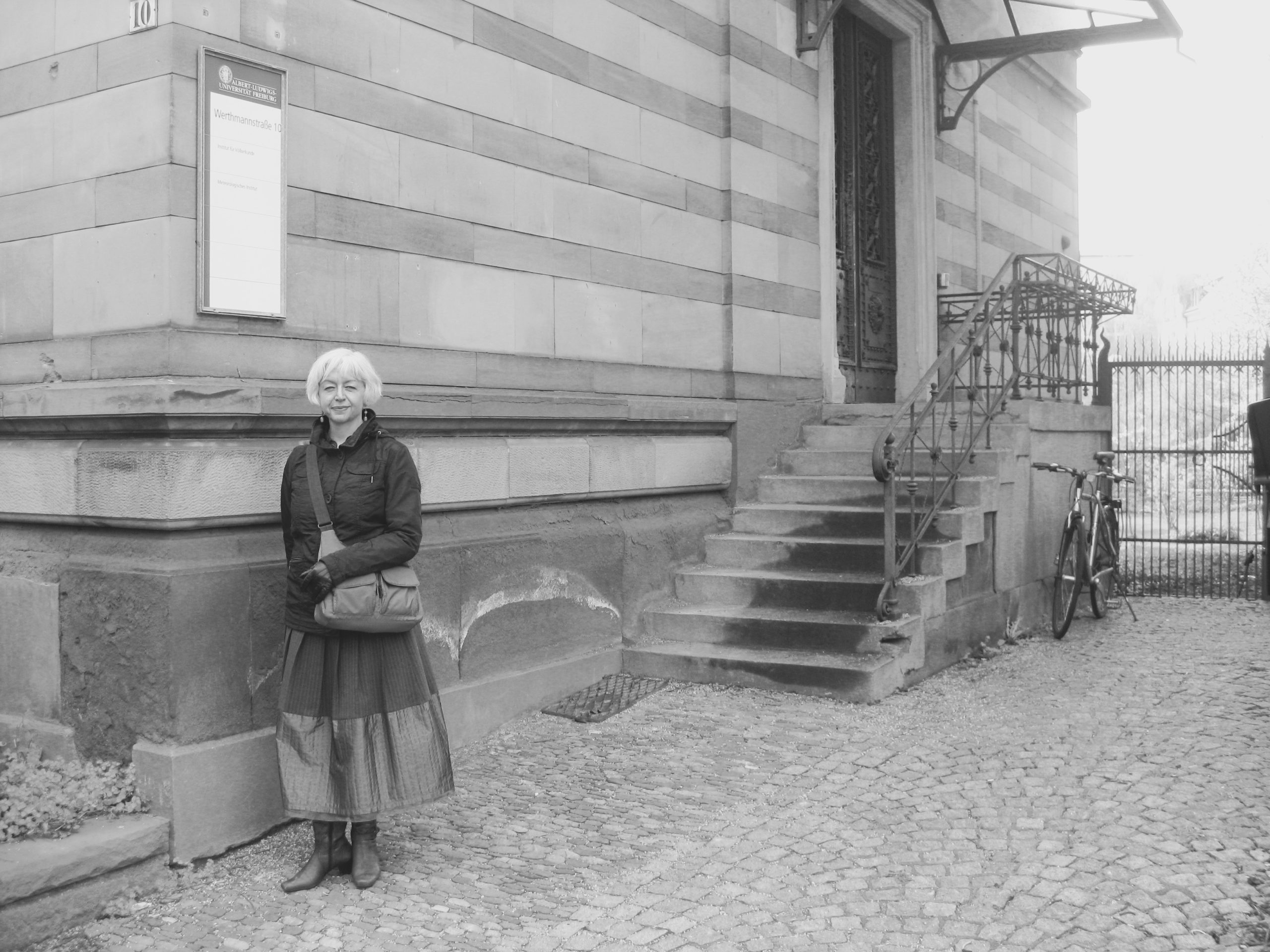
Plate note: Whilst studying in Europe in 2010, I visited the Department of Social and Cultural Anthropology at Albert-Ludwigs University in Freiburg to meet with the Head of Department Prof. Judith Schlehe to discuss my exploration of contemporary Mongolian society and culture. She made some wonderful suggestions that continue to stimulate new perspectives in my own writing to this day. I will forever be grateful to not only her but to so many others who have taken the time to help me along my way. I lived in Freiburg (Germany) for a month – such a vibrant university town! 14 April 2010. Photograph courtesy of Bernhard Schittich.
Having researched and then written Nomadic Temple: Daughters of Tsongkhapa in Mongolia (2011), my intention was simply to share aspects of my ethnographic study of contemporary Mongolian culture in Mongolia, a project I began after my first visit in 2004. Over time, however, I began weaving other threads of personal interest into its unfolding expositional arc.
— “What’s the point in having a mind, if you can’t change it?” —
There are now 230 original articles, intermedia works, and musical compositions across this WWW site and its two associated YouTube channels: a multi-platform presentation. There are no on-postings or feeds.
For an overview of the content, or an entry point into its information design, especially if you’re new to this channel, you may like to begin with the INDEX and its categorical structure. I suggest you start there.
Longitudinal in nature, the interconnectedness of this accumulation, manifest in various forms of cultural production, makes perfectly sound chronological sense to me. I smile. “Auto-ethnography,” you say? Quite possibly … given the autobiographical elements and critical reflection added to the mix.
In working with a purposeful selection of Mongolian and other cultural resources, I simply hope to reflect the creative practices of people around the world with whom I have the very good fortune to associate! This was my goal at the outset. In this regard, nothing has changed.
_________________________________
11. RECENT DEVELOPMENTS
11.1 2025 – 2026
After more than two decades, I still love sharing Mongolian culture through visual and text-based stories, and piano arrangements, works shaped by reflection and ongoing practice.
Since returning to Mongolia in 2025, my attention to narrative detail has deepened, particularly through my continuing study of Zava Damdin’s writing and poetry. Alongside the notes accompanying each translation, Letter from Mongolia 18: A Deliberately Interdisciplinary Practice offers further insight into the interpretive approach that has emerged from this work.
More recently (2026), my studies have expanded to include AI-assisted Mongolian music and artistic expression. Since beginning university research and teaching, I have continued to explore potentially useful creative tools and communication technologies as they emerge, particularly where they align with my own interests.
To be clear, for this channel I approach AI not as a replacement for lived knowledge, language, or careful listening, but as a new medium through which voice, memory, and cultural landscape can be reimagined.
_________________________________
11.2 2021 – 2024
The focus was on translating and interpreting a folio of poems (Skt. doha) by and with the contemporary Mongolian Gelug scholar-poet Zava Damdin Rinpoche (b.1976). You’ll find links to a selection of these in the “Mongolian Poetry”section of the INDEX.
This kind of ongoing formal training in the (fine) art of interpreting doha into another language, through culturally appropriate oral induction and lineage transmission, leaves its own additional imprints through intense, generative, (non)proximal inner experience.
It also leaves selective and persistent memories of the studious immersion and sustained concentration required to understand an original text according to the scholar-poet’s intended meaning, conceptually, through explanation and contextualised commentary, before articulating it poetically in another language.
All I can say is that my heart overflows with gratitude. Such intensive training “experiences”, when repeated, continue to inspire and fuel my own work! —CP
_________________________________
12. BACKGROUND
I was introduced to Buddhist philosophy in the Tradition of Je Tsongkhapa whilst travelling through India in 1987. Since then, I have taken opportunities to attend residential courses and other important events in centres, monasteries, and colleges of higher education around our small world.
Since 2004, I have had two Teachers. My heart tutor is the scholar-poet Zava Damdin Rinpoche (b. 1976), of ethnic Mongolian heritage and ancestry. In the study of sutra, Tibetan Lharampa Geshe Lobsang Dayang Thubten Trinley has profoundly influenced the discipline with which I continue to study and cultivate my comparatively small mind. In keeping with our principle of life-long learning, I occasionally study related subjects with other specialist tutors.
Back in 2004, when I first conceived and embarked on the CPinMongolia Project, the additional study and work it required ran alongside the obligations of a demanding professional life. More than two decades on, I remain deeply grateful that I made the effort and listened to my own heart’s voice at the time. I am a slow learner; nonetheless, a strong and beautiful Gelug voice sings in my heart.
_________________________________
13. RECOGNITION
13.1 The Zava Damdin Medallion
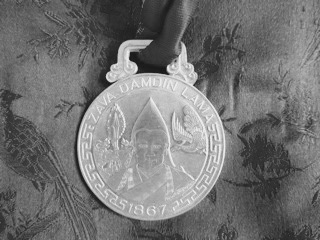
Plate note: The Zawa Damdin bLo bzang rta dbyangs (1867– ) Medallion
In November 2011, I was unexpectedly awarded the Zava Damdin Medallion in recognition of my scholarly contribution to the study of Mongolian Nomadic and Gelug Buddhist culture in Mongolia.
Here I must acknowledge my dear friend and colleague Sodontogos Erdenetsogt, former Director-General of Mongolia’s Montsame National News Agency, and thank her for all she has done, and continues to do, for so many others. Our scholarly collaboration is without parallel. The Honourable Professor Choirov Khishigtogtokh and master translator and storyteller Dr Hatagin Gotovin Akim received the same award at the same official ceremony for their own lifelong, and far greater, contributions to scholarship.
__________________________________________________
13.2 Research Fellow
In October 2014, I was honoured with the position of inaugural Research Fellow (Nomadic and Buddhist Philosophies) at the Zava Damdin Sutra and Scripture Institute in Mongolia. This unexpected appointment was a great honour. The interdisciplinary discourses on this website, and my contributions to Zava Damdin’s English-language publications, are among the harvests of this continuing honorary role.
_________________________________
14. AFTERWORD
In the “Mongolian Poetry” section of the INDEX, you can find a growing collection, more than 60 at last count, of Zava Damdin’s (b.1976) beautiful poetry.
Variously translated as “songs of experience” (Skt. doha) or “songs of realisation”, these compositions belong to a poetic form associated with the Vajrayana Buddhist tantric movement.
The doha form can be understood as a sung spiritual aphorism: a concise original thought often rendered linguistically in couplets. In intercultural interpretation, it is important to clarify what is meant here by ‘singing’. Such devotional songs are performed internally and are intimately connected with meditation, feeling, imagination, faith, deep love, and respect. (Zava Damdin, The Great Nenchen, trans. C. Pleteshner and E. Sodontogos (Mongolia: Zava Damdin Sutra and Scripture Institute, 2015), 3.)
In designing and curating one’s own channel, one has the opportunity to exercise a particularly spacious and judicious freedom: to discern and artistically (re)configure what one considers more important in relation to what may be deemed less so.
The curatorial aspect of maintaining one’s own digital archive also reflects a contemporary modernity shaped by the vast array of other online discourses that now inform, engage, and reshape transcultural diversity in a globalising world. Somewhere within that vast terrain, this site has gradually found its own place and focus. —CP
ARTEFACTS
To explore how my way of working developed in practice, see ARTEFACTS. It brings together earlier fieldwork, collaborations, publications, translations, and other milestones through which my ethnographic approach gradually took shape.
OTHER STUDIES
Beyond the Mongolia-focused work gathered here, the OTHER STUDIES page offers a glimpse into some of the other projects and professional work that shaped my scholarly life, including the skills and approaches I later brought to my research in Mongolia.
End of transcript.
Refer to the INDEX for other articles that may be of interest.
© 2013-2026. CP in Mongolia. This page is licensed under the Creative Commons Attribution 4.0 International License. Open access should not be understood as the absence of attribution. Documents linked from this page may be subject to other restrictions. Posted: 6 January 2014. Last updated: 21 September 2026.