This article continues the visual ethnography series using images and close observation to examine how people live, make meaning, and give those meanings form in practice. Please refer to the Index of Artscapes and Articles for other works that may be of interest.
The following essay is lengthy, detailed and mostly scholarly in register. It explores representations of Khalkha Mongol women during Mongolia’s soviet socialist era (~1924-1990), while brushing past a number of related themes along the way. Sub-headings have been added to help you find points of particular interest. For those unaccustomed to this form of literary exposition, I recommend a strong cup of coffee (or similar) before you embark. —CP
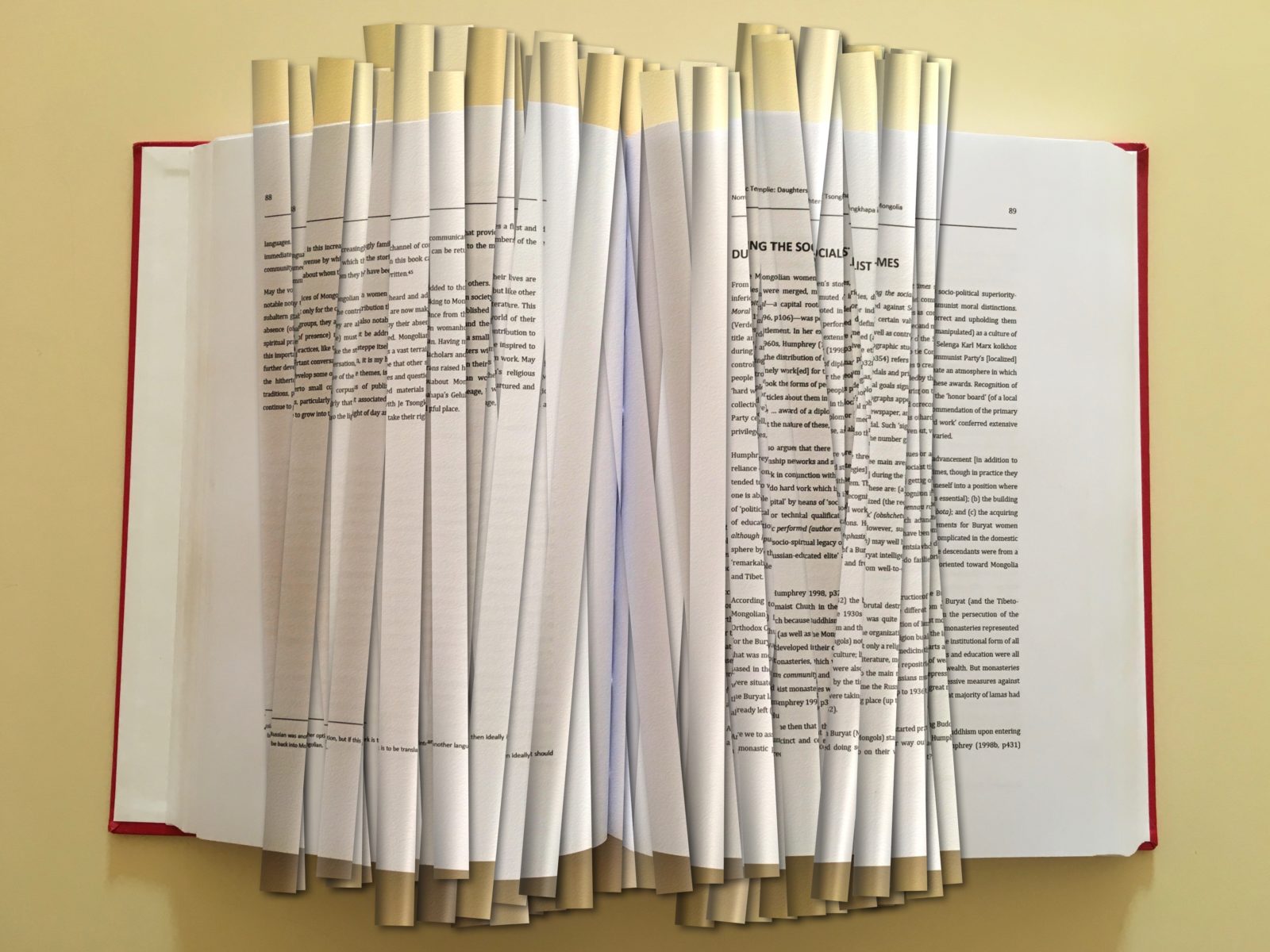
Figure 1: The folio of essays I have written about contemporary Khalkha Mongol women. See: Pleteshner, C. (2011). Nomadic Temple: Daughters of Tsongkhapa in Mongolia (Unpublished manuscript) Location: The Zava Damdin Sutra and Scripture Institute Library Archive (Manjushri Temple, Soyombot Oron). 10 June 2018. C.Pleteshner for CPinMongolia.com
1. RESEARCH GENESIS: Positioning and Women’s Socialist-Era Experiences
In 2010, I wrote a collection of thirty-four short stories about particular Khalkha Mongol women, each grounded in my own qualitative research: key informant interviews (2008 and other conversations), along with prior and subsequent participant-observation fieldwork in community with them in Mongolia between 2004 and 2010. Refer to Vignettes on this website for examples.
I applied a range of strategies to ensure a considerable degree of anonymity for study participants, with the delay of publication being the final layer of this important work. Many of the women in the study are happy to be identified with their vignette, with two already published in this form. In my ongoing consideration of what is best in terms of ethical qualitative data research and publishing practice, I cyclically return to that impasse between ethnographic researcher and friend-confidante. However, in my own assessment, enough time has now passed for me to proceed with publishing the remaining vignettes in my folio.
To my way of thinking, one can never be too careful or too mindful when writing and publishing narratives about other people’s lives using one’s own voice.
1.1 Ethnographic Voice, Representation and Researcher Positioning
Having completed the vignettes, I began writing “during the socialist times …” upon which this article is based. It takes its title from an expression frequently used by Mongol women with whom I keep company in Mongolia. It is their cue, a means of framing, locating and setting the scene for the telling of a usually quite long and detailed story, sometimes by a single orator and at other times collaboratively with women friends who, in some way, shared experiences during this complicated time.
Whilst the vignettes capture aspects of their first-person perspectives and experiences, in this post I review published scholarly, political and sociological conceptions about women in light of certain Soviet communist-era agendas and moral distinctions. The particular contemporary Mongol women who inform my own ethnographic study are never too far from my mind’s eye as I write.
1.1.1. Interpretation, Representation and Researcher Positionality
So you’re going to write about interpreting ‘representation’? …
In academic circles, methodologically, this is a thorny road to traverse, given that ‘interpretation of representation’ is such a personal affair. More on this important topic further down the post. But I’d really like to share with you some soviet-era images of Mongolian women (in the form of graphic art) that I think are important to better appreciating their lives, and so I am going to dip my toe into these contentious waters anyway.
In my mind’s eye are particular Khalkha Mongol women who belong to an older generation in Mongolia (in my study, those born between 1930 and 1964). My own biological mother (now deceased) and her friends in Australia, from varying cultural backgrounds (Ukraine, Poland, Germany, Latvia, Estonia, Hungary and Bulgaria), were also born into the upheaval of the 20th Century’s soviet socialist project. Russified and enculturated Soviet socialist-era women, to be sure.
In terms of my own position-ing, this is the vista from which I now write.
_____________________
2. SOCIALIST PARTICIPATION: Recognition and Social Capital
During the soviet socialist era, moral capital, a kind of social capital rooted in defining certain values as correct and upholding them (Katherine Verdery, 1996, p106), was publicly performed, as well as controlled and manipulated through a culture of title and entitlement.
In her extensive ethnographic study of the Selenga Karl Marx kolkhoz (a collective farm in Siberia) during the 1960s, the British anthropologist Caroline Humphrey (1998a, p328; p354) describes in detail the Communist Party of the Soviet Union’s localised control over the distribution of diplomas, medals and prizes to create an atmosphere in which people genuinely worked for the ideological goals signified by these awards. In this context, recognition of ‘hard work’ took the form of people’s photographs appearing on the ‘honor board’ of a local collective, and articles about them appearing in the local newspaper, usually on the recommendation of opinion leaders in the local and primary Party cell. Such ‘signs of hard work’ conferred extensive privileges. However, observation indicated that the nature and number of these awards varied.
Each of the older generation ‘soviet era’ Mongol women in my study, those born between 1930 and 1964, has her own extensive (yet different) cache of medals. They speak of similar participative practices and outcomes to those described above.
In the earlier days of post soviet socialism in Mongolia, I observed how these women adorned their traditional Mongolian vestments (cf. deels) with medals acquired in recognition of their own merits at important (to them) public events. Within my own cohort of Mongol women, by 2010, this adornment practice had generally subsided, if not ceased. These days, only older women with strong kinship affiliations to senior Mongolian army personnel and officials still wear their own collections of medals to public, commemorative (of the past), military-focused gatherings and displays. I have various photographs in my collection to this effect.
2.1 Education, Political Capital and Institutional Recognition
In the same analysis, Caroline Humphrey also argues that there were three main avenues for advancement for both men and women during the soviet socialist era. These were in addition to the continued reliance on kinship networks and a repertoire of other conjoined strategies. These were: (a) getting oneself into a position where one was able to do hard work which was recognised, with the potential for recognition being critical to the task; (b) building ‘political capital’ by means of ‘social work’ (Russian. obshchetvennaya rabota); and (c) acquiring educational or technical qualifications.
However, such advancements for Buryat women, although publicly performed (author emphasis), may well have been complicated in the domestic sphere by the socio-spiritual legacy of a Buryat intelligentsia whose descendants were from either a ‘remarkable Russian-educated elite’ or from well-to-do families oriented toward Mongolia and Tibet and the spiritual lineage connections therein.
Acquiring educational qualifications [cf. (c) above] was only a priority for some of the soviet era Khalkha Mongol women in my study. For them, travelling away from home and family (they each already had young children) to acquire certification with a view to ‘progress’ and improve their professional standing was mandatory.
They not only pursued opportunities when they became available, they also did what they were told by senior officials at local Party cell meetings. These were held in the local ‘house of culture’ that you can still find in Mongolia today. This is how they gained access to otherwise unavailable opportunities to learn and even travel abroad. As well as being mothers and wives, these women worked as pharmacists, medical doctors, teachers and geologists.
2.1.1 Embodied Socialist Participation and Post-Socialist Adaptation
However, most of these older soviet era women continued for a time to embody the practices associated with (a) and (b) as described above, for as long as they were physically able, even though the socialist times had passed. One of my observations, one that I could only have realised with the passage of considerable time (2004-2016), is that, in the now post-socialist setting, these women contracted such behaviour, limiting it to their immediate kinship networks.
They each did so at a different time, as one year flowed into the next. Given that, in the new and emerging post-socialist order in Mongolia, such efforts were no longer being recognised or rewarded by the state, they tended to drift away from community-centred activity and become more absorbed in other concerns: looking after grandchildren, trying to get a new business up and running in the climate of privatisation, engaging in all sorts of other entrepreneurial activities, that sort of thing.
In many ways, beyond immediate kinship affiliations (eg. being the mother or sister of a Buddhist prelate), I see older Mongol women’s voluntary contributions and participation in the emerging post-socialist Buddhist social and cultural sphere in Mongolia as a kind of proxy: a substitute, deemed worthy by them, for the soviet socialist form of social participation into which they were enculturated and habituated as young women. To be clear, I am not suggesting that this is the only catalyst for such participation by these older women. Nonetheless, we humans are creatures of repetition, routine, practice and, at times, also in need of social recognition and reward.
2.2 A ‘Russian-educated elite’
Nor has the attraction of a ‘Russian-educated elite’ lost its lustre in some Mongolian social circles today. These days, it is not the socialist era grandmothers but their grandchildren who partake in, embody and seek to accumulate the social capital associated with this fare. Whilst educational institutions in Germany, China and the USA now also compete with those in the Russian Federation in the eyes of well-to-do Mongolians in Mongolia, my longitudinal research data suggests that at least one young person, if not more, from each kinship network is being sent for secondary and/or tertiary schooling to an educational or military college deemed worthy somewhere in the Russian Federation. Here, post-soviet socialist Gelugpa Buddhist revival and participation by devoutly Buddhist families coalesces with members of that same kinship network actively engaging with still-valued conceptions of a Russian-educated elite, expressed and embodied by sending one’s own (grand)children to study there.
2.2.1 Social Porosity and Continuities Across Socialist and Post-Socialist Life
For some Mongolians-in-Mongolia, whilst there may be tensions, both practices are somehow harmonised across the kinship network. Rather than being seen as a contradiction, both participative associations, just as in the socialist era, continue to be at play. According to Caroline Humphrey (1998, p32), her research remains the lighthouse for my own attempts at unravelling contemporary Mongol culture in Mongolia, the brutal destruction of the Buryat (and the Tibeto-Mongolian) Lamaist institutions during the 1930s was quite different from the persecution of the (Russian) Orthodox Church. This is because Mongolian-Tibeto Buddhism and the organisation of monasteries represented for the Buryats (as well as the Mongols, she argues) not only a religion, but also the institutional form of all that was most developed in their culture; literature, medicine, the arts and education were all based in the monasteries, which were situated in community.
Are we to assume then that Buryat Mongols started practicing Buddhism upon entering a monastic precinct and ceased doing so on their way out? As Humphrey (1998b, p431) suggests, it would be simplistic to view Soviet ideology as merely replacing localised Lamaist or shamanist thinking.
What occurred during the Soviet socialist era in Buryatia was a much more complex cross-cutting of ideas, in which Soviet elements and ideals entered into folk structures, ways of thinking which continue to survive even though their previous strong institutional induction and subsequent supports in society have virtually disappeared. Socialist era grandmothers in Mongolia now sending younger members of their family to study in Russia is yet another thread of such continuity. The socialist to post-socialist dyad is far more porous, both socially and culturally, than historians would have us believe.
_____________________
3. GENDER AND KINSHIP: a Socialist/Post-Socialist Social Order
Returning to the setting of contemporary post-socialist Mongolia, the period during which data for this study is being collected, it is difficult for performances of emerging socio-economic positioning to be completely disassociated from previously dominant cultural formations. With the formal dissolution of the use of labor as a political resource (Humphrey 1998, p300), new ‘traditions’ and ways of doing things in Mongolian society may be emerging, not all of which are solidifying around western (class) distinctions associated with conspicuous consumption of material goods.
According to Lovell (2004, p38), culture is increasingly mediated by consumption, now held to be more formative of individuals’ social identities and allegiances than social class. From such a perspective, the centrality of the individual is an attractive point of departure, in that it may afford greater recognition of personal agency. Given that ‘women’ have traditionally carried responsibility for certain aspects of consumption, the foregrounding of gender here in terms of the formation of subjectivities and identities may be useful too.
3.1 Gender, Reproduction and the Kinship Household
However, individualist approaches to theorizing about Mongolian women’s lives, either during the socialist era (until 1990, with its social control and engineering) or during the early post-socialist period (from 1990 and for a decade or two thereafter), lack the necessary degree of epistemic traction. Mongolian women in Mongolia are temporally and socially embedded in extensive and interconnecting blood and bone kinship networks. It is important to remember that soviet era women, who are mostly now also grandmothers, gave birth to many children, with between six and eight children each being the soviet socialist social engineering goal.
Hence, in contemporary post-socialist Mongolia, whilst not all women gave birth to so many children, a more appropriate view (as a baseline) is one where the family and its combined resources, rather than a collection of atomised or partnered individuals, form the basic unit of social stratification (Goldthorpe 1983, p465; p469). Here, women’s positionings in relation to men in their kinship group typically form part of an overall family strategy.
In this context, a woman is considered as a person with a female body (Moi, 1999:8). In this framework, even though biological sexual difference remains in place, a woman cannot be reduced to just her female body. Rather, Moi (1999, p76) invokes Simone de Beauvoir’s concept of the body as the situation. A woman is someone with a female body … from the moment she is born until the moment she dies. But the body is her situation not her destiny.
Feminist sociological and anthropological analyses that ignore sexual difference and the social relations of reproduction do so at their peril (Lovell, 2004, p52). Doing so with the pre and post socialist cohorts of Khalkha Mongol women who are participating in my Mongolia study would be to miss, even obfuscate, prevailing gendered roles and their socially-scripted formations. As for their grand children born into female bodies? Individualist theorising could get epistemic traction there (although I have yet to embark on this additional work).
3.1.1 Gender, Reproductive Labour and the Nation-State
During the Soviet socialist era, the ideation of ‘parent state to family patriarch’ promoted a particular nation-state meta-narrative regarding the social (re)organisation of gender within post-socialist Eastern European countries (Katherine Verdery 1996, p61). For this analysis, political processes in Romania are her touchstone.
Referring to Hungary as another national case in point, Verdery (1996, pp81-82) further argues that ‘socialism’ and ‘capitalism’ are closely interwoven as ‘variants’ of the organization of gender ‘bound up’ with a ‘national idea.’ The end of socialism brings with it an end to the state assuming responsibility for the costs of biological and social reproduction.
Instead, such costs are decentralized and assigned to ‘households’ as in capitalist systems of socio-political governance. Verdery further contends that, ‘if the gender organization of the capitalist household cheapens the costs of labor for capital by defining certain necessary tasks (such as housework) as non-work and therefore not remunerating them, then the economies of post-socialist Eastern European economies will be viable only with a comparable cheapening.’
An end to political processes associated with socialism has also corresponded to the making invisible of certain tasks, particularly those that became too costly when rendered visible and assumed by the state. Such tasks are feminised and reinserted into individual households. The commodification of such household tasks (e.g. child care, cleaning, provision of meals) into a service economy, such as those now found in advanced capitalist economies, Verdery argues, costs more and is more closely aligned with the real cost than what would be paid when these same tasks are located in the category of ‘housework.’[1] Verdery’s argument is predicated on a return to a ‘housewife-based domestic economy’ model.
However, in the Mongolian nomadic pastoralist context, I would argue that there was little shift away from the Mongolian woman as the center of the ger-household, her children and her own particular household methods (albeit varying) for organizing its day-to-day running and economizing during the socialist times.
Some things, such as numbers of people and locations, are changing, including the widespread drift of nomadic herders and their families to major metropolitan centres such as UB, but some things, such as access to reliable child care, have not. The older generation of women in this study speak of the difficulty of organizing reliable childcare for their own children during the socialist times whilst they were also required to work fulltime, paid work that often required travel away from home.
3.2 A State Repression and Socialist Paternalism
The American sociologist and political theorist Charles Tilly (2006, pp80-81) offers us a schema for discussing the different facilitative strategies used by repressive regimes. Of the four broad-brush regime types, the ‘low-capacity non-democratic’ typology has the most resonance for me in relation to Mongolian women and their families during socialist times.
In ‘low-capacity non-democratic regimes’, there are only (a) a few ‘prescribed performances’ for women; (b) contention with the state regarding Buddhist practice was expressed through hidden-forbidden (covert) performances and settings; and (c) there were high levels of violence in contentious interactions. Mongolian men who were lamas and central figures in their kinship clans were executed, humiliated and/or marginalised.
3.2.1 Socialist Paternalism and State–Subject Relations
The form of relations between ‘state’ and ‘subject’ of concern here is that of a ‘socialist nation’, wherein a ‘quasi-familial dependency’ is emphasized (‘socialist paternalism’) and ‘subjects’ of the geo-political state are presumed to be ‘grateful recipients, rather like small children in a family, of benefits granted to them by their rulers’ (Verdery 1996, p63).[2]
ependency rather than agency is the ‘subject disposition’ produced. In this framing, when both ‘gender’ and ‘nation’ are deemed essential to the hegemonic projects of modern nation-state building, a prime vehicle for symbolizing (making visible something of cultural significance that would otherwise be invisible) and organizing the interface between gender and nation is the family.
Verdery argues that ‘Socialist paternalism’ constructs its ‘nation’ on an implicit view of society as a family headed by a wise Party, hence the ‘parent-state.’ In this framework, socialist society is reconfigured as an extended family, composed of ‘nuclear’ families but bound into larger familial organizations of patriarchal authority, with the ‘father’ Communist Party at its head. Peculiar to this socialist model (‘zadruga-state’), implemented in Eastern Europe, was the substantial reorganisation of gender roles within the ‘nuclear families’ (cf. to Goven and Dolling).[3]
3.3 Modernisation, Russification and the Production of National Identity
Verdery (1996, pp64-65) argues that the reason for this was the push towards industrialisation (hence modernisation), which was labor-intensive and capital-poor, therefore requiring everybody’s labor regardless of gender. There is, however, a crucial difference between the Eastern European countries discussed by Verdery and Russia. According to Humphrey (2002, p54), in the former, the Soviet system was seen as introduced, whereas in Russia it had to be acknowledged as ‘ours.’
3.3.1 Russification, Historical Narrative and National Identity
For Eastern European countries, as well as Mongolia, the promulgation of Stalinism into these territories in order to gain control of ethnically diverse and distributed populations was accompanied by Russification. Tensions surrounding traditional identity-making, and strategies for ameliorating, if not harnessing them, became grist for the Soviet socialist propaganda machines.
In his 1998 paper, Christopher Kaplonski (1998, pp35-38) argues that the Mongolian socialist government itself was responsible for creating and propagating an identity based on the concept of ‘nation’ in Mongolia, turning to the ‘well-recognised tactic of an appeal to, and concomitant rewriting of history.’ Kaplonski proposes that the rewriting of history (by the socialists) was ‘a particularly efficacious approach under socialism in Mongolia’, due, amongst other things, to (a) the lack of a widespread system of secular education, working in tandem with (b) the [Gelugpa] Buddhist tradition, which attributes additional ‘authority’ to the written word. Traditionally, such texts take the form of liturgical and/or other Madhyamaka philosophical or commentary texts translated and interpreted by learned ‘Teachers’ (Mong. Bagsh).
Embedded in this reading of history are two very important assumptions: firstly, that the audience/recipients of such ‘written histories’, the Mongolians and their aimag kin-affiliates, are a passive and uncritical audience. In this theory-driven approach, Mongolians (as a homogenous group) are constructed as easily influenced nomads, or, as one of the Mongolian women in the study put it, seen as ignorant and uncivilised. The possibility of Mongolians reading such historical texts in multiple or various ways, even ‘resisting’ them, is not mooted.
The second assumption, however, is even more important: in aligning ‘national identity’ with ‘Mongolian’ twentieth century archival histories and the (potential) development of national self-awareness of the ard (commoners) (cf to Daniels in Kaplonski 1994, p38), then,
What of the other literacies, embodied practices and forms of Khalkha Mongol in Mongolia identity making?
Where do mentor-mentee oral transmissions, most of which are not ossified into the conventional forms we associate with the documentation of socio-political histories, fit in?
Institutional discourses, because of the considerable investment required (in learning language/s, learning how to read critically and quickly with comprehension, and gaining control of the discourse through the performance of certain genres of writing, for example), privilege only certain types of agency. As one of the socialist era Mongolian women in my study succinctly put it:
“Here, we all have public, private as well as secret lives.”
Using this comment as a springboard, wouldn’t adopting a ‘bottom-up’ approach to investigating Khalkha Mongol identity-making in Mongolia prove fruitful? To make this adjustment (from a top-down perspective), I refer to Ernest Gellner’s assertion (1983, p55) that:
“It is nationalism which engenders nations and not the other way round.”
In his discussion of ‘the rural’ and ‘the urban’ in a ‘pastoral Mongolia’, David Sneath (2006, p140) uses ‘elite-centralist’ and ‘rural-localist’, aligned with Bourdieu’s notion of habitus, as a heuristic device to explore the ‘complexes of norms, values and skills’ in contemporary post-socialist Mongolian society. The symbiotic cultural spectrum constructed using this framework seems to privilege the ‘personal orientation of individuals’ in terms of lifestyle and occupational choices.
Although acknowledging that most Mongolians have social and kinship networks that cross between the rural and the urban (Sneath 2006, p156), this particular discussion nevertheless stops just short of considering the complementarity of those same individual personal orientations in relation to each other and within the context of their extended kinship groups across the rural-urban spectrum and beyond.
As Ole Bruun and Li Narangoa (2006, pp15-16) point out, ‘social networks in rural districts have long crossed the boundaries between mobile and settled aspects of Mongolian life, with both products and people, particularly children, moving between settlements and the mobile pastoral encampments to create a social matrix that links [not only] local rural and urban contexts, but with affiliated kinship networks located further afield in larger political and economic urban centres as well as overseas.
3.4 Rural–Urban Relations and Socialist Modernisation
Drawing on Bourdieu’s notions of (separate) streams of socio-cultural reproduction to describe recurrent themes in Mongolian social change (Sneath, 2006, p140-41), actual inter-connections could also be explored rather than relying on a general ‘dualistic treatment of rural and the urban culture.’ Bourdieu’s emphasis on reflexivity as a prerequisite to knowledge reminds us to be vigilant of the boundaries and hence limitations of the epistemic positions from which we speak (cf. to Skeggs 2004, p21).
3.4.1 Urbanisation, Industrialisation and Socialist Modernity
During the socialist times, the Mongolian State undertook an ambitious program of urbanisation and industrialization, supported by considerable investment from the Soviet Union. In the process, the socialist political system generated a Mongolian variant of the dominant Soviet political culture and integrated the Mongolian elite, to some extent, into the national elite of the USSR. In addition, Marxist values were ‘powerfully promoted’ by the educational system and the mass media (Sneath 2006, p146; p147).
Although this ‘center-focused complex’ of a ‘field of knowledge’ was neither uniform nor totalising, it did offer Mongolian people contrasting aspirational content, alternative notions of self-worth and aesthetic value, as well as alternative and publicly performed pathways for personal fulfilment (further Sneath 2006, p147).
Working from a foundational premise of Marxist dogma in which industrial workers would lead ‘socialism’, state socialism further reinforced the identification between political centers, elites and the city by investing heavily in urban and industrial centers and the ways of life associated with them. Industrial workers were promoted as both the heroes and the leaders of the revolution.
Lots of statues, stories and books about man-heroes right?
But what of the inspirational images of Mongolia’s female socialist protagonists?
What do they look like? What about them?
One of the primary vehicles for promoting such a ‘national allegory’ was a genre of art referred to as ‘socialist realism.’[4] David Sneath (2006, p148) also suggests that ‘the appeal (to the Mongolian people) was relatively non-gender specific, although senior Party posts were still largely held by older men.
The espoused ideology was one of gender-neutral meritocracy. However, as Figure 2: Scientific development and industry brings a new life (1932) below illustrates ’[5 ] this was not always the case. Where are the boys in this picture? Also, enter, stage left: the hand-powered sewing machine … to sew military uniforms for Russian soldiers perhaps?
_____________________
4. SOCIALIST REALISM

Figure 2: Original Russian text: “Развитие науки и промышленности приводит к новои жизни” (“Scientific development and industry brings a new life”). Banner by Гэнгоржав. (1932). Plate no. 32 in the Плакаты (Poster) Chapter of “Графика Монголии” (Mongolian Graphic Art) Edited by Д Майдар (Москва, 1988). Dimensions of the original banner not specified. 10 June 2018. C.Pleteshner for CPinMongolia.com
As the official art form in Soviet Russia from the mid-to late twentieth century, and later by allied socialist parties worldwide until 1990, in the years following 1924 in Mongolia, ‘socialist realism’ [6], a style of realistic art, became one of the primary vehicles for disseminating Joseph Stalin’s vision of Communist ideology.
Visual (rather than literary) narratives seemed well-suited to a Mongolian populace not yet literate in Cyrillic Russian, the language of Soviet socialist propaganda. Throughout the 1930s and 1940s, Soviet artists and teachers introduced their art in Mongolia, and a number of Mongolian artists were sponsored to train in the Soviet Union.
Through such cultural exchanges, Mongolian artists learned to use oil paints and became familiar with socialist realism, as well as 19th century Russian Realism and Impressionism. Socialist Realism was dominant during the socialist regime, depicting the lives of people working hard together to develop the country. Mongolian artists were still going to live and study in Moscow, training formally in these genres, until as recently as the 1980s. (Soloymaa’s story from Nomadic Temple illuminates this point).
4.1 Interpreting Socialist Representations of Mongolian Womanhood
Гэнгоржав’s banner can be interpreted as introducing, through visually deconstructing familiar-to-Mongolian people associations of known elements while strategically introducing new ones into a pastiche, a ‘rural-localist’ and ‘elite-centralist’ heuristic (cf. Sneath 2006), the lines along which socialist reconstruction would progressively unfold.
The now complex pastiche of disassociated symbols, images and motifs conflates rural with urban, pre-empting, even promulgating, a notional shift towards centralised power and its institutions from the prevailing sparsely distributed nomadic-herder pastoralist distribution of Mongolian people across the grassland steppe; something that was a temporal and social reality for them. And far from being a gender-neutral normative framework, this 1932 banner is so gender-role specific. Where are the people in male bodies? Aren’t they going to be sewing too?
Although the actual dimensions are not specified, the banner appears to be quite large (note the fold lines) and therefore transportable. In terms of the social life of this material object, it may well have been carried from one community gathering to another, perhaps in time through the network of Soviet houses of culture (see Marsh 2006) yet to be established. These were instituted as the primary nodes of socialist community (re)construction, located in the urban centre of each of the then 300 sums (local districts) distributed by the Communist Party across the Mongolian steppe.
One of the threads in my interpretation of this Soviet socialist representation of the two women, one Russian (left) and the other Mongolian (right), is that they are depicted as central; as progenitors and protagonists of the socialist industrialisation agenda through State institutional infrastructures and across the then imagined Mongolian-rural to industrialist-urban divide. According to Jacob Emery (2008, p164), in the Stalinist epoch, the figures of young women, about-to-be if not already mothers, and nation were recuperated. Posters extolling ‘Mother Russia’ (mat-Rossiia) and the ‘motherland’ (Rodina-mat) became commonplace.
Embarking on modernisation through: (a) ‘advancements’ in education; note the folder ‘embraced’ by the Mongolian woman’s left arm; (b) adopting a different mode of production through mechanisation, of which the Soviet-introduced hand-powered sewing machine is a key and strategic example; and (c) collaboration and cooperation; note the right hand outstretched in a gesture of acceptance.
Mongolian womanhood could now take up the baton of soviet socialist mechanisation in the context of industrialisation whilst still looking after the kiddies playing at her feet. The image is an empowering and positive one. There is no visual narrative alluding to possible punitive measures for non-adoption (of new technologies) or non-compliance. The outstretched hands of both parties present the image of a smooth transition and a done deal; a fait accompli.
In rendering the above interpretation, I may have gone too far, since the relation between what we see and what we know is never settled (Berger 1972, p7). Although images are indexical of social reality and have something to say about society, such socialist realist propaganda should not be read as equivalent to Mongolian social reality during the socialist times.
Nothing is known about how the banner’s intended audience read this visual text. I am making the assumption that the intended audience for this socialist banner was Mongolian women and men. However, I could be mistaken: the main audience may have been [just] women or [just] the State patronage for whom the banner was created by the artist. The politics of artistic production is nevertheless implicated.
I have yet to show this or other soviet socialist banners to the Mongolian women in my own ethnographic study, using them as a point of departure to stimulate exploratory conversations that inevitably take us elsewhere. Mongol women of this older generation are such interesting people! Given that time is running out, maybe one of you would like to try out this methodology in one of your own data collection strategies, one-on-one or in a group? — CP
4.1.1 Ideological Representations of Mongolian Womanhood
So how do we work with visual, as well as literary, narratives intended to project a political dimension of womanhood in the form of national allegory, where the story of the private individual becomes an allegory of a socialist and embattled situation for public culture and society? (cf. to Bernstein 2008, p1). In what sense is the above banner a national allegory? Is it, to some degree, allegory as fabrication, even social fiction? Is this an image first made to conjure up the appearance of a socialist something that was absent? (cf. to Berger 1972, p10). Or is it tapping into aspects of Mongolian womanhood and [re]establishing their place in a new and imaginary social world?
4.2 Motherhood, Nation and National Allegory
There are innumerable ways in which to explore cultural narratives connecting notions of womanhood, particularly motherhood and the mother’s body, to ideas of community and nation; not only to establish the concept of ‘nation’, but at times to challenge the idea of ‘nation’ as an ‘imagined community.’
According to Bernstein (2008, p211), the notion of mother-as-nation spans time and cultures. ‘Mother Russia’ and ‘Mother India’ are familiar terms through which we imagine the nation as mother to her citizen children. From creation myths to symbolic mother countries, fertility goddesses and mothers of religious deities, the maternal body has been used to represent national communities across geographical regions and historical periods. And so, under which conditions have Khalkha Mongol women in Mongolia been permitted to enter public discourse and political activism as mothers? Are we looking at a prototype of a Soviet socialist construction of the ‘Mother Mongolia’ ideal?
It may be sobering and realistic at this juncture to draw on Katherine Verdery’s summation (1996, p65) of how, in Eastern European countries under socialism, socialist women came to bear the ‘triple burden’ of housework, mothering and wage work, while unpaid household labor became the responsibility of pensioners, who cared for grandchildren and cooked for younger members of the family who worked for wages.
In my early days of fieldwork, the older soviet era Mongolian women in my study spoke to me of how they juggled these competing responsibilities for so many years. (These preoccupations have been overtaken by other interests now). In such a socialist framing, however, it was quite difficult for me to imagine the circumstances wherein a Mongolian woman’s existing and routinised animistic-Buddhist spiritual practices could be sieved, separated out, quarantined, ‘preserved’, from her considerable other social, familial and, now also, it would appear, increasingly public socialist-political obligations to the State.
In fact, many of the Mongol women in my study spoke of their ‘commitments of continuity’ as if this was a fourth (and therefore additional) stream of responsibility, to be carried along with all of the rest. Let me tell you, these particular Mongol women are so tough. Their demonstration of resilience during this demanding time is simply remarkable!
Lisa Bernstein also argues that the experiences of actual women and their ‘mother’s stories’ are often missing from the prevailing discourse of national motherlands.[7] Drawing on evidence from literary and social discourses to build her argument, Bernstein (2008, p211) concludes that the figure of the mother as nation-state allegory has been used at times both for imperialist expansion, to represent the nation (for the purposes of constructing national identity), and to envision new and different concepts of community and social space beyond the idea of the nation-state, which seems to me more applicable to understanding the situation for Mongol women in Mongolia during the socialist era under discussion here.
She also cautions us to be mindful that the inscription of ‘the mother’ as national allegory contrasts dramatically with women’s historical, systematic exclusion from the sphere of public national life. In terms of how this summation may apply to Mongolian women in Mongolia during the socialist era, I make no claim to insight. However, I can offer you an illustrative example that supports Bernstein’s assessment from 2008, nearly 2 decades after the cessation of socialism in Mongolia. In Mongolia’s 2008 national election, only three women (Dashjamts Arvin, Sanjaasuren Oyun and Dulamsuren Oyunhorol) were elected to a seat in the Mongolian parliament, the State Great Hural. At that time, there was a total of 76 seats representing 26 multi-member constituencies.[8]
4.2.1 National Allegory and the Politics of Representation
The term ‘national allegory’ has been attributed to Marxist literary critic Fredric Jameson (1986) who used it in a very particular way.[9] Jameson (1986, p69) argues that national allegories are displayed in texts that are products of western machineries of representation: reflecting capitalist culture, there is a split between the private and the public, amongst other things. We (as westerners), according to Jameson, have been trained in a deep cultural conviction that the lived experience of our private existences is removed from and incommensurable with the abstractions of economics and political dynamics. An interesting perspective. What do you think?
But what if one’s family and life are subject to, or subjects of, a totalitarian experiment in political domination, such as the extended Soviet socialist project in Mongolia, undertaken by a revolutionary movement with an integralist conception of politics? (Emilio Gentile 2000, p19).
In such ‘revolutionary anthropological experiments’, instruments such as demagoguery were exerted through constant and all-pervasive propaganda and the mobilisation of enthusiasm. Coercion was imposed through violence, while totalitarian pedagogy was institutionalised and delivered at a high level according to male and female role models developed in accordance with the principles and values of a palingenetic (rebirthing) ideology. Discrimination against outsiders was undertaken through coercive measures, ranging from exile from public life to the physical elimination of human beings who, because of their competing (for example, ‘religious’) ideas, were considered enemies of the objectives of the totalitarian experiment and therefore regarded as undesirable (Gentile 2000, pp20-21). If aligning with this perspective, the early socialist banner (1932) titled ‘Scientific Development and Industry Brings a New Life’ serves as an example of totalitarian visual pedagogy and propaganda designed to affect mobilisation of the imagined industrialised female workforce.
4.3 Political Religion, Symbolism and Soviet–Mongolian Visual Culture
Gentile (2000, p21) also proposes a kind of religious dimension to the politics of such totalitarian states; even a sacralisation of politics, a term, he argues, that applies neither to theocracies [in Mongolia’s case, my interests relate to Buddhist lineages] nor to regimes governed by traditional religions (Gentile 2000, p22). I step back from referring to ‘Buddhism’ in Mongolia as a ‘traditional’ religion, given the interwoven fabric of beliefs and practices there, especially amongst the Khalkha women I have come to know and met over the years. It is more complicated and variable than the categorical descriptor ‘tradition’ infers.
A religious dimension is instituted when politics is conceived, lived and represented through myths, rituals and symbols that demand faith in the ‘sacralised secular entity’, such as, in this current context, a State institutionalising Soviet-styled socialism. For such a religious dimension to be invoked, socialist politics (and those who are its protagonists) must have secured its autonomy from traditional religion, which for Mongol peoples includes, but is not limited to, Buddhism, Tengrism, Animism, Totemism, Shamanism, ancestor worship, polytheism and monotheism, by secularizing both [Mongolian] culture and the [Mongolian] state.
According to Gentile (2000, pp23-24), ‘religion of politics’, interpreted as ‘civil religion or political religion’ (Gentile 2005), is mimetic. In this sense, it draws from the systems of creating beliefs and myths, dogmas and ethics from traditional religions. And although the phenomenon of such a sacralisation of politics is considered to have been most intense during the inter-war years, ie between WW1 and WW2, the syncretic aspect, that of incorporating the traditions, myths and rituals of traditional religion and adapting them to its own mythical and symbolic universe, is very much worth considering here.
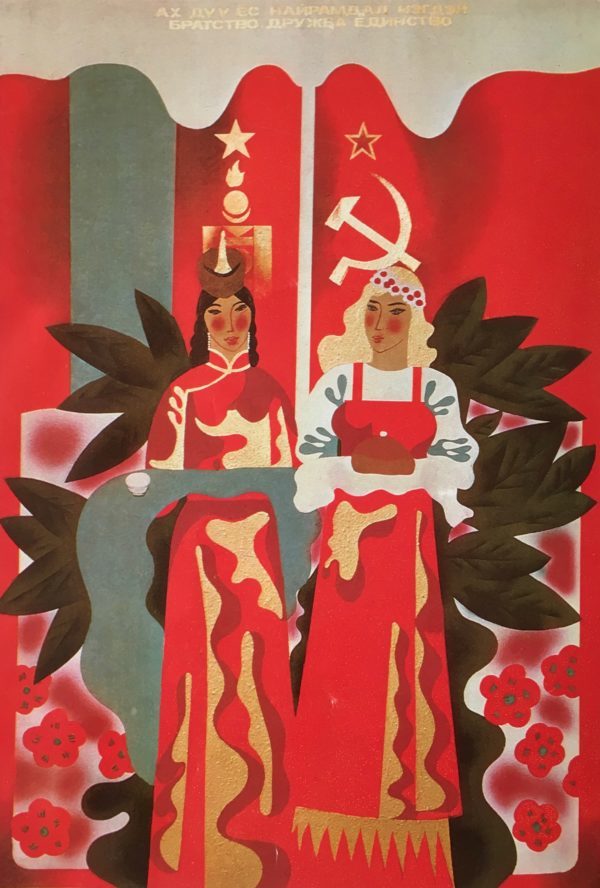
Figure 3: Russian text (second line): “Братство Дружба Единство.” (“Brotherhood, Friendship, Unity”). Original Mongolian text (top line): Ах дүү ёс, найрамдал,нэгдэл. Poster by Н Амгаланбатар (1984). Plate no. 49 in the Плакаты (Poster) Chapter of “Графика Монголии” (Mongolian Graphic Art) Edited by Д Майдар (Москва, 1988). Dimensions of the original not specified. 10 June 2018. C.Pleteshner for CPinMongolia.com
Figure 3: Brotherhood, Friendship and Unity is a poster painted by the Mongolian national artist Н. Амгаланбатар under State patronage more than 50 years into the soviet socialist project in Mongolia (1983). It exemplifies the creativity and artistic exactitude that an experienced artist can bring to a particular work performed within the tightly scripted constraints of a particular genre (ie. socialist realism). The inclusion of the latter work is testimony to the resilience of the syncretic formulas of socialist realism as administered.
This is another visual arts example of soviet socialist central and integralist conceptions applied to the creation of propaganda. In this poster, both Mongolian and Russian women are implicated, a visual construct common to many such works. We’ll put aside for now the fact that although the poster depicts two people in female bodies, the title of the work (as translated) begins with the descriptor ‘brotherhood’. Here, I wonder if a retrospective analysis through the lens of feminist anthropology and its contemporary western conceptions has a role to play …
4.3.1 Bread, Gender and Soviet–Mongolian Symbolism
In the poster, the woman on the right is Russian. She holds a loaf of bread. Caroline Humphrey (2002, p57)— yes, she’s back! As I have already mentioned I never venture too far from her meticulous and insightful works—refers to bread as having symbolic value for Russian peasants before the Revolution in 1917. It was offered, together with salt, to welcome visitors on behalf of the village community. During the Soviet socialist period in Russia, bread came to epitomise food. In the context of experiencing war as well as hunger, for some ‘bread’ became something almost sacred.
Bread, as well as some form of libation, is being offered to the viewer. Rather than the larger vessels into which Mongolian mare’s or other milk is decanted by Mongolian people, the young Russian woman holds a drinking vessel akin to the small size from which say a shot of vodka? could be consumed. The young Russian women is foregrounded. Her right shoulder is positioned just in front of the young Mongolian woman to her left, so that she appears to be leading. Through this lens a closer viewing reveals that this syncretic interpretation by the artist has privileged the Russian. Here I wonder what the older Mongolian women in my study would have to say about this work?
Painted in 1984, not long before the final collapse of the Soviet Union (1989), the khatag is rendered green rather than the blue of a Mongolian Buddhist khatag; possibly a hue more synonymous with fields of young wheat and rye crops from which, after harvesting, the bread is then made. Here, issues of colour reproduction quality may also be of concern …
Nevertheless, a khatag, now green in colour, is being offered to us, the people, by the young Mongolian woman. Having been disassociated from its original colour (blue) and ritual presentation, to one’s lama, one’s own beloved father or mother for example, the ritual khatag is now deemed secular, both in terms of its depiction and its intended (imagined) audience-recipient. The view to the communist hammer and sickle (top right) is complete and clealry visible, whereas the view of the Mongolian flag with its soyombo[10](see Atwood 2004, pp518-19) is partially obscured..[11]
Enlisting these two young women, one Mongolian (left) and the other Russian (right), as a national allegory, a political bipartisan approach is (kind of) represented. Although syncretic, a power relations differential of superior (Soviet) to subordinate (Mongolian) is portrayed. Although ‘sisters’, the young Russian woman depicted here in Figure 3, with her long flowing blond hair, is the more mature of the two. See her curvaceous form and plump bosoms?
Unlike the two representations of women, one Russian and the other Mongolian, in the early 1932 propaganda banner (Figure 2), where the sexuality of both female bodies has been downplayed, in Figure 3 the sexuality of the young Russian woman is foregrounded. Here, there is no sign of androgyny, nor ambiguity as to the gendering of the people (female) and the provision of service through the offering of substances (food and drink) with which women in both cultures are conventionally associated (Emery 2008, p165). With communist red as the dominant colour, schematically, their social presence has been developed by the artist within a limited space (cf. to Berger 1972, p46).
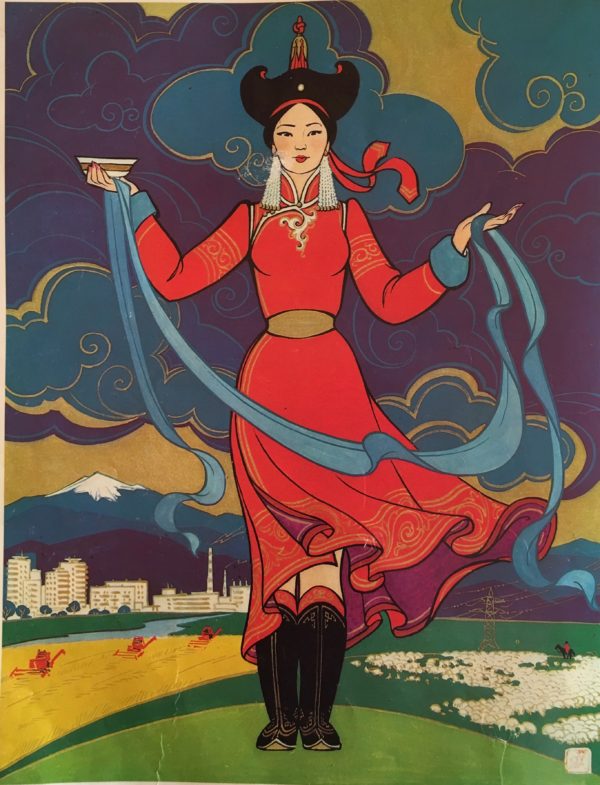
Figure 4: Original Russian text: “Добро пожаловать!” (“Welcome!”) by Я. Уржйнээ (1980). Plate no. 137 in the Станковая Графика (Machine-printed Graphic Art) Chapter of “Графика Монголии” (Mongolian Graphic Art) Editeed byД Майдар (Москва, 1988). Dimensions of the original artwork not specified. 10 June 2018. C.Pleteshner for CPinMongolia.com
Specialising in Russian history, Elizabeth Waters (1992, p124) has pointed out that these kinds of metaphors can also be read as proceeding from the pre-Stalinist period, when Soviet propaganda availed itself of the therapeutic possibilities of young, beautiful female figures of motherhood offering succour; a cup of milk in a time of considerable social upheaval and change. Here, the iconic conflation of mother and motherland, family and state, is deemed to serve, humanise and legitimise the communist Party, even if that conflation is never completely successful. Here we begin the interpretation of representation. Figure 4: Welcome.
These somewhat instrumental perspectives offer a complicating narrative to what early documented codes of Soviet law were espousing. According to Benwell (2006, p136 no.16), the status of women and men in the socialist period was ideally equal, with the Soviet 1918 Code of Law abolishing the inferior position of women at the time. Even now, it is rare to see men in Mongolia offering food and drink, unless, that is, they are a restaurant owner or waiter in now-cosmopolitan UB. I digress …
The above machine-printed poster was also published towards the end of the soviet socialist era in Mongolia, although it appears to have been drawn by Я. Уржйнээ well before then. There are many symbolic and other elements of interest in this composition. Here I’ll touch and speculate upon a few.
Dressed in a highly-stylised depiction of a well-to-do young Mongolian woman’s traditional vestments and adornments (note the hat and traditional draping of pearls to frame the face), she is ready, poised and waiting for someone: you, us, the voyeur, the outsider, the unknown and anonymous ‘other’? Her deel (traditional dress) is red in colour. Is it the red associated with the soviet socialist community part? Or is it the innovative red of the deels worn by Mongol women who were coming out as Buddhist nuns at the onset of post-soviet socialist change?
Solid in her footing, her arms are open and outstretched as she balances a traditional silver and timber (often walnut) bowl of mare’s milk (arag) in her right hand atop a blue khatag (Buddhist offering scarf). What kinds of messages does this presentation of her posture convey? Openness? Confidence? Accomplishment? Stability? Or welcoming change?
The young Mongolian woman’s stance is outwardly open and inviting. Amongst my Khalkha Mongol friends in Mongolia (women and men), her palms facing upwards (towards the heavens) form an often-used culturally-constructed gesture and embodiment. ‘Welcoming’ is but one use of this form.
It is reasonable to say that our interpretation of the meaning of this gesture would depend on our situated-ness and context at the time of its presentation. It would also depend on who we (the intended recipients) are. Supplication, acknowledgement and making a request are other interpreted meanings associated with this same gesture.
Her stylised features are elongated. Note her tall slim body, her long arms, elongated neck (swan-like), hands and fingertips? Are we to interpret this through the lenses of Buddhist iconography? Or is this particular representation of a young Mongolian person’s womanhood better aligned with newly encroaching notions of beauty and elegance that prevail in the west? Her skin is rendered pale in colour, not dark as it would be in real life … she is rendered thin, with not an extra gram of body fat in sight.
In a soviet socialist framing, the ‘milk’ in her vessel could also have considerable symbolic force. In this framing, a mother’s ‘nursing’ represents the individual’s first participation in the social economy (see Ransel 1988, p235). Further to a socialist framing, the inclusion of common symbols associated with the electrification and industrialization of Mongolia’s ‘landscape’ (note the various elements in the background) integrates into a figurative system the idea of milk as a ‘pre-eminent form of food’ (see Emery 2008, p165). During my many years of fieldwork in rural Mongolia, I have rarely entered a nomadic pastoralist’s main or kitchen ger (yurt) where there wasn’t a big cauldron of fresh milk boiling away on top of the central stove or fire. It is from this central position that the matriarch of the household, as she constantly stirred and aerated the milk with her ladle, held court.
In this poster, the inclusion of an image of a blue khatag establishes a Mongolian differentiation marker. Here, the association is with Mongol (not Tibetan) Buddhism. Here the khatag is blue. In Tibetan Buddhism the kata is white. The incorporation of the khatag (as a symbolic element) is in itself an innovation. It differentiates this artwork by a Mongolian artist from many of the other soviet socialist posters I have seen.
With one of Mongolia’s four holy Buddhist mountains which surround Ulanbaator visible in the background (left), the image of the sky is heavy and pregnant with potential, as if there is about to be a downpour of some kind. Perhaps of welcome rain for the grain being cultivated in the pastures? But this idea would be limited to the fertile soils of Selenge Aimag, of course. Possibly of the preeminent substance contained within the vessel perhaps? We can speculate wildly on what that could be! Or maybe this wonderful poster tries to capture the idea of ‘Mongolia’ on the cusp of soviet socialist to post-socialist change with the sky symbolising the massive and turbulent social upheaval on the way.[12]
Question: What do you see in each of these three artistic representations of Mongolian womanhood? What are they saying to you?
________________________________
5. CONCLUDING SUMMARY
The enduring legacy of the creative spirit during the Socialist era in Mongolia was not defined merely by its relationship to external ideological frameworks, but rather by the quiet, persistent resilience of the artist’s inner voice. In navigating the complex intersections of state-sanctioned aesthetics and personal conviction, practitioners of that time maintained a specialised form of agency: a subtle, multi-dimensional negotiation that preserved the integrity of the Mongolian cultural narrative under constraint.
This historical resilience underscores the profound ethical and artistic weight carried by those who commit their thoughts to the written word today. To better understand the evolution of the creative agency discussed in this historical context, one might refer to the more contemporary reflections on the responsibilities of the craft itself in Mongolian Poetry 64: On Writing Poetry.
________________________________
6. AFTERWORD
Looking Back from 2026
Now writing for CPinMongolia from 2026, I am struck by how much has changed in Mongolia since the period discussed here, and how much has not. The women whose lives and memories shaped this article belonged to a generation formed by socialist institutions, kinship obligations, religious continuities and the abrupt uncertainties of post-socialist change. Their daughters and granddaughters now inhabit a very different social, economic and political landscape, yet many of the older patterns traced here remain legible beneath the surface.
For me, that is perhaps the most useful reason to return to these representations now: not as relics of a closed historical period, but as visual and cultural traces of ideas about womanhood, nation, labour, family and belonging that continue to echo, mutate and reappear in contemporary Mongolia. —CP
________________________________
Personal Note
This article is dedicated to my dear friends Jantsan Gundegmaa and Yadamjav Sumya who over the years have been unfaltering in their perseverance and personal generosity towards not only myself but to so many others. If I have made any errors through lack of understanding in composing this manuscript, they are entirely my own, and for these I humbly apologise.
________________________________
NOTES
[1] Verdery (1996, p82) also advocates that as the transition [away] from socialism continues, scholars should be especially attentive to how nationalist politics integrates gender [and] the alternative forms of national imagery that are being offered and by whom … [therein] producing distinctive forms of democracy and capitalism in which nation and gender are intertwined in novel ways.
[2] Verdery’s narratives circle around women, reproduction and abortion as a means of social engineering in Romania during (post) socialist times. On this topic, also see Anton (2008). However, the topic of abortion did not come up, nor was it raised, during my fieldwork with Mongol Buddhist women in Mongolia.
[3] Verdery (1996, p245 no.15) notes the general lack of availability of family/gender configurations from one or another Eastern European society prior to 1945. That being the case, it is difficult to comment on to what extent the family/gender configuration patterns continued or differed from something earlier.
[4] Socialist Realism is such an interesting topic. Joseph Stalin’s control of all artistic production (music and the arts) and its consumption, the establishment of both a Writers Union and an Artists Union (associations that were neither free nor predicated on a guild model), its use to bring ethnically different nationalists into the soviet social and political sphere, the social reality that the State became the sole ‘benefactor’ and source of income for artists (State patronage), and the use of socialist propaganda in Mongolia in particular to appeal to people’s goodness and hope for a better future all require more attention that I am able to give here.
[5] I wish to thank my translator and now long-time Mongolian friend Damdin Gerelbayansgalan for the many hours she allocated from her own busy schedule for us to visit and search through the many small bookshops and street markets that were in UB during my early years of fieldwork looking for interesting books. It was during one of these excursions—its was late in the day, we were tired and hungry, the sun was setting and the temperature outside was dropping— when we stumbled across a second hand copy of Mongolian Graphic Art from which this image of a relatively early soviet socialist banner was drawn. I found it amongst a pile of other old books set out on the ground by a less than well-to-do elderly Mongolian man who was selling his family’s small collection of books accumulated over a lifetime to buy food and fuel. The early 2000s was a very tough time for most Mongolians, financially. I have never forgotten this exchange and my privileged position in the transaction. In terms of considerate (if not ethical) anthropological research practices, rather than just letting this particular book continue to sit on the shelves of my own library’s collection, I really wanted to invoke its use by sharing with others selected elements drawn from its contents. In some way methodologically, doing so brings a sense of satisfaction as well as completion for me.
[6] Search The Museum of Modern Art’s (MoMA) open access online catalogue using the search term ‘socialist realism’ at http://www.moma.org/collection/theme.php?theme_id=10195 [Accessed: 10 June 2018].
[7] As an example, during the depths of Word War in his important speech (an appeal to the people) Joseph Stalin (1942) invoked ‘the Motherland’ and not the State in an attempt to rally his civilian and other troops. Stalin moved to using symbols of pre-Soviet nationalism, which had previously been rejected as bourgeois. ‘Motherland’ rather than having disappeared, was for strategic geo-political purposes re-invoked. Once the war had been won, however, the central propaganda machine reverted to Marxist-Leninist formulas (see German Propaganda Archive 1988).
[8] In the relatively short history of the Mongolia’s democratic parliament, the greatest number of women were elected in the 2004 election; at which time nine women were elected. Since 1990 when Mongolia’s democratically-elected parliament was established, 3 Mongolian women have already reached the position of Minister: N. Bolormaa (Minister for Education, Culture and Science); Dr. Sanjaasuren Oyun (who is a sister of an assassinated in 1990 at the age of 36 Mongolian democratic leader Sanjaasuregiin Zorig) was Minister for Foreign Affairs; and T. Gandi who was (Acting) Minister of Labor and Social Welfare. However, According to Benwell (2006, p136 no.17) an unofficial list of the 2004 Mongolian parliament elections lists only three women, i.e. 2.28 percent.
[9] Jameson’s position has been challenged by some post-colonialist theorists (see Ahmad 1987, Szeman 2001).
[10] The Mongolian ‘soyombo’ is derived from the Sanskrit ‘svayambhu’ (self-existent).
[11] According to Bulag (1998, p238) both the Buddhist lotus and the Soyombo are invoked by different political groups in their contention for power.
[12] Other feminist scholars might impute a less abstract, less wholesome reading of this womanhood-as-allegory visual narrative. Lisa Bernstein (2008, p231) suggests the ‘mother-as-allegory’ narrative of men saving [the nation] conceals somewhat pervasive state-sanctioned violence against women, even as it reveals the danger of dividing women and men into ‘life givers’ and ‘life takers.’ Such separation on a metaphorical level may predispose us to see ‘all women’ as ‘naturally’ peaceful and to condone men as ‘naturally’ aggressive and thus unable to control their violent behavior. Domestic and other violence towards Mongolian women (Witte, Batsukh, and Chang 2010, Shagdarsuren Oyunbileg, Nyamjav Sumberzul, Natsag Udval, Jung-Der Wang, and Craig R. Janes 2009 )is a real problem.
________________________________
MORE NOTES
- The text of this article is an edited extract from the third chapter of Nomadic Temple: Daughters of Tsongkhapa in Mongolia (C.Pleteshner 2011, unpublished manuscript: 365pp). The Zava Damdin Sutra and Scripture Institute Library Archive in the Manjushri Temple, Soyombot Oron). [Updated: August 2026]
2. The first image (Figure 1) in this post is an artistic representation of the Nomadic Temple tome and the Mongol women’s stories that have shaped its form.
3. To the best of my knowledge, the scanned images represented here in Figures 2, 3 and 4 for educational and non-commercial purposes does not breach Soviet Union original artist copyright law. Mongolian Graphic Art, a bilingual—Russian Cyrillic (primary) and Mongolian Cyrillic text, with photographed images of artists’ original works was edited by D. Maydar and published in Moscow by Izobrazitel’noye iskusstvo Press in 1988.
4. In this post I thought it important to retain at least some of the Russian Cyrillic text in order to reflect some of the processes of Russification (in this case language) promulgated during the soviet socialist era in Mongolia and where the older generation of Mongolian women were at the time culturally immersed.
5. If you’d like to explore the topic of Soviet socialist-era graphic art in Mongolia further, as a point of departure a copy of the book Mongolian Graphic Art and other compendiums of original artistic works by ethnic Mongol artists may be located in The Mongolian State University of Arts and Culture‘s extensive library collection. It is likely that The National Library of Mongolia has a copy of this soviet era publication too. The Mongolia and Inner Asia Studies Unit (MIASU) Cambridge University has listed Mongolian Graphic Art in their own library’s 2017 catalogue (A29). The American Centre for Mongolian Studies (ACMS) also has a copy in their collection (Call no. NC359.M6 M254 1988).
________________________________
FURTHER READING
Mongolian Poetry 58: Let Nothing Be Carried Beyond Its Measure brings an emic perspective to Mongolian spiritual and linguistic heritage. Through verse and oral tradition, Poem 58 conveys philosophical understandings from within the cultural world in which they are sustained.
Letter from Mongolia 21: Home’s Distant Outline approaches place and belonging through auto-ethnographic reflection. By linking personal experience with wider cultural themes, Letter 21 considers how a sense of home is shaped within contemporary Mongolian life.
Intermedia 10: White orphan camel calf offers a musically expressive account of the delicate realities of pastoral care through a singular, moving story of survival. Its echo of interspecies relations brings into view the affective labour, responsibility, and moral economy that underpin everyday nomadic life.
Out and About 19: Khui Doloon Khudag: Naadam on the Open Steppe brings participant-observation to the communal life of Naadam. Through attention to performance and ritual on the open steppe, it complements Artscape 07 by showing how shared traditions help sustain Mongolia’s social and cultural fabric.
Artscape 10: The look of compassion: seated Quanyin approaches Buddhist continuity through sacred art. While Artscape 07 considers the pressures of the Socialist period, Artscape 10 focuses on an image that endured those upheavals. In relation, they suggest how Buddhist iconography could persist despite periods of suppression.
Soundscape 17: Biyelgee of Everyday Life considers embodied knowledge through traditional Mongolian dance, with particular attention to how cultural memory is preserved through physical performance and gesture.
Landscape 13: Transition-ing Mongolia examines the physical and social transformations of socialist and post-socialist Mongolia. Its attention to landscape and topographic memory offers a broader context for the cultural and artistic shifts encountered in Artscape 07.
Artscape 19: Balin for the New Year examines the art of balin dough offerings. Through close attention to sacramental material culture and the transient nature of ritual objects, it complements the historical focus of Artscape 07.
Vignette 06: What’s in a Name? extends the historical perspective developed in Artscape 07 into the ethnographic study of personal nomenclature. Together, the two pieces examine how individual naming practices persisted within the broader political constraints of the socialist period.
Letter from Mongolia 14: Chandmani Erdene examines where traditional song meets artificial intelligence. Through digital ethnography, it considers techno-animism and how cultural continuities adapt within modern technological frameworks.
Out and About 01: 100th Anniversary of Artist L.Namkhaitseren brings a biographical perspective to the artistic history considered in Artscape 07. By following Namkhaitseren’s life and legacy, it gives a personal dimension to broader questions of artistic lineage and institutional change in twentieth-century Mongolia.
Artscape 18: Mongolian womanhood, desert canyon offers a contemporary visual perspective on Artscape 07, exploring the representation of Khalkha women in the Gobi landscape. Together, the two pieces examine how women’s identities are articulated across changing historical, political and visual contexts.
Letter from Mongolia 01: Eej and the new lam offers another perspective on Artscape 07, documenting the psychological and social climate of the early post-socialist Gobi. Together, the two pieces explore the resilience and lived experiences of individuals, particularly women, as they navigated changing political realities.
Artscape 08: Revitalising the life of social objects complements Artscape 07 by examining how material artefacts survived the socialist era and entered new cycles of cultural life. Together, the two pieces document both the objects themselves and the people whose care ensured their survival.
Landscape 16: Dinosaur fossil in the Gobi oldest ever found explores the deep time of the Mongolian landscape through a remarkable paleontological discovery. Its focus on the Gobi connects deep-time history with Mongolia’s modern cultural and scientific identity.
Letter from Mongolia 15: Tsagaan Sar: Kinship Renewed examines the role of kinship and domestic ritual in sustaining Mongolian identity. It explores the modern celebration of Mongolian New Year as a return to ancestral and familial roots, while Artscape 07 examines the socialist era’s attempts to redefine these family and religious structures.
Mongolian Poetry 64: On Writing Poetry examines where Mongolian Buddhist literary tradition, poetic inspiration, movement, humour, and contemporary life meet.
Soundscape 14: Changeover explores the transition of musical authority as musicians trained during the socialist era retire. It examines the legacy of the Soviet ensemble system and institutional training, while Artscape 07 provides the social and political context that shaped this twentieth-century training ecology.
________________________________
REFERENCES
Ahmad, Aijaz. 1987. “Jameson’s Rhetoric of Otherness and the ‘National Allegory’.” Social Text(17):3-25.
Anton, Lorena. 2008. “Abortion and the Making of the ‘Socialist’ mother during Communist Romania.” In (M)Othering the Nation: Constructing and Resisting National Allegories through the Maternal Body, edited by Lisa Bernstein, 49-61. Newcastle, United Kingdom: Cambridge Scholars Publishing.
Atwood, Christopher Pratt. 2004. Encyclopedia of Mongolia and The Mongol Empire. In Facts on File Library of World History. New York: Facts on File Inc.
Atwood, Chrsitopher Pratt. 1994. “National questions and national answers in the Chinese revolution: or, how do you say Minzu in Mongolian?” Indiana East Asian Working Papers(5):37-73.
Berger, John. 1972. “Ways of Seeing.” In, 10-11. London: British Broadcasting Corporation and Penguin Books.
Bernstein, Lisa. 2008. “Saving the Motherland?” In (M)Othering the Nation: Constructing and Resisting National Allegories through the Maternal Body, edited by Lisa Bernstein, 160-172. Newcastle, United Kingdom: Cambridge Scholars Publishing.
Bulag, Uradyn Erden. 1998. Nationalism and Hybridity in Mongolia, Oxford Studies in Social and Cultural Anthropology. New York: Clarendon Press.
Emery, Jacob. 2008. “The Land of Milk and Money: communal kitchens and collactaneous kinship in the Soviet 1920s.” In (M)Othering the Nation: Constructing and Resisting National Allegories through the Maternal Body, edited by Lisa Bernstein, 160-172. Newcastle, United Kingdom: Cambridge Scholars Publishing.
Gellner, Ernest. 1983. Nations and Nationalism. Cambridge: Cambridge University Press.
Gentile, Emilio. 2000. “The Sacralization of Politics: definitions, interpretations and reflections on the question of secular religion and totalitarianism. Translated by Robert Mallett.” Totalitarian Movements and Political Religions1 (1).
Gentile, Emilio. 2005. “Political Religion: a Concept and its Critics – a critical survey. Translated by Natalia Belozertseva).” Totalitarian Movements and Political Religions6 (1):19-32.
German Propaganda Archive. 1988. Kleines politisches Worterbuch (GDR Political Dictionary): Neuausgabe. Berlin: Dietz Verlag pp17-18; 795-797.
Goldthorpe, J. 1983. “Women and Class Analysis: in defence of the conventional view.” Sociology17 (4):465-488.
Humphrey, Caroline. 1998a. “Politics in the Collective Farm.” In Marx Went Away – but Karl stayed behind. Ann Arbor: The University of Michigan Press.
Humphrey, Caroline. 1998b. “Ritual and Identity.” In Marx Went Away – but Karl stayed behind. Ann Arbor: The University of Michigan Press.
Jameson, Fredric. 1986. “Third-Wolrd Literature in the Era of Multinational Capitalism.” Social Text(15):65-88.
Marsh, Peter K. 2006. “Beyond the Soviet Houses of Culture: Rural Responses to Urban Cultural Policies in Contemporary Mongolia.” In Mongols from country to city: floating boundaries, pastoralism and city life in the Mongol lands, edited by Ole Bruun and Li Narangoa, 290. Copenhagen: NIAS.
Ransel, David L. 1988. Mothers of Misery: child abandonment in Russia. Princeton, New Jersey: Princeton University Press.
Shagdarsuren Oyunbileg, Nyamjav Sumberzul, Natsag Udval, Jung-Der Wang, and Craig R. Janes. 2009. “Prevalence and Risk Factors of Domestic Violence among Mongolian Women.” Journal of Women’s Health18 (11):1873-1880.
Skeggs, Beverley. 2004. “Context and Background: Pierre Bourdieu’s analysis of class, gender and sexuality.” In Feminism after Bourdieu, edited by Lisa Adkins and Beverley Skeggs, 19-24. Oxford: Blackwell Publishing.
Sneath, David. 2006. “The Rural and the Urban in Pastoral Mongolia.” In Mongols from country to city: floating boundaries, pastoralism and city life in the Mongol lands, edited by Ole Bruun and Li Narangoa, 140-161. Copenhagen: NIAS.
Stalin, Joseph. 1942. Order #227 (28 July 1942) by the People’s Commisar of Defence of the USSR. Transcribed and translated by Soviet Russia Today. Available at: http://www.mishalov.com/Stalin_28July42.html.
Szeman, Imre. 2001. “Who’s Afraid of National Allegory? Jameson, Literary Criticism, Globalization.” The South Atlantic Quarterly100 (3):803-827.
Tilly, Charles. 2006. Regimes and Repertoires. Chicago & London: The University of Chicago Press.
Verdery, Katherine. 1996. “From Parent State to Family Patriarchs.” In What Was Socialism, and What Comes Next?, 61-82. Princeton, New Jersey: Princeton University Press. [Princeton Studies in Culture/Power/History. Edited by Sherry B Ortner, Nicholas B Dirk and Geoff Eley].
Waters, Elizabeth. 1992. “The Modernization of Russian Motherhood 1917-1937.” Soviet Studies44 (1).
Witte, Susan S, Altantsetseg Batsukh, and Mingway Chang. 2010. “Sexual Risk Behaviors, Alcohol Abuse, and Intimate Partner Violence Among Sex Workers in Mongolia: implications for HIV intervention development.” Journal of Prevention & Intervention in the Community38 (2):89-103.
End of transcript.
Refer to the INDEX for other articles that may be of interest.

|
© 2013-2026. CP in Mongolia. This post Artscape 07: “During the Socialist times” is licensed under the Creative Commons Attribution 4.0 International License. Open access should not be understood as the absence of attribution. Documents linked from this page may be subject to other restrictions. Posted: 12 June 2018. Last updated: 28 September 2026. |