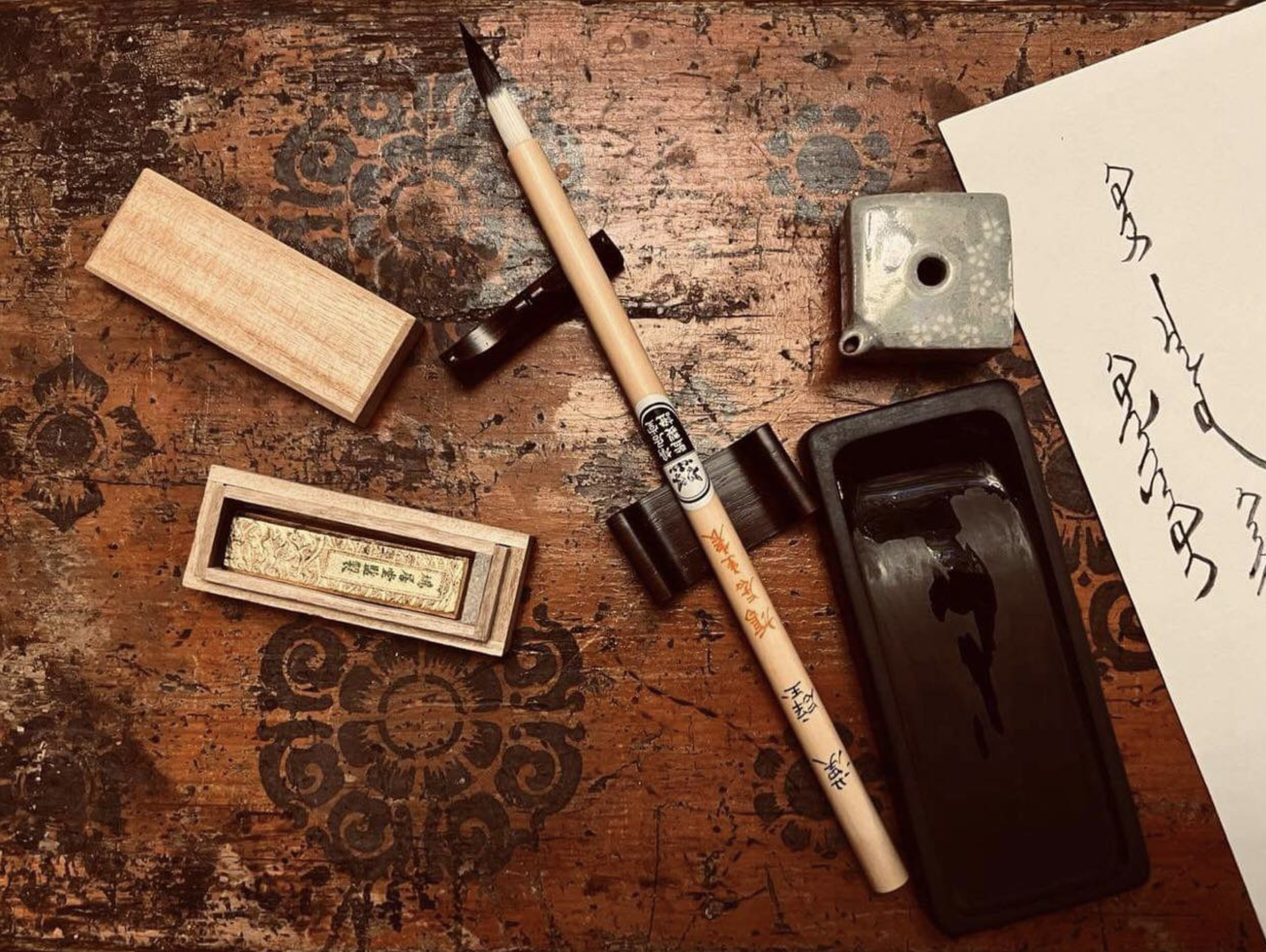
Plate note: This photograph shows the calligraphy brush, ink, and writing tools of the Mongolian scholar poet Zava Damdin (b. 1976) on his traditional writing table. The vertical Mongol Bichig inscription on the right reads “ХҮЛЭЭХҮЙ”, which may be translated into English as “Waiting”. Location: Soyombot Oron, Delgertsogt Sum, Mongolia’s Gobi Desert. Photograph reproduced on CPinMongolia with permission. 21 February 2024.
The following is a translation of a poem by the Mongolian scholar poet Zava Damdin (b. 1976). Although our paths first crossed in 2004, when he was in residence teaching at Amarbayasgalant Monastery in northern Mongolia, I began working with Rinpoche on translations of his literary works in the Year of the Green Wood Horse (2015).
Together with Erdenetsogtyn Sodontogos, we translated Zava Rinpoche’s The Great Nenchen. I continue to study with “Zava Bagsh” to this day (2026). Please refer to the Index of Mongolian Poetry and Articles for other works that may be of interest.
______________________________
WAITING
(English Translation)
Waiting for the thick and icy snow to melt
Waiting for the remote mountain to be decorated with beautiful blue anemones
Listening to the sound of ducks echo across the waterways
As usual all the universes and seasons are turning, and yet
What is the heart still waiting for?
It awaits human heart, anyway
The expectations of wishful waiting
Are like waiting for your own mind
Likewise, heart’s melting and wavering
It’s like predicting that the interior chest mountain will have eternal spring
In my higher mind, I wish to become a windborne duck, and sing
Not to the west or to the east. Not to the south or to the north
At the centre of my heart I dwell, like an eagle taking flight.
Written by a little finch on a dragon mountain
Eleventh day of the White Moon month in the Year of the Dragon
Zava Damdin
Land of Soyombot
21.02.2024
______________________________
Translated by Zava Damdin and C.Pleteshner.
English interpretation 26.02.2024 from the original Mongolian 21.02.2024.
______________________________
ХҮЛЭЭХҮЙ
(Original Mongolian)
Хөр цасан хайлахуйг хүлээнэм
Хөхүмдэг яргуй дэлбээлж аглаг уулыг чимэхүйг хүлээнэм
Хөх тэнгэрийн чинад дор ганганах ангир шувуудыг хүлээнэм
Хүй орчил улирал бүр орчдогоороо орчсоор буй атал
Хүлээхүй сэтгэл яг юуг үргэлж хүлээнэм буй
Хүмүүний сэтгэлийг л харуулдан хүлээн буй биз
Хүсэмжлэн бодох тэрхүү хүлээлт инү харин
Өөрийнхөө сэтгэлийг өөрөө хүлээх мэт аж
Өр зүрхэндээ хайлан мэлтэгнэхүйг хүлээх мэт
Өвчүүн доторхи аглаг уулаа үргэлж хавар болгохуйг зөгнөх мэт
Өрнүүн сэтгэлдээ ангир болоод дуулан нисэхүйг эгээрэх мэт
Өрнийг бус дорныг бус өмнөдийг ч бус умрыг ч бус
Өвч сэтгэлийн төв дор бүргэд мэт тогтон нисэхүйг хүлээн буй аж
Цогт уулын бялзуухай бээр бичив
Луу жилийн Цагаан Сарын шинийн арван нэгэн
Соёмбот Орон
Зава Дамдин
21.02.2024
______________________________
NOTES
Source: A Bilingual Collection of Zava Damdin (1976- ) Poetry. Vol. 1 (2021-2024). The Zava Damdin Sutra and Scripture Institute Library Archive, Manjushri Temple Soyombot Oron, Mongolia. Unpublished manuscript. pp43-44.
Translation is always an interpretation into another culture.
____________________________
FURTHER READING
For an intimate perspective on patience and everyday care within monastic life, see Letter from Mongolia 01: Eej and the new lam.
Readers interested in continuity through everyday practice may also enjoy Letter from Mongolia 02: The Kitchen-house.
For a broader perspective on cyclicality and historical memory, see Landscape 02: a Social Matrix for Local Reconstruction.
For a reflection on transition, remembrance, and the renewed presence of heritage in public life, see Landscape 03: Transition-ing.
____________________________
NOTES
Excluding the preparatory training and clarity of narrative structure and ideation required, the journey of such compositions tends to move through three phases, starting with: (i) the creation of the original composition with the vertical Mongol Bichig Script (see above photograph); (ii) the subsequent transfer and rendering of this transcript into the Mongolian Cyrillic Script; and then on to, (iii) a (British) English language interpretation, such as you see here.
I bring to this interpretive exercise my own particular collection of English language narrative skills and their imagined audiences. From this perspective, a final English language version of a narrative emerges as a negotiated text.
end of transcript.
Refer to the INDEX for other articles that may be of interest.

|
© 2013-2026. CP in Mongolia. “Mongolian Poetry 01: Waiting“ is licensed under the Creative Commons Attribution 4.0 International License. Open access should not be understood as the absence of attribution. Documents linked from this page may be subject to other restrictions. Posted: 1 March 2024. Last updated: 11 September 2026. |