This series explores the ontological intersections of nomadic memory, spiritual practice, and the environmental ‘vessel-world’ of Mongolia. Please refer to the Index of Landscapes and Articles for other works that may be of interest.
In December 2024, Mongolia’s Zava Damdin (b. 1976) visited the American Museum of Natural History (AMNH) on the Upper West Side of Manhattan in New York City. In August 2025, a group of international paleonologists were honoured guests of Zava Rinpoche at his monastery near Delgertsogt Mountain in the Dundgovi Province of Central Mongolia.
1. INTRODUCTION
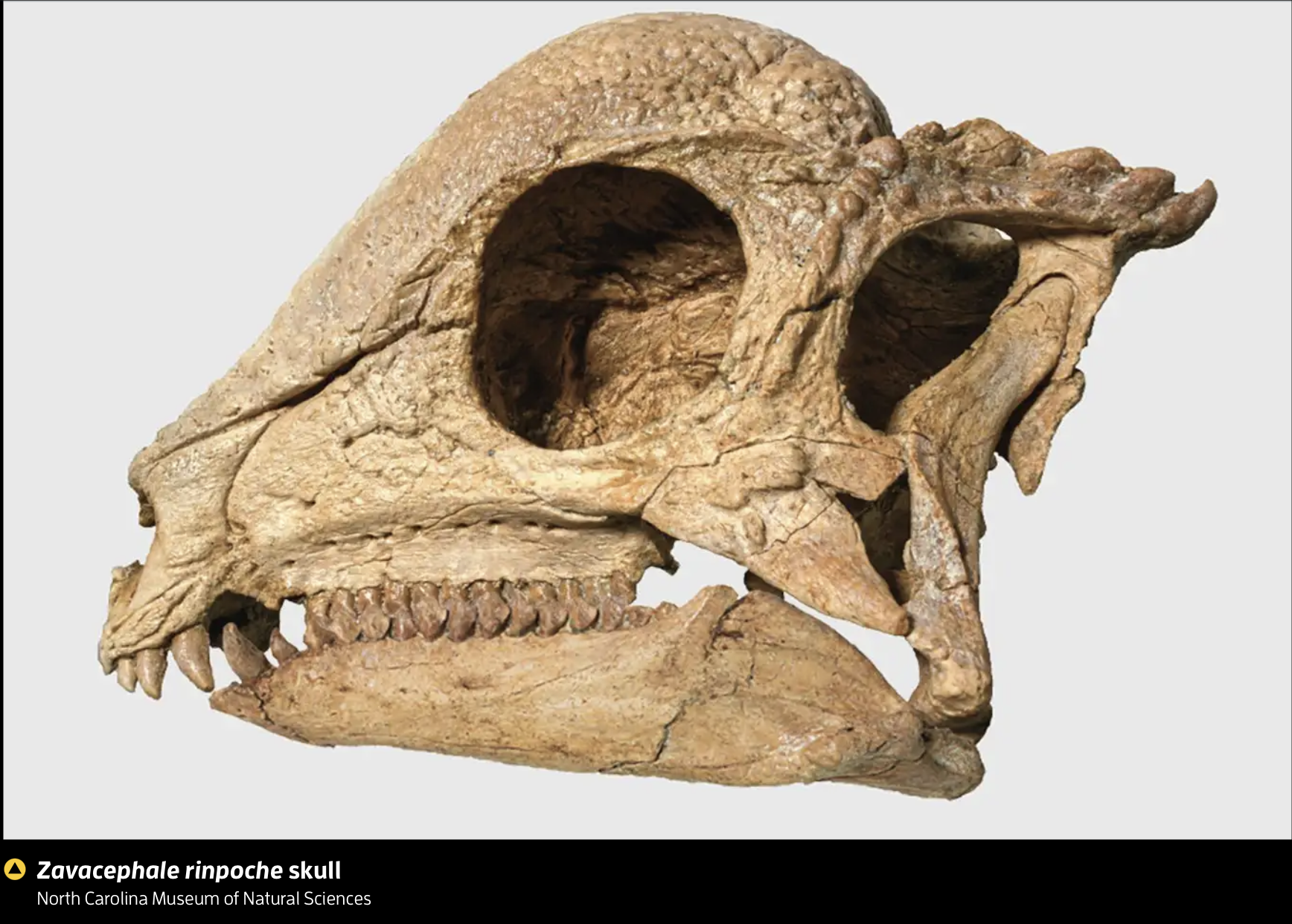
Auspiciously, it was soon after this celebration, that the oldest and most complete pachycephalosaur fossil in the world was discovered nearby (see below), and named in honour of Zava Rinpoche (b.1976). The scientific name assigned to this fossil holotype specimen (MPC-D 100/1209) is Zavacephale rinpoche or its abbreviated form, Z.rinpoche. Embedded in this nomenclature is a culturally-nuanced Mongol socio-historical perspective and meaning.
The dome-headed dinosaur from Mongolia is the oldest ever found. A fossil from about 108 million years ago reveals an early member of the pachycephalosaurs, a group of dinosaurs with protrusions on their skulls that may have been used in combat.
Palaeontologists working in the Dundgovi desert of Mongolia saw the fossil skull protruding from the rock like a cabochon jewel*, says Dr. Lindsay E. Zanno, Head of Palaeontology Division of the North Carolina Museum of Natural Sciences. “And so we chose the species name ‘rinpoche’, which means ‘precious one“.
Z. rinpoche predates any other pachycephalosaur species by around 15 million years and is also the most complete specimen ever found, with a near-complete skull and limb bones and substantial parts of its vertebrae and hips. The team also recovered hand bones, as well as stomach stones, which would have been used to grind its food.
The fossil dome is covered in dimples, which may indicate the presence of other, unknown features on its head. “Pachycephalosaur skulls are so flashy,” says Zanno. “They not only have domes, they also have bony spikes and nodes around the skull for display. These ornaments were essentially dome accessories.”
To determine the age of the dinosaur at its death, the team cut a thin slice of its lower leg bone. They describe it as a “teenager” that would have been about a metre long and weighed just under 6 kilograms. Although it is impossible to estimate how big it would have been had it reached adulthood, other pachycephalosaurs reached lengths of more than 4 metres and 400 kilograms in weight.
“The tissue preserves two growth rings and indicates the animal was still actively growing at the time of its death,” says Zanno. “The bones of the spine are also unfused, leaving room to grow.”
CT scans of the dome show that its structure was fully formed, indicating that even as a juvenile, this feature was fully developed, highlighting its importance.
[Source: Edited extract of Dome-headed dinosaur from Mongolia is the Oldest Ever Found, an article by J. Woodford in NewScientist published 17 September 2025.]
2. THE RESEARCH
Chinzorig, T., Takasaki, R., Yoshida, J. et al. A Domed Pachycephalosaur from the Early Cretaceous of Mongolia. Nature (2025).
2.1 The Abstract
The dome-headed pachycephalosaurians are among the most enigmatic dinosaurs. Bearing a hypertrophied skull roof and elaborate cranial ornamentation, members of the clade are considered to have evolved complex sociosexual systems.
Despite their importance in understanding behavioural ecology in Dinosauria, the absence of uncontested early diverging taxa has hindered our ability to reconstruct the origin and early evolution of the clade. Here we describe Zavacephale* rinpoche gen. et sp. nov., from the Lower Cretaceous Khuren Dukh Formation* of Mongolia, the most skeletally complete and geologically oldest pachycephalosaurian discovered globally. Z. rinpoche exhibits a well-developed frontoparietal dome and preserves the clade’s first record of manual elements and gastroliths.
Phylogenetic analysis* recovered Z. rinpoche as one of the earliest diverging pachycephalosaurians, pushing back fossil evidence of the frontoparietal dome by at least 14 Myr* and clarifying macroevolutionary trends in its assembly. We found that the earliest stage of dome evolution occurred by means of a frontal-first developmental pattern with retention of open supratemporal fenestra, mirroring proposed ontogenetic trajectories in some Late Cretaceous taxa. Finally, intraskeletal osteohistology of the frontoparietal dome and hindlimb demonstrate decoupling of sociosexual and somatic maturity in early pachycephalosaurians, with advanced dome development preceding terminal body size.
_______________________
2.2 DATA AVAILABILTY
The Z. rinpoche holotype specimen* (MPC-D 100/1209) is reposited in the Institute of Palaeontology, Mongolian Academy of Sciences on Peace Avenue in the Bayanzurkh District of the nation’s capital Ulaanbaatar. Geographic coordinate data are available upon request from the MPC-D for scientific purposes.
______________________
2.3 ACKNOWLEDGEMENTS
[The researchers] thank the field crew and local and regional Mongolian authorities (Ministry of Education, Culture, Science, and Sports and local governor offices of the Dundgovi Province) for fieldwork assistance and permissions.
We thank preparators C. Bayardorj (MPC-D), A. Giterman (NCSM) and B. Byambatsogt (MPC-D) for fossil preparation and reproduction.
We thank the following people and institutions: C. Mehling; R. Benson (AMNH); J. Mallon; S. Rufolo (CMN); D. Evans, K. Seymour (ROM) and P. Currie (UoA) for collections access; H. Avrahami and L. Herzog (NCSM) for computed tomography scanning and other laboratory support; D. Idersaikhan (MPC-D), T. Tanaka (Univ. of Hyogo), S. Hayashi (OUS) and M. Iijima (IVPP) for extra photographs; G. Masukawa for skeletal reconstruction; M. Hattori for life reconstruction artwork; and K. Chiba (OUS), D. Evans (ROM), C. Woodruff (Patricia & Phillip Frost Art Museum), A. Dyer (ROM) and J. Mallon (CMN) for discussion.
The Willi Hennig Society provided free TNT software for phylogenetic analyses.
This study was supported by a Grant-in-Aid for JSPS Research Fellow of Japan (17J06410 and 20J01696) and JSPS Overseas Research Fellowships to R.T.; JSPS KAKENHI Grant (21K14026) to J.Y.; a National Geographic Society grant (NGS-100601R-23) to L.E.Z., R.T.T., K.T., J.Y. and T.C.; and a Paleontological Society Arthur J. Boucot Research Award and Collection Study Grant of the RGGS at the AMNH to T.C.
________________________
2.4 AUTHORS and AFFILIATIONS
Department of Biological Sciences, North Carolina State University, Raleigh, NC, USA. Tsogtbaatar Chinzorig & Lindsay E. Zanno
Institute of Paleontology, Mongolian Academy of Sciences, Ulaanbaatar, Mongolia
Tsogtbaatar Chinzorig, Batsaikhan Buyantegsh, Buuvei Mainbayar & Khishigjav Tsogtbaatar
Paleontology, North Carolina Museum of Natural Sciences, Raleigh, NC, USA
Tsogtbaatar Chinzorig, Ryan T. Tucker & Lindsay E. Zanno
Department of Ecology and Evolutionary Biology, University of Toronto, Toronto, Ontario, Canada. Ryuji Takasaki
Faculty of Biosphere-Geosphere Science, Okayama University of Science, Okayama, Japan. Ryuji Takasaki
Fukushima Museum, Aizu Wakamatsu City, Fukushima, Japan. Junki Yoshida
Department of Earth Sciences, Stellenbosch University, Stellenbosch, South Africa.
Ryan T. Tucker & Lindsay E. Zanno
Department of Geology, Field Museum of Natural History, Chicago, IL, USA. Lindsay E. Zanno
Natural History Museum of Utah, University of Utah, Salt Lake City, UT, USA. Lindsay E. Zanno
Vertebrate Paleontology, Oklahoma Museum of Natural History, Norman, OK, USA. Lindsay E. Zanno
Evolutionary Studies Institute, University of the Witwatersrand, Johannesburg, South Africa. Lindsay E. Zanno
To read the full version of the 2025 research paper, see: DOI: 10.1038/s41586-025-09213-6.
_________________________________________
CP NOTES (glossary)
- Cabochon refers to a gem that has been polished but not faceted.
- In Paleontology and related sciences, Myr is an abbreviation for Million years or Million years ago, used to denote a unit of time equal to 1,000,000 years, though alternatives like Ma and Mya are also common.
- Cephale (or Kephalē, Κεφαλή) is the Ancient Greek word for “head”.
- The Lower Cretaceous Khuren Dukh Formation, also known as the Khukhteeg Formation is a geological formation dating to the Aptian-Albian stages of the Early Cretaceous (roughly 125-100 million years ago) where fossilised evidence of dinosaurs, reptiles, plants and angiosperms have been noted. The formation is found in central and southeastern Mongolia particularly in the Choir Basin.
- Phylogenetic analysis is a method for estimating and visually representing the evolutionary relationships between genes, populations, or species using data like DNA or protein sequences, morphological traits o behaviours. It results in a branching digram called a phylogenetic tree, which illustrates how different organisms re connected through a shared evolutionary history, helping scientists understand biodiversity and evolution.
- A holotype specimen is a single, specific physical example of an organism that was formally designated by scientists when a new species was first described and named. Zavacephale rinpoche (Z.rinpoche) now serves as the authoritative, name-bearing reference for this new species which all scientist must now compare their findings to, ensuring consistency and stability in subsequent scientific classification.
- If you are interested in paleontology or palaeontology (see below), the branch of science concerned with fossil animals and plants, many of the above previously published research papers are available to read in the public domain using Google Scholar and/or PubMed.
- And finally, both “paleontology” and “palaeontology” are correct spellings for the scientific study of prehistoric life through fossils, with “paleontology” being the standard in American English and “palaeontology” preferred in British and other Commonwealth English. The difference is a regional variation, much like the term itself comes from Greek roots and has variations in other European languages, such as French and German.
________________________________
FURTHER READING
Against the deep time of Landscape 16, Mongolian Poetry 20: That Which Stirs the Heart turns to what moves and endures within human experience, offering a poetic perspective on value across a very different timescale.
Closer to the rhythms of everyday Gobi life, Letter from Mongolia 02: The Kitchen-house enters the domestic interior, considering hospitality, communal grounding and the cultural meanings of nutag.
For another perspective on landscape and time, Artscape 16: Oсень (Autumn) records seasonal and atmospheric change in Nukht through an ongoing visual study of the Mongolian environment.
End of transcript.
Refer to the INDEX for other articles that may be of interest.

|
© 2013-2026. CP in Mongolia. “Landscape 16: Dinosaur fossil in the Gobi oldest ever found” is licensed under the Creative Commons Attribution 4.0 International License. Open access should not be understood as the absence of attribution. Documents linked from this page may be subject to other restrictions. Posted: 19 September 2025. Last updated: 1 October 2026. |