This is the first article in the new visual ethnography series about using images and close observation to examine how people live, make meaning, and give those meanings form in practice. Please refer to the Index of Artscapes and Articles for other works that may be of interest.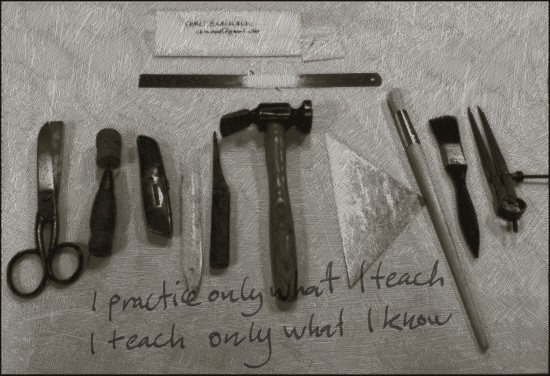 Plate note: “Tooltalking” Digital Art by Christopher William Blackall (Canberra, Australia) for CPinMongolia.com. The digital artwork (see below) appears with permission of the artist. 21 November 2013.
_________________________
AN OPENING DISCUSSION
Some projects are more complex to implement than others. A particularly innovative project can take many years to come to fruition. Distance, time, language and resources all play a part, as does allowing the considerable time needed to establish new and sustainable cross-cultural, research-based relationships.
The Mongolia Project has been just such a project. It and I have travelled together for a number of years now. But unlike eating chocolate, its implementation has been far from a straightforward ‘got it down and dusted’ affair. This has been largely due to my reluctance to adopt a snatch-and-grab ethnographic approach to collecting important data from people about their lives.
That reasoning seems to have been well founded, as the project is now coming to fruition in more satisfying, community-based and sustainable ways. While others have grown bored or impatient, or simply lost interest, my friend and colleague Christopher Blackall (Australian National University, Canberra) is one of a small handful of scholars who have remained unfaltering in their support of my approach to this anthropological work in Mongolia.
Here, notions of honour and humility, and their integration into the ethos of good scholarship, teaching and learning, spring to mind. To my way of thinking, being a learn-ed person exists only in a social vacuum unless it is tempered through our relations with others (cf. Goffman, Erving. 1959. The Presentation of Self in Everyday Life) by these other two qualities.
I am not alone in this thinking. Next, I draw on a more recent paper by David Hayward, Changing the Game: What Voters Can Do to Improve Political Discussion and Debate, presented at the Independent Scholars Association of Australia (ISAA) Language and Power Conference in Canberra in 2012. Of particular interest are David’s discussions of honour, humility and the Dunning-Kruger effect.
Honour is having a reputation for behaviour that is becoming or worthy … a fine sense of one’s obligations … Honour is associated with Trust (p21, cf to The Macquarie Dictionary Online).
Humility is having a modest sense of one’s own significance. Humility is not thinking less of yourself but rather thinking of yourself less. It is the spirit of self-examination; a hermeneutic of suspicion toward yourself and charity toward people with whom you may disagree (p22, cf. Wikipedia/seven virtues).
The Dunning Kruger Effect is the tendency of the lesser skilled to overestimate their competence relative to others, while the competent tend to underestimate their ability (p22).
“Today I have to work on my ignorance again. It’s a full-time job!” These words were uttered during a recent friendly exchange with Christopher Blackall. And so, this first post to the Artscapes category of CPinMongolia.com honours this approach to teaching and learning, a practice I hope other readers of my channel might also share. —CP
________________________
FURTHER READING
Taking “tools for talking” into ethnographic method, Letter from Mongolia 09: Situated Interpretation considers the ethical and practical challenges of cultural nuance and situated knowledge in fieldwork.
For the poetic language of respect, Mongolian Poetry 68: Noble Steed’s Forelock Brush considers how material imagery carries symbolic meaning within the nomadic landscape.
Extending these questions into the Gobi landscape, Landscape 18: Dragons Dancing with Blue Wind considers how traditional visual motifs are given form within Mongolia’s physical topographies and environmental narratives.
End of transcript.
Refer to the INDEX for other articles that may be of interest.
|
© 2013-2026. CP in Mongolia. “Artscape 01: Tooltalking” is licensed under the Creative Commons Attribution 4.0 International License. Open access should not be understood as the absence of attribution. Images and documents linked from this page may be subject to other restrictions. Posted: 1 February 2014. Last updated: 28 September 2026. |