This article continues the visual ethnography series using images and close observation to examine how people live, make meaning, and give those meanings form in practice. Please refer to the Index of Artscapes and Articles for other works that may be of interest.
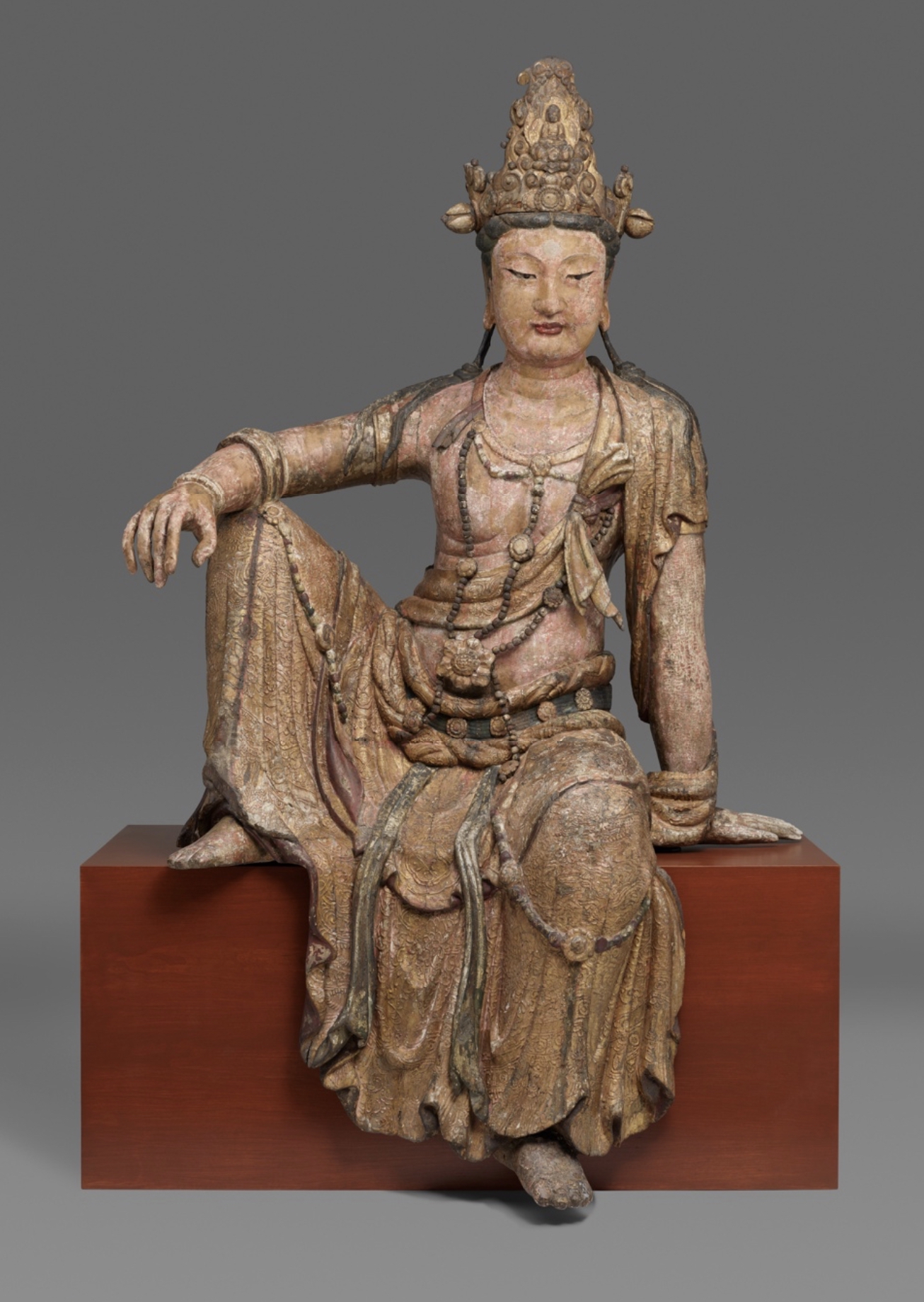
Plate note: “Seated Guanyin” (Bodhisattva of Compassion) Song dynasty (960-1279). The Art Institute of Chicago. IIIF Manifest: 9259. The International Image Interoperability Framework (IIIF) represents a set of open standards that enables rich access to digital media from libraries, archives, museums, and other cultural institutions around the world. Image reprinted on CPinMongolia.com under the CC0 Public Domain Designation where attribution is in accordance with standards based on ethical norms, such as those that apply to scholarship. Based on ethics and professional reputation, these norms are well articulated, widely held and self-policing. 6 January 2025. CPinMongolia.com
DISCUSSION
Did you know that during the Song dynasty (960-1279) this beloved (Chinese) Buddhist deity of Compassion was originally perceived (in socio-cultural terms) as a male or gender-neutral entity before being progressively re-imagined and re-constructed as the female figure with which we associate (Chinese) Guanyin today? So interesting ….
Guanyin or Guanshiyin (literally, Perceiving the Sounds of the World) is the Chinese name for Avalokiteshvara, Bodhisattva of Compassion, one of the most beloved of Chinese Buddhist deities. He can be identified by the small figure of Amituo (Amitabha), Buddha of the Western Paradise, in his headdress.
Guanyin is seated in the pose of “royal ease,” with one leg hanging down while the right arm rests on the knee of the raised leg. This posture originated in Indian sculpture and became popular in China during the Song dynasty, presenting a figure who is both majestic and approachable, reflecting a new humanistic style characteristic of Song dynasty (960–1279) sculpture.
The Paulownia wood carving was originally painted with intricately patterned robes and traces of color are still visible on his back. Later, probably during the Ming dynasty (1368–1644), the wood was again covered but on this occasion entirely with gold.*
____________________________
FURTHER READING (Guanyin)
A curatorial investigation under years of grime revealed how the appearance of this statue of the popular Chinese Buddhist deity changed to suit the needs of devotees and secular viewers over the centuries. For an online and interactive educational feature about the Seated Guanyin, go to: The Look of Compassion: Uncovering the Many Faces of Guanyin
*Edited extract from: Seated Quanyin Accessed: 5 January 2025.
For a consideration of how stability and instability manifest in, and have shaped this artwork, the narratives told about it, and how it has been presented from a professional curatorial perspective see: Seeking Balance: Material and Meaning in a Polychrome Guanyin
Please note: that the above research articles are both authoritative digital publications AND accessible online in the public domain.
_______________________________
A Personal Note
Whilst I make no claim to being a specialist in this field, and use the latest digital technologies to express my own creativity, I have long been drawn to studying earlier Buddhist art represented in human form, a practice I was first introduced to years ago by an art historian friend who was at that time CIO for the National Gallery of Australia in Canberra. For the following decade, he opened my eyes to the artistic expression of Buddhist philosophy through gallery visits, curatorial essays and other publications, the usual scholarly way. For this informed and learned introduction, I will forever be grateful.
After meeting Zava Damdin (b.1976) in 2004 my studies on this trajectory continued. Initially this was through viewing and receiving explanatory introductions from him about the works in his collection, and also through visiting local datsans (cf. temples) and other Mongolian Buddhist households with one of his appointees during my annual visits to Mongolia between 2005 and 2019.
These days we continue to work together online. He’s so busy, I’m so grateful … I receive [an unannounced] visual image of a work of fine Buddhist art along with an introductory voice message from Rinpoche. The specific points made in such a voice message are my cue to further my own studies, in so doing, adding to what I already (think) I know. What I do (or not do) with such a welcomed, generous and open invitation is, as always, up to me …
______________________
FURTHER READING
Alongside this Artscape’s study of compassion through the Song dynasty Quanyin, Mongolian Poetry 11: Legendary Beings offers a poetic perspective on warm-hearted qualities, anticipation and humility in representations of sacred beings.
Carrying the theme of maternal protection into contemporary Mongolia, Letter from Mongolia 19: Udgan Tenger considers lineage, ancestral presence and the maternal dimensions of another living cultural and ritual form.
For a wider methodological context, Letter from Mongolia 18: a deliberately interdisciplinary practice considers how different forms of knowledge can be brought together when interpreting and writing about Mongolian cultural difference.
End of transcript.
Refer to the INDEX for other articles that may be of interest.

|
© 2013-2026. CP in Mongolia. “Artscape 10: the look of compassion: seated Quanyin” This post is licensed under the Creative Commons Attribution 4.0 International License. Open access should not be understood as the absence of attribution. Documents linked from this page may be subject to other restrictions. Posted: 6 January 2025. Last updated: 28 September 2026. |