A translation of a devotional poem by the Mongolian scholar-poet Zava Damdin (b. 1976).
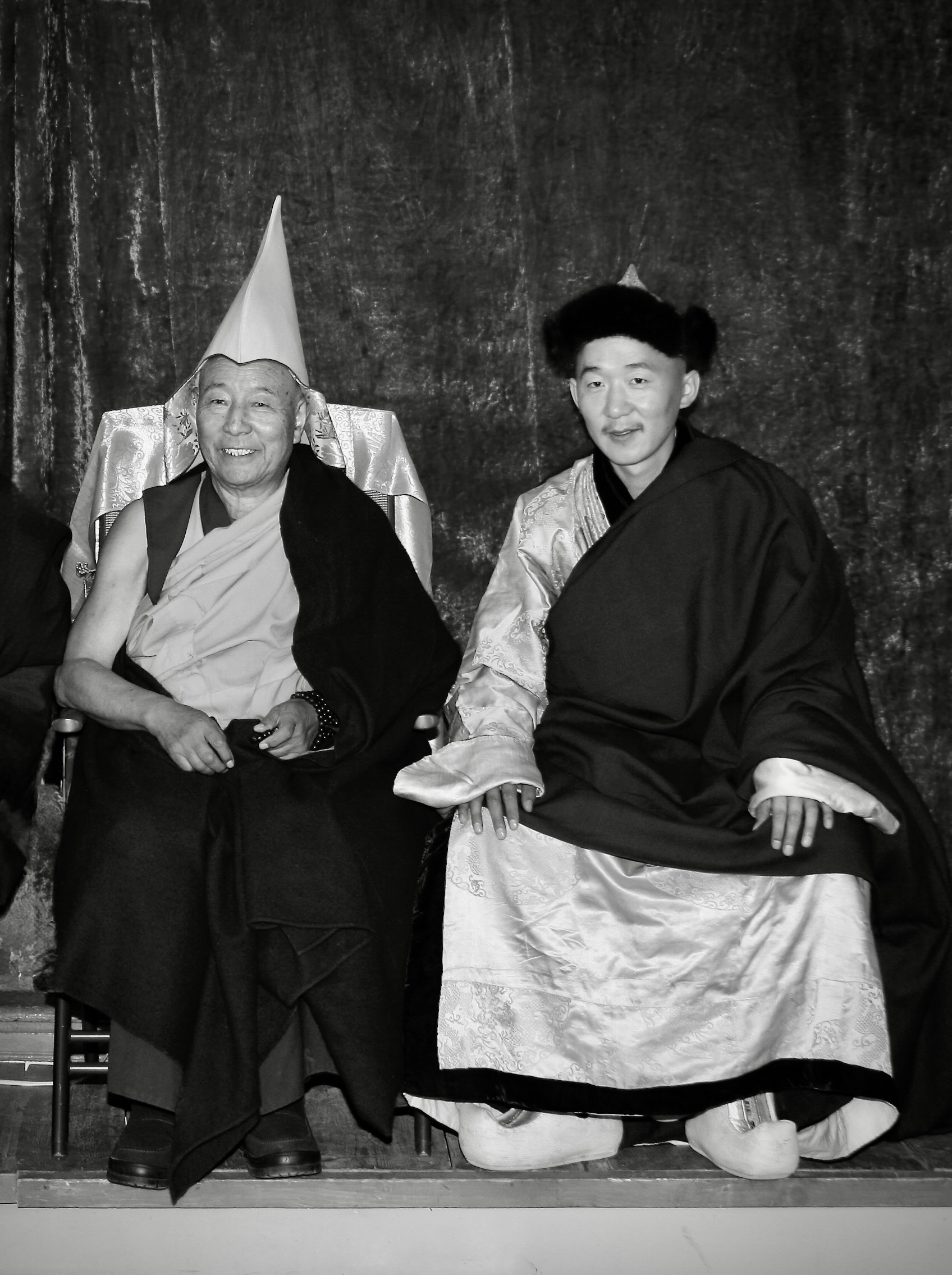
Plate note: Lharampa Geshe Lobsang Dayang Thubten Trinley (left) and Zava Damdin Luvsangdarjaa (right) during a visit to Dornogovi Aimag in South Eastern Mongolia. 17 September 2005. Photograph: C. Pleteshner.
_______________________________
VENERABLE BOGD ABIDES COOL AND CLEAR
(English Translation)
My Venerable Bogd, some days, abides in his revered body within the air of Dharma
My breast-heart grieves and mourns, remembering, yearning, my breath grows constricted
My Venerable Bogd, some days, arrives and lingers before me
Blessing and bestowing his singular, gracious Dharma-teachings, my mind settles, balanced and peaceful
Within the turning of time, within the apparitions of impermanence
Like lines of cranes in winged formation, arriving and departing, the cycle turns
If one cultivates boundless blessing through meditative practice, every wheel of immeasurable worlds
In the unobstructed air of emptiness, without coming, without going, abides as clear light
When your son, at times, truly suffers within the life of this turning world
You, garuḍa-king amid the vast assembly of humankind, remain, enveloping the sky like enormous clouds
Like a snake’s heart, shielding and cooling the anguished heat of conditioned existence
In the air of meditative guidance, again and again you remind me that no thing is truly real
If living compassion grows scarce, the path of true view becomes obscured and declines
If one does not meditate on the boundless expanses of the Great Seal, it becomes an obstacle to great bliss
If even one of the paired wings of heroic maturation and passage, method and wisdom, is harmed
Since the precious blessing of the Gracious Supreme Bogd may rust, do not hasten; ripen
Thus every day is the day of Venerable Bogd’s nirvāṇa
If not so, every day Venerable Bogd abides, cool and clear
The humble son, not submerged by appearances, inner or outer, clings to your soles
Having built his own raft-boat, he fares onward as a young voyager
The heart-son of the Venerable Bogds sang this.
13.06.2026
_______________________________
Translated by C.Pleteshner
English interpretation 17.06.2026 from the original Mongolian 13.06.2026
_______________________________
БОГД СЭРҮҮН ТУНГАЛАГ СААТАЖ БҮРҮҮН
(Original Mongolian)
Өвгөн Богд мину зарим өдөр номын агаар дор лагшин оршиж
Өр зүрх мину эмгэнэн гашуудаж санан санагалзаж амьсгал багтрамуй
Өвгөн Богд мину зарим өдөр өмнө мину залран саатаж
Өвөрмөц тааллын номоо соёрхон адислаж сэтгэл мину тэгш амгалан оршруун
Эргэх цаг хугацаа мөнх бусын үзэгдэл дор
Эгнэж жигүүрлэсэн тогоруун цуваа ирэхүй, буцахуй мэт орчиж
Энгүй увдисыг бясалгаваас цаглаш үгүй ертөнцийн хүрд бүхэн
Эвэршээл үгүй хоосон чанарын агаар дор ирэхүй үгүй, одохуй үгүй гэгээн гэрэл лүгээ ажруун
Хөвүүн нь заримдаа орчлонгийн амьдрал дор бодитойёо зовохуй дор
Хөвчин их хүмүүний хан гарьд та бээр аварга үүлс мэт огторгуйг бүрхэн ажраад
Хэмнэл харьцангуй энэлэлт халууныг могойн зүрхэн мэт халхлан сэрүүцүүлж
Хөтөлбөр бясалгалын агаар дор юмс бүхэн бодит үгүйг ахин дахин сануулруун
Аху нинжин сэтгэл хомсдовоос үнэн үзлийн мөр балран доройтмуй
Агуу Их мутрын хязгаар үгүй дардсыг үл бясалгаваас их амгалангийн түйтгэр буюу
Арвис баатарлаг боловсрон туулах арга, билгийн хос жигүүрийн нэг нь л гэмтэвээс
Ачит Дээд Богдын нандин увдис зэврэх учир үл түрдэн боловсруун
Тийн бөгөөс өдөр бүр Өвгөн Богдын нирваан болсон өдөр буюу
Эс бөгөөс өдөр бүр Өвгөн Богд сэрүүн тунгалаг саатаж бүрүүн
Өчүүхэн хөвгүүн ямарваа үзэгдэл дор үл живэн таны өлмийнөөс зүүгдэж
Өөрийн сал онгоцоо бүтээн залуу сартваахь болон аялан зорчруун
Өвгөн Богдсын зүрхний хөвүүн бээр дуулав
13.06.2026
_______________________________
NOTES
In this translation, I sought to preserve the doha’s formal devotional register as an ode to a beloved Teacher. I have kept the original lineation and retained key doctrinal terms where English paraphrase would have weakened the doha’s resonance. Difficult, culturally embedded images have been preserved rather than explained within the doha itself.
* * *
“Like a snake’s heart” preserves the Mongolian image могойн зүрхэн мэт. Although startling in English, the image is not arbitrary. From my reading, it likely draws on a wider Buddhist field of serpent, nāga, and dragon symbolism in which such beings are associated not only with danger, but also with water, cooling, hidden potency, protection, and guardianship. In the surrounding lines, the venerated Bogd shields and cools the orator’s suffering amid images of sky, clouds, heat, meditation, and insubstantial appearances. The phrase may therefore suggest the inward, living core of protective serpent-power: cool, hidden, alert, and sheltering.
* * *
In an Indo-Buddhist or Indic context, the phrase evokes the nāga rather than a merely zoological snake. Nāgas are serpent-beings associated with water, rain, subterranean treasure, fertility, protection, and volatile sacred power. The paradigmatic Buddhist image is Mucalinda, the nāga king who shelters the Buddha after awakening, coiling beneath him and spreading his hood above him during the storm. Read in this light, the comparison suggests not revulsion or menace, but the inner pulse of protective serpent-power. The word “heart” intensifies the image by shifting attention from the serpent’s outward form (hood, skin, coil) to its living centre: hidden, cool, alert, and sheltering.
* * *
In Chinese Buddhist contexts, Indic nāga imagery is often absorbed into the broader symbolism of the dragon 龍 (long). The dragon-serpent is associated with rain, clouds, rivers, hidden waters, cosmic vitality, and the protection of the Dharma. Buddhist dragon kings guard scriptures, command waters, and appear among the non-human beings who attend and protect Buddhist teaching. Against this background, “like a snake’s heart” may suggest not a literal animal comparison alone, but the hidden, cooling potency within the dragon-serpent body. This resonance is strengthened by the surrounding imagery of sky, clouds, heat, and cooling: the venerated Bogd covers the sky “like enormous clouds” and relieves the “anguished heat” of conditioned experience. The image also produces a striking symbolic tension. The venerated Bogd is compared to a king-garuḍa, traditionally the enemy of nāgas, yet he cools “like a snake’s heart.” In such a devotional Buddhist setting, predator and serpent, sky and water, heat and coolness are reconciled in awakened compassion.
* * *
In Japanese Buddhist contexts, serpent and dragon imagery inherits both Indic nāga traditions and Chinese dragon symbolism. Nāgas become associated with ryū 龍, dragon kings, rain-making, water deities, and the protection of Buddhist places. Japanese religious imagery also links serpents with water, fertility, hidden treasure, caves, ponds, jewels, and deities such as Benzaiten, whose iconography often includes serpent or dragon associations. Against this background, “like a snake’s heart” may evoke the cool, hidden, living centre of a water-serpent or dragon power: not outward majesty, but inward potency, silently protecting the practitioner from the heat of delusive suffering. In this cultural context, the image may suggest sacred water-energy, coiled protection, and concealed blessing rather than a merely zoological snake.
_______________________________
Notes on key choices
“Cool and clear” keeps сэрүүн тунгалаг literal. The phrase gathers the poem’s imagery of air, cooling, sky, meditation, and clear light, so I avoided paraphrases such as “alive and lucid” or “serenely present,” though those meanings hover nearby.
“Breast-heart” is deliberately unusual. Өр зүрх carries both bodily and emotional force, and my translation preference is to preserve bodily-spiritual imagery where it is active rather than dissolve it into abstract feeling.
“Dharma,” “nirvāṇa,” “garuḍa,” and “Great Seal” are retained because translating them fully would flatten doctrinal and devotional resonance. I used “Great Seal” for Их мутар, with the Sanskrit/Tibetan doctrinal equivalent Mahāmudrā implicit. In the Mongolian Gelug context, such contemplative terminology belongs to a learned Buddhist vocabulary shaped by scholastic, devotional, and practice traditions (cf. Kollmar-Paulenz 2018).
“Raft-boat” renders сал онгоц, holding both the fragile vehicle and the broader journeying image. “Young voyager” for залуу сартваахь is tentative; depending on the intended nuance, it may also suggest a young boatman or ferryman.
_______________________________
A Song of Devotion / Бишрэлийн дуулал
(Literary perspective)
From what I can work out, stylistically, this doha is marked by Zava Damdin’s characteristically expansive syntax, in which long devotional sentences unfold through parallel clauses, conditional turns, and cumulative images rather than through compact aphorism. Its movement is wave-like: grief gives way to visionary presence, cyclic time opens into clear light, suffering is cooled by the Teacher’s blessing, and doctrinal reflection returns to filial devotion. Also, the diction combines elevated Buddhist vocabulary with intimate address, allowing philosophical terms to remain embedded in feeling rather than becoming abstract exposition. Repetition such as “some days,” “every day,” “again and again”, gives the poem a liturgical cadence, while images of air, cranes, clouds, cooling, and the raft-boat create a continuous atmosphere of movement, protection, and passage.
Glossary
Expansive syntax: Long, unfolding sentence structure built through linked clauses and accumulating images.
Parallel clauses: Phrases or lines built in similar grammatical shapes, so that one movement of thought echoes and strengthens another. Example: “My Venerable Bogd, some days…” / “My Venerable Bogd, some days…”. The repeated opening creates a balanced devotional movement between absence and presence.
Conditional turns: Moments shaped by “if,” “thus,” or “if not so,” where the doha turns from one contemplative possibility to another. Example: “Thus every day is the day the Venerable Bogd entered nirvāṇa / If not so, every day the Venerable Bogd abides, cool and clear”. The doha turns between the Teacher’s nirvāṇa and his continuing presence.
Cumulative images: Images that gather force gradually, each one adding to the atmosphere or meaning of the previous ones. Example: “air,” “cranes,” “clouds,” “snake’s heart,” and “raft-boat”. These images accumulate into an atmosphere of spaciousness, protection, cooling, and passage.
Compact aphorism: A brief, self-contained saying that compresses an insight into a sharp, memorable form. Here, Zava Damdin works less through such compression than through unfolding devotional movement. Example: instead of stating simply “all things are impermanent,” the doha unfolds impermanence through the image: “Like lines of cranes in winged formation, arriving and departing, the cycle turns.”
Liturgical cadence: A rhythm of language that feels shaped by prayer, chant, ritual recitation, or repeated devotional address. It does not necessarily mean the doha is a formal liturgy; rather, the phrasing moves with a solemn, repeated, prayer-like rhythm. Example: “My Venerable Bogd, some days…” / “My Venerable Bogd, some days…” and “Thus every day…” / “If not so, every day…”. These repeated openings give the doha a ritual, chant-like movement, as though grief, remembrance, and devotion are being voiced again and again before the Teacher.
_______________________________
Translation is always an interpretation into another language and culture. Any errors in this regard are entirely my own, and for these I humbly apologise
_______________________________
FURTHER READING
Baldick, Chris. The Oxford Dictionary of Literary Terms. 4th ed. Oxford: Oxford University Press, 2015.
Kollmar-Paulenz, K. (2018). History Writing and the Making of Mongolian Buddhism. Archiv für Religionsgeschichte, 20(1), 97–122.
End of transcript.
Please refer to the INDEX for other poems and articles that may be of interest.

|
© 2013-2026. CP in Mongolia. “Mongolian Poetry 51: Venerable Bogd Abides Cool and Clear” is licensed under the Creative Commons Attribution 4.0 International License. Documents linked from this page may be subject to other restrictions. Posted: 18 June 2026. Last updated: 1 August 2026. |