A poem by the Mongolian Buddhist scholar Zava Damdin Rinpoche (b. 1976). This is a long read, so settle in. Let your imagination travel a little, and take your time.
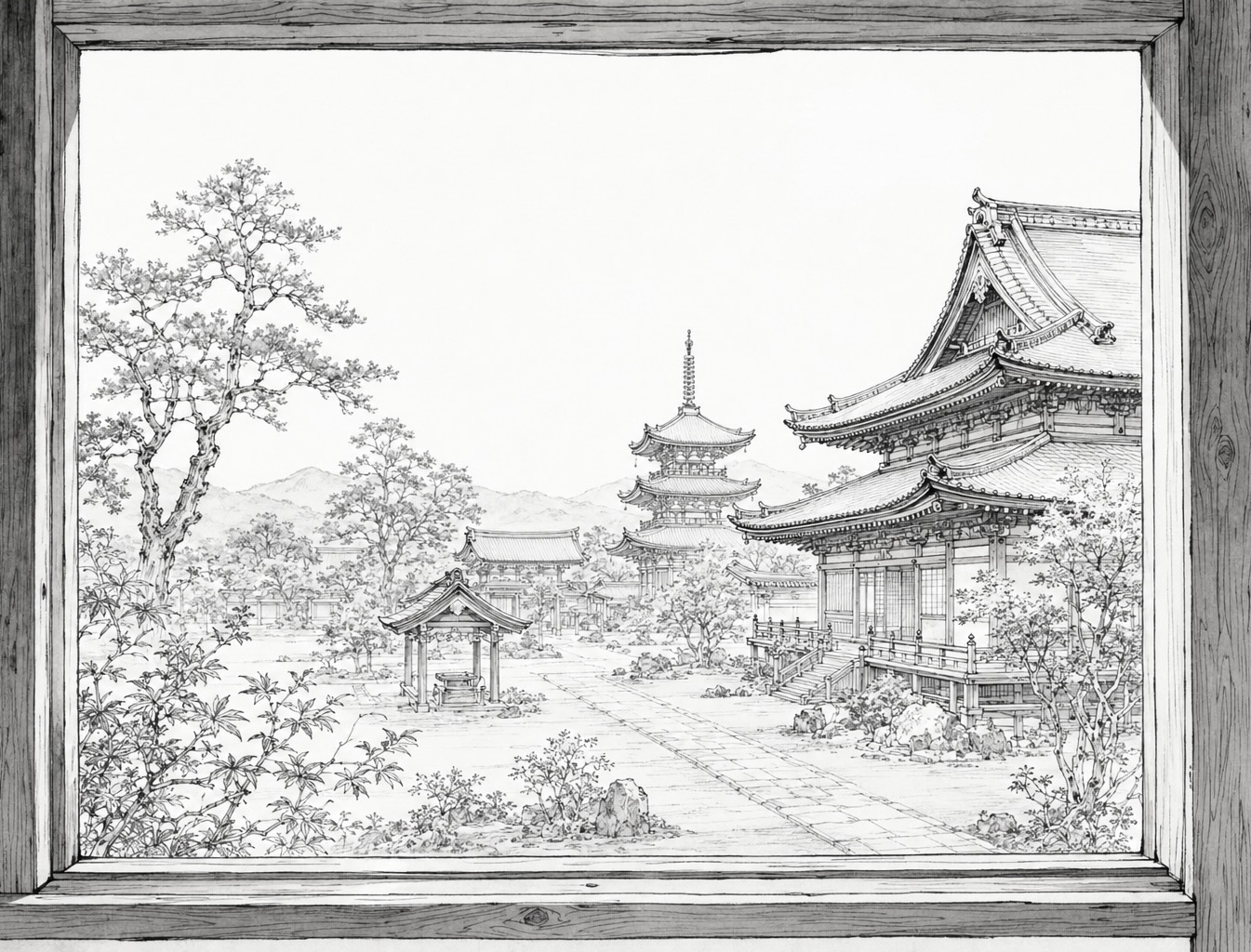
This pen-and-ink illustration, suggestive of a Japanese monastic precinct, was composed through text-guided image synthesis following human instruction. It is not based on a photograph of an actual place. It is another example of using these new drawing tools. I’m still thinking through how such images might sit on a page alongside Zava Damdin Rinpoche’s beautiful poetry. With this in mind, please accept the illustration not as an interpretation of the poem as a whole, but as an image inspired by one of its lines. C. Pleteshner, 25 June 2026.
_______________________________
WHERE IS THE ENEMY WE FEAR?
(English Translation)
Beyond the vast eastern quarter
On the coral of the great Pacific, where the sun rises
Upon one harmonious great island
Among one hundred and twenty-three million
People dwelling there from ancient times
As I was sitting where the centres of eleven monasteries meet*
One evening, drawing a breeze through the kanji window*
My little bird-friend with perfectly translucent eyes
Spread its wings wide in beauty and came down, saying this:
Ah, my fine singing boy*
Are you dwelling peacefully in this island land?
I came because I missed you from my living heart
There are a few things I wish to ask and sing with you
At this, I rejoiced until my eyelashes grew moist
And, sitting with ears pricked like a perceptive deer, I replied:
In the cuckoo moon* I dreamed and dreamed of you and missed you
Gazing and gazing into the blue lapis sky, I missed you
Among the hills in flower, meditating and meditating, I missed you
At this, the bird was gladdened and said:
This time, my fine singing boy, what I ask of you is this:
What degrees of enemy are there, and where are they to be found?
Speak without concealment, the bird said, and so I answered
Joining the teaching of the Bogds* with my own thought and meditation
If one weighs it very well and looks closely, it may be said
There are three kinds of enemy: external, internal and secret
And also one further enemy that obstructs the deepest truth
With any companion in wrongdoing, there is no far or near
Those who, out of petty envy and resentment, stand in the way
Those who wear the Dharma’s face but have let their noble vows and discipline fall away
They may be found among friends who seem close, beloved kin, and those held in familial closeness
Above all, one’s own carelessness along the way, and the ways of self-deception —
These too must always be recognised among the external enemies
The internal enemy is ignorance, anger, desire, pride, jealousy, and the rest
From the five root-stocks of decline and the shoots of a poisoned mind
There are ten thousand enemies branching out in bristling ranks
If one can bridle the leader of those herds, the bull without a bridle
There is a way by which the great herd of eighty-four thousand may be led*
The secret enemy is what is always stalking and creeping within oneself
Like hidden watchers and spies, always poisoning through the harm of Māra
The ghostlike, ungraspable conception that clings to the innate “I”
I have recognised that the greatest butcher and torturer was inside me
Its remedy is to meditate again and again that no self can be found
The further enemy is what lies in the depths of my heart
Always secret of secrets, hidden of hidden, utterly silent
That distorted mind is the great enemy, unequalled in this world, binding us fast
So I, the least and smallest one, sometimes fondly remember, even in dreams,
The oral teaching of my ever-accomodating, gentle Bogd teacher,
Who reached the far shore of the profound and vast Dharma
Meditate on emptiness,* the true view, the powerful antidote
Limited as I am, I have merely recognised the enemy
And though the whole war is far from subdued
I am learning to calm the great turmoil as it rises
If one fears, one should fear the second and third enemies the most
If those two and the ultimate enemy can be subdued
The external enemy that kindles the fire of conflict, can be fully subdued
This is a precious thing to remember, in the way of the skilful sages
When I had said this
The gentle bird, who had been listening with its breast-heart held still in attentive concern,
For a few moments seemed to abide in samadhi*
Then, calmly raising its head and smoothing its feathers, it said
Ah, noble son, your answer is complete with richly layered ornament
Small and playful as I am, I have worried over you
At times I have feared and shrunk back thinking
Some enemy bearing malice might harm you, why hide it?
Ah but if you have recognised these enemies
And are putting the needed remedies into practice
The trembling of my breast-heart has grown less, the bird said
At this, palms together, I replied
Dear little bird, you came down in season
And awakened and tended this handful of a heart still more
You have kindled courage to subdue the twisted enemy
Always seek me out, whenever you wish, I said
My unwavering little bird rejoiced in delight
And flew away to circle the many temples, so perfect in form.
Zava Damdin Rinpoche
14.06.2026
_______________________________
Translated by C.Pleteshner
English interpretation 20.06.2026 from the original Mongolian 14.06.2026
_______________________________
АЮУХ ДАЙСАН ХАМИГАА БУЙ
(Original Mongolian)
Нармай их дорно зүгийн чинад дор
Наран ургах их Номхон далайн шүр болсон
Найралт нэгэн их арал дээр
Арван хоёр мянга, гурван зуун түмэн
Ард иргэдийн дунд эрт үеэс аху оршсон
Арван нэгэн хийдийн төв огтлолцол дор суух цаг дор
Нэгэн үдэш ханзны гэгээвчээр салхи татуулан
Нэвт гэрэлтэх мэлмий төгөлдөр шувуухай анд мину
Нэлийтэл далавчаа үзэсгэлэнтэй еэ дэлгэн бууж ирээд ийн
Ай сайхан дуулалч хөвгүүн мину
Арлын энэхүү орноо амар ажаан суумуй заа
Амин зүрхнээс чамайгаа санаад ирэв
Асуун дуулалдах хэдэн зүйл буй хэмээсэн дор
Би бээр аньсага чийгттэл баясаад
Билигт гөрөөсөн мэт сортоо лугаа суугаад ийн өчрүүн
Хөхөө сар дор чамайг зүүдлэн зүүдлэн санав
Хөхүмдэг номин тэнгэрийг ширтэн ширтэн санав
Цэцэгт толгодын дунд бясалган бясалган санав
Хэмээсэн дор тэр бээр машид баясаад ийн
Энэ удаа дуулалч хөвгүүн чамаас асуух ану
Дайсан хэмээх ямар зэрэг буй, басхүү хамигаа буй
Далдлал үгүй айлдан ажаамуу хэмээсэн дор ийн
Тэгүүн дор Богдсын номыг өөрийн бясалгал, бодрол лугаа нийлүүлж
Тэнсэж сайтар үзвээс өгүүлж болох бөгөөд
Тэрс дайсан дор гадаад, дотоод, нууц гурав болоод
Янагуухь дайсан ану үнэмлэхүй дор тотгордох бас нэгэн зүйл буй яа
Ямарваа нүглийн садан болбаас хол, ойр хэмээх үгүй
Ядмаг атаа хорслоор бодь мөрийн зэрэг дор шуудаар тотгордогчид буюу
Ялгуун тангараг санваараа алдсан номын дүртэн нүгүүд хийгээд
Янаг дүрт нөхөд, амраг садан, ах дүү хамигаа дотор буй ба
Ялангуяа өөрийн явдал мөр хуумгайдаж өөрийгөө хуурах тэргүүтэн
Ямагт танин барихуй гадаад дайсан ану мөн бөлгөө
Дотоод дайсан ану мунхаг, урин, тачаал, омог, атаархал сэлт
Доройтлын таван уг язгуур тэргүүтэй хорт сэтгэлийн найлзуураас
Дорсойн салбарласан үй түмэн дайсан буй бөгөөд
Дөр үгүй бух мэт тэдгээр сүргийн манлайг нь дөрлөж авбаас
Найман түм дөрвөн мянган их сүргийг залж чадах мөр буй аж
Нууц дайсан ану болбаас өөрийн дотор үргэлж гэтэн мярааж
Нуугдмал тандуул туршуул мэт шимнугийн хорлолоор үргэлж хордуулж байдаг
Нутад барьсан “би” хэмээх хий үзэгдэл мэт баригдах үгүй үзэл баримтлал аж
Хамгийн том яргачин тамлагч бээр дотор мину байсныг олж танив
Тэгүүний ерөндөг инү болбаас бодгалийн би үгүйг цаг ямагт бясалгах аж
Янагуухь дайсан ану болбаас зүрхний гүн дор минь байж
Ямагт л нууцын нууц, далдын далд, чив чимээгүй оршдог
Ямарваа юмс үзэгдэл бүхнийг үнэхээр бүтсэн бодит дор үзэгч
Тийн атгаг сэтгэл бөгөөс ертөнц дахин дор тэргүүлш үгүй цаг дор хүлэгч
Агуу их дайсан мөн хэмээн гүн хийгээд дэлгэр номын чинад дор хүрсэн
Агуужим дөлгөөн Богд багшийн аман айлдварыг заримдаа
Адаг өчүүхэн би зүүдэндээ хүртэл ээнэгшин санаж
Ачир ерөндөг үнэн үзэл болохуй хоосон чанарыг бясалгамуй яа
Өчүүхэн би дайсныг танин барьсан төдий бөгөөд
Өвч дайнаа дарахуй ану өдий төдий боловч
Өрнөлт их түйтгэрийг намжаан явж буй
Аюуваас хоёр, гурав дугаар дайснаас нэн аюух хэрэгтэй
Тэдгээр хоёр хийгээд үнэмлэхүй дайсныг дарж чадваас
Тэмцлийн гал асаан бүхүй гадаад дайсныг нам дарж чадмуй хэмээх
Арвис хурц мэргэдийн аху ёсон дор дурдал чухаг ажээ хэмээвээс
Аюулхай зүрхээ даран сонордож агсан амармаг шувуухай бээр
Агшин хэдэн зуур самади дор орших мэт болоод
Амарлингуй тэргүүнээ өргөж, өд сөдөө засаад ийн
Аяа, язгууртны хөвгүүнээ хариулт чину давхар чимэг лүгээ бүрүүн
Алиахан би чинь чам дор санаа зовинож,
Атаат дайсан хорлох буюу хэмээн зарим үе
Аюун гирвэшиж байдгаа нуух юун билээ л
Ай, тэгтэл чи бээр дайсан нугуудыг танин барьж
Алимад ерөндөг нүгүүдийг үйлдэн буй аваас
Аюулхай зүрх мину түгших инү багасчухуй хэмээсэн дор
Алга бээн хамтатган би бээр ийн өчрүүн
Амрагхан шувуухай чи мину бээр цаг лугаа бууж
Атгахан зүрхийг мину улам сэрээн додомдож
Атгаг дайсныг дарах урам зоригийг бадраажухуй
Хэзээд л чи мину намайг зорин ирээрэй хэмээсэн дор
Хэлбэрэл үгүй шувуухай мину таалан баясаад
Хэв төгөлдөр олон сүмийг эргэхээр нисэн одвай
Зава Дамдин Ринбүчи
14.06.2026
_______________________________
NOTES
“As I was sitting where the centres of eleven monasteries meet” (Арван нэгэн хийдийн төв огтлолцол дор суух цаг дор). This line was difficult to pin down. Although the doha’s cultural framing, and the image I have chosen to accompany it, both echo Japan, the phrase “where the centres of eleven monasteries meet” does not seem to refer simply to a present location there. Rather, it may glance towards the historical layout of Nalanda Mahavihara, the ancient Buddhist university in Bihar, India. Zava Rinpoche’s dohas often move across more than one “geography” at once: lived place, remembered place, sacred place, and inner place. Here, the line seems to allow those coordinates to overlap.
Kanji window, Ханзны гэгээвч (khanzny gegeevch), kept close to the Mongolian rather than flattened into simply “window.” In this Japanese setting, ханз (khanz) points to kanji, the Chinese characters used in Japanese writing. More broadly, the same character tradition appears across East Asia under different names and histories: hanzi in China, kanji in Japan, hanja in Korea, and chữ Hán in Vietnam. From this window, the speaker looks out toward сүм хийдүүд (süm khiidüüd) — temples and monastic buildings — so the image joins writing, seeing, and sacred architecture. The phrase may seem slightly strange in Mongolian, and I have allowed it to remain slightly strange in English.
Singer, Дуулалч хөвгүүн (duulalch khövguun), literally “singing boy” or “boy of song.” Here, it refers to Zava Damdin (b. 1976) as the singer of dohas: songs that weave together his own reflections with instruction, narrative, poetic expression, and nomadic sensibilities.
In the cuckoo moon, Хөхөө сар (khökhöö sar), a Mongolian poetic expression for early summer. In this Japanese setting, it also evokes the cuckoo (hototogisu), long associated with the arrival of the season.
Bogds, Богд (Bogd), an honorific for highly respected Buddhist teachers or incarnate prelates. In this poem, Bogds is left untranslated: it does not mean “gods”, but authoritative and revered teachers.
Eighty-four thousand, Найман түм дөрвөн мянга (naiman tüm dörvön myanga), a well-known Buddhist number suggesting the vast range of human afflictions and the teachings that address them. Here, it also echoes the poem’s herd imagery, giving the number both poetic and Buddhist significance.
Emptiness, Хоосон чанар (khooson chanar), in a Buddhist context refers to the understanding that people and things do not exist in a fixed, independent way. Instead, they arise through causes, conditions, relationships, and perception.
Samadhi, Самади (samadi), a state of deep meditative stillness or collected attention.
_______________________________
Translation of Buddhist poetry (doha) is always an interpretation into another culture. Any errors in this regard are entirely my own, and for these I humbly apologise. We each enter a poem such as this from our own perspective, and therefore in different ways.
_______________________________
End of transcript.
Please refer to the INDEX for other poems and articles that may be of interest.
© 2013-2026. CP in Mongolia. “Mongolian Poetry 56: Where is the Enemy We Fear?” is licensed under the Creative Commons Attribution 4.0 International License. Documents linked from this page may be subject to other restrictions. Posted: 25 June 2026. Last updated: 25 June 2026.