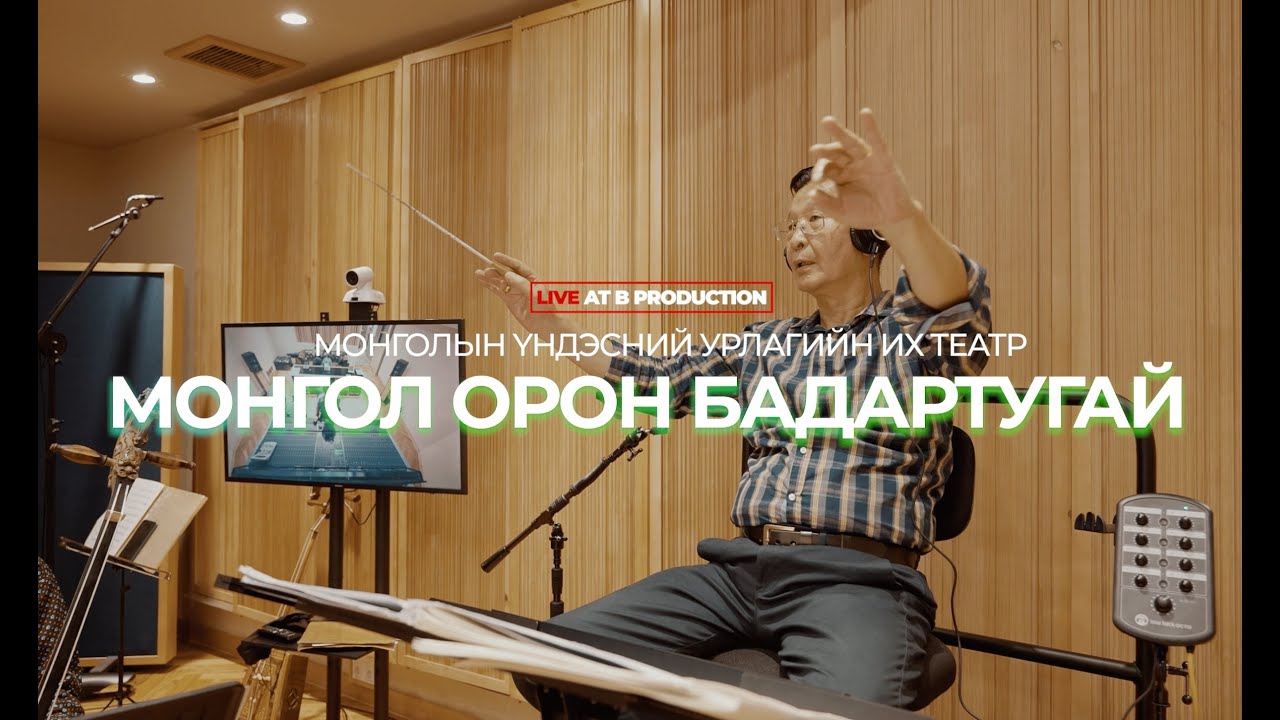
While I was in Mongolia last year, another interesting change I noticed was the clear generational changeover in some of the country’s elite musical ensembles, with a new wave of highly trained younger performers stepping confidently into the spotlight (see notes). To illustrate this change, I’ve selected the following video of a live recording session at the state-of-the-recording-art B Production Studio in Ulaanbaatar, featuring “Mongol Oron Badartugai” (“Монгол орон бадартугай”), which translates as “May Mongolia flourish,” an orchestral composition by my favourite Mongolian composer, B. Sharav.
If you’ve never seen Mongolian orchestral instruments up close, never heard Mongolian orchestral music, need something energising to put spring in your step, or you’re an aspiring musician looking for inspiration from young professional musicians honing their craft (so much practice, such tight unanimity in the attacks and releases!), then this video is for you. Ritardandi and accelerandi are beautifully calibrated, with rock-solid ensemble through every transition, just listen and watch for yourselves…
_______________________
________________________
Notes
The Mongolian Grand National Orchestra (MGNO) is a prestigious ensemble that serves as the premier traditional music group of the Mongolian Grand Theatre of National Arts. In terms of instrumentation, the ensemble consists of nearly 80 musicians playing traditional Mongolian instruments, including:
-
- Morin Huur: The iconic “horse-head lute”
- Ikh Huur: The grand lute
- Yatga: A traditional zither or harp
- Yochin: A hammered dulcimer made of hardwood, ideal for fast-paced melodies
- Other instruments include the huuchir (two-stringed instrument), shudraga (three-stringed lute), flutes, drums, and cymbals.
In terms of repertoire, MGNO performances blend ancient palace music, melodies dating back to the 8th century, and modern compositions by famous Mongolian and international artists. It is also known for accompanying Khoomei (throat singing) and Urtiin duu (long songs). The orchestra frequently performs for state celebrations and national diplomatic events in Mongolia and internationally.
“Changeover”
We can ground the “changeover” idea in scholarship on Mongolian music institutions more broadly, rather than this one orchestra. Across the late-socialist and post-socialist periods, researchers describe a shift in how musical authority and expertise are reproduced: earlier generations were often formed inside state ensembles and socialist cultural infrastructure, while newer cohorts increasingly come through conservatory-style pipelines (notably the State Conservatory) and circulate across a wider mix of institutions, projects, and markets (Yoon 2011, 82–105; Hutchins 2020, 1–3).
In this picture, generational turnover isn’t just “older players retire, young players replace them,” but a change in training ecology (institutional schooling, standardized technique, repertoire systems) and career ecology (ensembles, freelancing, heritage circuits, popular music, and new professional expectations) that reshapes what counts as mastery and how traditions are transmitted (Yoon 2011, 175–238; Tsetsentsolmon 2015, 118–140; Hutchins 2020, 1–3; Badamsuren et al. 2022). Scholars also note moments when institutions or ensembles step in to support transmission when older pedagogical lineages become less accessible, which is another way “seat changeovers” become visible at the institutional level (Hutchins 2020, 1–3).
In the Mongolian Grand National Orchestra, the “changeover” from senior to younger players can be described most responsibly as part of a wider, post-socialist reconfiguration of Mongolian musical institutions: as veteran musicians—many shaped by socialist-era ensemble systems and their rehearsal cultures—retire, younger performers increasingly arrive through conservatory-style training pipelines and step into established chairs with strong technical standardisation and broader stylistic exposure (Yoon 2011, 82–105; Hutchins 2020, 1–3).
It seems that what is happening is less of a rupture than a careful rebalancing: institutions and ensembles become the main sites where intergenerational transmission is stabilised, so an orchestra’s continuity depends on how well inherited ensemble sound, etiquette, and repertoire practice are passed on inside the institution even as the professional ecology around it grows more diverse and market-oriented (Hutchins 2020, 1–3; Tsetsentsolmon 2015, 118–140; Badamsuren et al. 2022).
Further Reading
Badamsuren, B., O. Chuluunbaatar, A. Colwell, J. Curtet, et al. 2022. Mongolian Sound Worlds.
Cook, H. 2022. Changes in Identity: How Mongolian Musicians and Performers Have Responded to Geopolitical Transition. Independent Study Project paper, School for International Training.
Hutchins, K. G. 2020. “The Melodious Hoofbeat: Ungulate Rhythms in the Post-Socialist Conservatory.” Inner Asia 22 (2): 217–243.
Tsetsentsolmon, Baatarnaran. 2015. “Music in Cultural Construction: Nationalisation, Popularisation and Commercialisation of Mongolian Music.” Inner Asia 17 (1): 118–140.
Yoon, S. 2011. Chasing the Singers: The Transition of Long-Song (Urtyn Duu) in Post-Socialist Mongolia. PhD diss., University of Maryland.
Refer to the INDEX for other music and articles that may be of interest.
End of transcript.
© 2013-2026. CP in Mongolia. “Soundscape 14: Changeover” is licensed under the Creative Commons Attribution 4.0 International License. Music and documents linked from this page may be subject to other restrictions. Posted: 28 February 2026. Last updated: 28 February 2026.