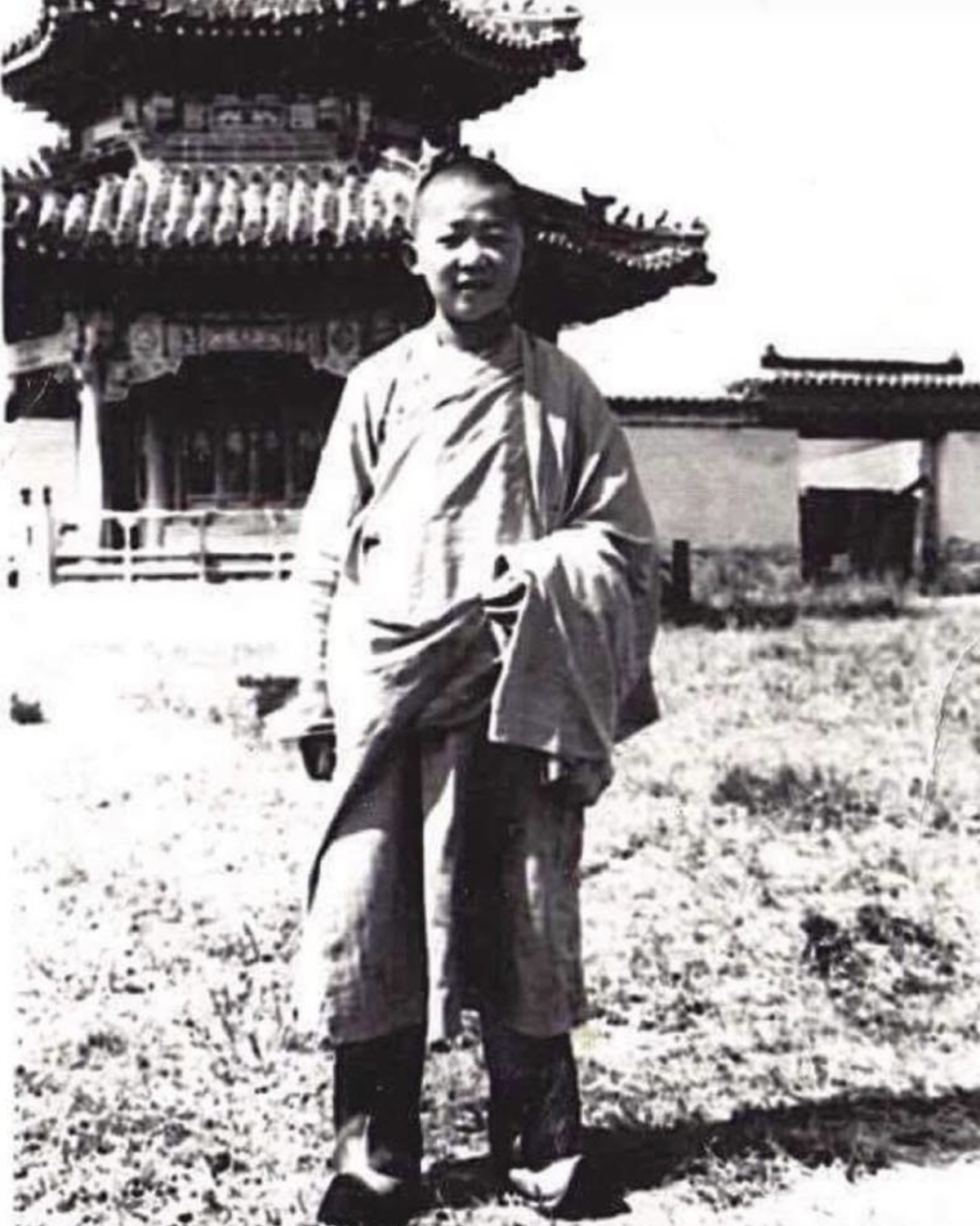
Zava Damdin Luvsandarjaa (b. 1976), pictured here as a young lama, standing in front of one of the smaller temples of Amarbayasgalant Monastery (Амарбаясгалант хийд), a Gelugpa monastery in the Iven Valley, Selenge Aimag, northern Mongolia, where he lived and studied with his younger brother, Dugarjav Bilguun, and later taught before relocating to his seat at Delgeruun Choira in the Gobi. At the time of the photograph, the temples and the vast precinct were still awaiting restoration. Built between 1727 and 1736, the monastery complex was dedicated to Öndör Gegeen Zanabazar (1635–1723), the first Bogd and Buddhist leader of Mongolia, who also founded the Mongolian school of religious art. Laid out symmetrically, with buildings arranged successively along a north–south axis, the complex displays a strong stylistic unity. Its dominant architectural style is Chinese, with some Mongolian influence. Amarbayasgalant was one of the few Mongolian monasteries to partially survive the Stalinist purges of 1937. Although buildings beyond the central section were destroyed, 28 original buildings in the central complex remained. Restoration began in 1988 with support from Mongolian’s famous prelate Lobsang Tenzin Gyatso Pal Sangpo, Guru Deva Rinpoche (1908–2009), and UNESCO. Photograph date unknown. Courtesy of our friend Naran Davaa. Accessed 5 July 2026. Reprinted with permission of the Zava Damdin Sutra and Scripture Institute of Mongolia.

Zava Damdin Luvsandarjaa (b. 1976), pictured here as a young lama, standing in front of one of the smaller temples of Amarbayasgalant Monastery (Амарбаясгалант хийд), a Gelugpa monastery in the Iven Valley, Selenge Aimag, northern Mongolia, where he lived and studied with his younger brother, Dugarjav Bilguun, and later taught before relocating to his seat at Delgeruun Choira in the Gobi. At the time of the photograph, the temples and the vast precinct were still awaiting restoration. Built between 1727 and 1736, the monastery complex was dedicated to Öndör Gegeen Zanabazar (1635–1723), the first Bogd and Buddhist leader of Mongolia, who also founded the Mongolian school of religious art. Laid out symmetrically, with buildings arranged successively along a north–south axis, the complex displays a strong stylistic unity. Its dominant architectural style is Chinese, with some Mongolian influence. Amarbayasgalant was one of the few Mongolian monasteries to partially survive the Stalinist purges of 1937. Although buildings beyond the central section were destroyed, 28 original buildings in the central complex remained. Restoration began in 1988 with support from Mongolian’s famous prelate Lobsang Tenzin Gyatso Pal Sangpo, Guru Deva Rinpoche (1908–2009), and UNESCO. Photograph date unknown. Courtesy of our friend Naran Davaa. Accessed 5 July 2026. Reprinted with permission of the Zava Damdin Sutra and Scripture Institute of Mongolia.

Zava Damdin Luvsandarjaa (b. 1976), pictured here as a young lama, standing in front of one of the smaller temples of Amarbayasgalant Monastery (Амарбаясгалант хийд), a Gelugpa monastery in the Iven Valley, Selenge Aimag, northern Mongolia, where he lived and studied with his younger brother, Dugarjav Bilguun, and later taught before relocating to his seat at Delgeruun Choira in the Gobi. At the time of the photograph, the temples and the vast precinct were still awaiting restoration.

Built between 1727 and 1736, the monastery complex was dedicated to Öndör Gegeen Zanabazar (1635–1723), the first Bogd and Buddhist leader of Mongolia, who also founded the Mongolian school of religious art. Laid out symmetrically, with buildings arranged successively along a north–south axis, the complex displays a strong stylistic unity. Its dominant architectural style is Chinese, with some Mongolian influence.

Amarbayasgalant was one of the few Mongolian monasteries to partially survive the Stalinist purges of 1937. Although buildings beyond the central section were destroyed, 28 original buildings in the central complex remained. Restoration began in 1988 with support from Mongolian’s famous prelate Lobsang Tenzin Gyatso Pal Sangpo, Guru Deva Rinpoche (1908–2009), and UNESCO.

Photograph date unknown. Courtesy of our friend Naran Davaa. Accessed 5 July 2026. Reprinted with permission of the Zava Damdin Sutra and Scripture Institute of Mongolia.

Zava Damdin Luvsandarjaa (b. 1976), pictured here as a young lama, standing in front of one of the smaller temples of Amarbayasgalant Monastery (Амарбаясгалант хийд), a Gelugpa monastery in the Iven Valley, Selenge Aimag, northern Mongolia, where he lived and studied with his younger brother, Dugarjav Bilguun, and later taught before relocating to his seat at Delgeruun Choira in the Gobi. At the time of the photograph, the temples and the vast precinct were still awaiting restoration.

Built between 1727 and 1736, the monastery complex was dedicated to Öndör Gegeen Zanabazar (1635–1723), the first Bogd and Buddhist leader of Mongolia, who also founded the Mongolian school of religious art. Laid out symmetrically, with buildings arranged successively along a north–south axis, the complex displays a strong stylistic unity. Its dominant architectural style is Chinese, with some Mongolian influence.

Amarbayasgalant was one of the few Mongolian monasteries to partially survive the Stalinist purges of 1937. Although buildings beyond the central section were destroyed, 28 original buildings in the central complex remained. Restoration began in 1988 with support from Mongolian’s famous prelate Lobsang Tenzin Gyatso Pal Sangpo, Guru Deva Rinpoche (1908–2009), and UNESCO.

Photograph date unknown. Courtesy of our friend Naran Davaa. Accessed 5 July 2026. Reprinted with permission of the Zava Damdin Sutra and Scripture Institute of Mongolia.