This article opens a new series on Mongolian music for dance training, extending my exploration of sound across creative and cultural contexts.
________________________________________
________________________________________
NOTES
A. Everyday Life in Waltz Time
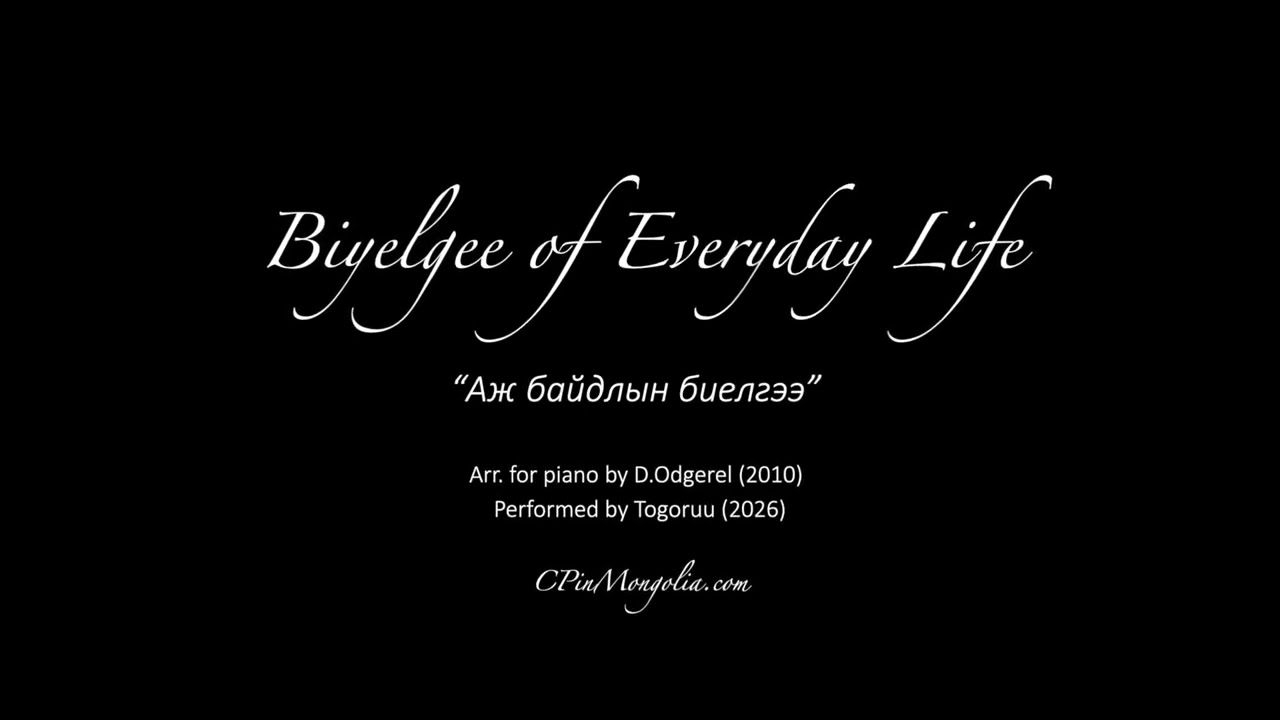
Аж байдлын биелгээ (Aj baidlyn biyelgee) literally means something like “biyelgee of everyday life” or “everyday-life biyelgee.” In this context, it is best understood as the title of a traditional-style dance piece depicting ordinary life or everyday activity within the biyelgee tradition.
Marked Вальс хэмнэлд (Vals khemneld), “in waltz rhythm” or “at a waltz tempo,” the piece is shaped by a triple-meter lilt, suggesting that the gestures and scenes of everyday life are here rendered with a gently stylised rhythmic grace.
________________________________________
B. Elements and characteristics of dance style
Mongolian folk dance draws on a movement vocabulary that includes walking, gliding, squatting, stamping, shaking, bending, turning, jumping, lifting, swaying, stretching, trembling, and sharply coordinated gesture. In practice, however, its distinctiveness lies less in isolated movements than in style itself: carriage, rhythmic weight, restraint, accent, and a recognisably Mongolian quality of motion shaped through disciplined training.
________________________________________
C. Biyelgee, Transmission and Heritage
However, Biyelgee (бий биелгээ) is not simply a generic Mongolian “dance style,” but a distinct traditional folk performance practice historically rooted in western Mongolia. Rather than large travelling movements, it is marked by controlled gestures of the upper body, shoulders, arms, wrists, torso, and facial expression, a feature often linked to its performance in the restricted interior space of the ger. In this sense, biyelgee is best understood as an embodied vernacular tradition shaped by domestic, pastoral, and communal life rather than as a purely theatrical genre (UNESCO 2009; Ichinkhorloo 2014).
The tradition is also strongly associated with the ethnic and regional diversity of western Mongolia, especially with Oirat-related and other western groups, including communities such as the Dörvöd, Bayad, Torguud, Zakhchin, and Uriankhai. It is therefore misleading to treat biyelgee as a primarily Khalkha form or as an undifferentiated “national dance.”
Different communities preserve distinct styles, repertoires, and gesture systems, many of which encode local lifeways, occupational practices, gendered roles, and modes of self-representation (UNESCO 2009; Tumursukh 2015; UNESCO 2022).
Biyelgee furthermore carries significance beyond dance alone: its movements often allude to herding, milking, riding, archery, craft, and household activity, making it a condensed expression of memory, locality, and social identity. Modern staged renditions have helped preserve and circulate the tradition, but scholars and heritage specialists stress that these should be distinguished from older community-based forms transmitted through family and regional practice. For that reason, бий биелгээ is most accurately described as a regional-ethnic performance tradition of western Mongolia, rather than merely a decorative subset of Mongolian choreography (Ichinkhorloo 2014; UNESCO 2009; Tserendulam and Burnand 2021).
________________________________________
D. The Piano Score
D. Odgerel, arr.,“Аж байдлын биелгээ” in Music for Mongolian Folk Dance Practice: A Practical Guide for the Rehearsal Pianist, by D. Odgerel (Ulaanbaatar, 2010) 63.
A rare pedagogical resource for piano accompaniment in Mongolian folk-dance training, this collection was prepared for use in the Department of Choreography at the Mongolian State University of Culture and Arts. Associated with D. Odgerel, a composer and former concertmaster teacher in the department, this volume emerged from the practical needs of studio teaching, especially the scarcity of suitable notated materials for rehearsal and classwork.
This terrific collection of piano arrangements brings together arranged traditional melodies, original practice pieces, and studio-oriented scores designed to align musical phrasing closely with choreographic training. Its value lies not simply in supplying accompaniment, but in supporting the transmission of rhythm, phrasing, style, and movement quality within the formal teaching of Mongolian folk dance. As such, it stands as an important practical and pedagogical contribution to the development of accompaniment materials for Mongolian dance instruction.
________________________________________
Further Reading
Blanchier, Raphaël. 2024. “Bii Biyelgee and its Value(s): Negotiating and Remunerating a Mongolian Dance Heritage.” Terrains & travaux 45 (2): 73–97.
Blanchier, Raphaël. 2023. “Dancing Heirs of Nomadic Culture: The Bii Biyelgèè Dance and Heritagisation Processes in Mongolia.” Études mongoles et sibériennes, centrasiatiques et tibétaines 54.
Ichinkhorloo, Sh. 2014. “Traditional Mongolian Dance and Its Symbolic Features.” Proceedings of the Mongolian State University of Arts and Culture 12: 44–52.
Tserendulam, D., and Ambra Burnand. 2021. “Safeguarding Intangible Cultural Heritage in Mongolia: Community Participation and Transmission.” International Journal of Intangible Heritage 16: 98–113.
Tumursukh, D. 2015. “Regional Characteristics of Western Mongolian Folk Performance Traditions.” Mongolian Studies 38: 73–91.
UNESCO. 2009. “Mongolian Traditional Folk Dance, Biyelgee.” Representative List of the Intangible Cultural Heritage of Humanity. Paris: UNESCO. https://ich.unesco.org/en/RL/mongolian-traditional-folk-dance-biyelgee-00311
UNESCO. 2022. Periodic Reporting on the Status of Elements Inscribed on the Representative List of the Intangible Cultural Heritage of Humanity: Mongolia. Paris: UNESCO. https://ich.unesco.org
Ministry of Education, Culture, Science and Sports of Mongolia. 2019. National Inventory of Intangible Cultural Heritage: Performing Arts Section. Ulaanbaatar: Government of Mongolia.
Refer to the INDEX for other music and articles that may be of interest.
End of transcript.
© 2013-2026. CP in Mongolia. “Soundscape 17: Biyelgee in Everyday Life” is licensed under the Creative Commons Attribution 4.0 International License. Documents and music linked from this page may be subject to other restrictions. Posted: 2 April 2026 Last updated: 2 April 2026.