Last year, in the months before I left for Mongolia, I was pulling together a small library of things to take with me. I found myself returning to earlier study I’d done about Mongolia during the Qing Dynasty—work I first explored with the encouragement of my scholar friend, Christopher Blackall. Around the same time, Simon was kind enough to share a number of resources—and among them was a real treat: his pre-publication translation of The Solitary Tree. I can’t thank him enough for his generosity. It was such a wonderful read: vivid, thoughtful, and quietly absorbing. The imagery drawn with words remains with me still…
After many years of careful scholarship, this extraordinary translation has finally been published. From the heart, I’m wishing Mend-Ooyo Gombojav and Simon Wickhamsmith every success as they continue to bring Mongolia’s remarkable culture to new readers—through storytelling that’s every bit as extraordinary as the world it opens up.
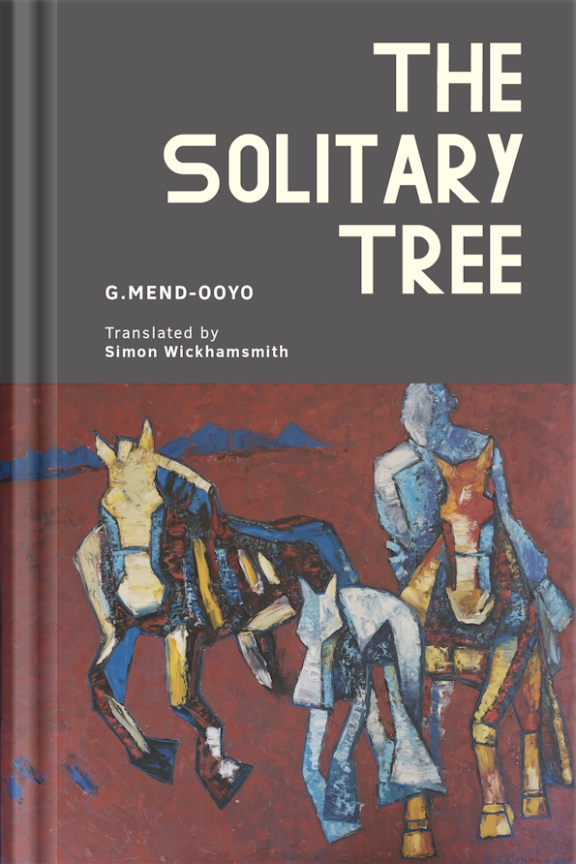
G. Mend-Ooyo 2026 The Solitary Tree. trans. Simon Wickhamsmith
Citation: Gombojav, Mend-Ooyo. The Solitary Tree. Translated by Simon Wickhamsmith. Central Asian Literatures in Translation. Academic Studies Press, 2026. https://www.academicstudiespress.com/9798897831005/
____________________________
Notes
Set in nineteenth century Mongolia, under the sway of the Manchu Qing Emperor in Beijing, G.Mend-Ooyo’s novel tells the story of the outlaw Tooroibandi, who is charged by the mysterious Mountain Sage with discovering the fate of the Solitary Tree, which has stood for generations in the Ongon Sands before recently being destroyed by fire. Tooroibandi’s quest is complicated by an arrogant local official, and enriched by his meeting with Sharmaani, who becomes his wife. All the while he works with his band of fellow outlaws, the Good Men of Shil, to return resources to the local people which had been stolen from them by the authorities. Up above, the action is observed silently by a pair of falcons, who live out their lives distinct from, but always engaged with, the lives of the humans beneath them.
The poet, novelist, and cultural commentator G.Mend-Ooyo was born in 1952 in the Sühbaatar region of southeastern Mongolia. He came to national prominence during the 1980s, and since Mongolia’s democratic revolution of 1990 has been a prominent voice for the preservation and promotion of nomadic cultural heritage. He lives in Ulaanbaatar.
Simon Wickhamsmith is a translator and scholar of modern and contemporary Mongolian literature. He currently teaches at Rutgers University and lives in central New Jersey.
Refer to the INDEX for other articles that may be of interest.
End of transcript.
© 2013-2026. CP in Mongolia. “Out and About 17: The Solitary Tree” is licensed under the Creative Commons Attribution 4.0 International License. Documents linked from this page may be subject to other restrictions. Posted: 2 March 2026. Last updated: 2 March 2026.