The following is a translated extract, with annotations, from a recent open letter by Zava Damdin (b. 1976). I was deeply moved by its beauty and sentiments, and wanted to share it with you here.
__________________________________________________________
I offer greetings of peace for the Great Assembly
on the Fifteenth Day of the New Year.
by Zava Damdin
04.03.2026
“In the northern expanse of the wide open steppe stands Delgertsogt Mountain, preserving the history of countless generations—almost as if proving and reminding us that Delger’s history stands shoulder to shoulder with world history.
Upon its rocks are ancient images [сүг зургууд / süg zurguud]—faded and weathered by sand, yet still distinctly visible—along with split stones [задын чулуу / zadyn chuluu], bronze arrowheads [хүрэл сум / khürel sum], iron arrowheads [төмөр сум /tömör sum], and other artifacts; from scriptures [ном судар / nom sudar], chronicles [шастир / shastir], and legal records [цааз / tsaaz], even to the progress of this age’s ingenious wheel-mechanisms [оньсон хүрд / onyoson khürd].
It is as though the mountain graciously holds them all: chanting praises [дуулал/duulal] of the vessel-world [cав ертөнц/sav yertönц, the physical material environment that “contains” living beings] and the living world [шим ертөнц / shim yertönц, all the sentient beings that are “held”] through the wind, drawing it with clouds, writing it with the tips of grass.
* * *
Delgertsogt Mountain is guarded by a white-bearded elder spirit—the White Old One [цагаан сахалтай өвгөн сахиус / tsagaan sakhaltai övgön sakhius]—dwelling together with a white elder lion [цагаан өвгөн арслан / tsagaan övgön arslan]. Like a venerable gray-haired father, he can be stern with the stern, gentle with the gentle, and he treasures justice and calm restraint.
It is said he was once a heroic figure of ancient legend, and that his luminous spirit transformed into a guardian deity to watch over his homeland and waters, keeping vigil over the steppe. I, in my humble way, like to think he may be one of the heroes who appears in the Khalkha epics.
* * *
Even if I do not speak fully of it, what I have spoken is inseparably connected with the “Soyombo Oron” temple, so it cannot be passed over in silence. It is for the vital importance of loving and protecting one’s mountains and waters, one’s native land and its administrative unit [хошуу / khoshuu]. For there is a subtle wisdom in how we, the beings of the living world, exist in mutual dependence with the vessel-world, our environment.
If humans harm the vessel-world, the vessel-world will return a fitting response. The philosophy of life rests on an understanding this simple. Yet some people fail to grasp even this, and still spend their whole lives talking in volumes—arguing theories, debating philosophy and politics—until their days are exhausted. It is both laughable and sad. True philosophy is very simple, and it exists right beside us.
____________________________________
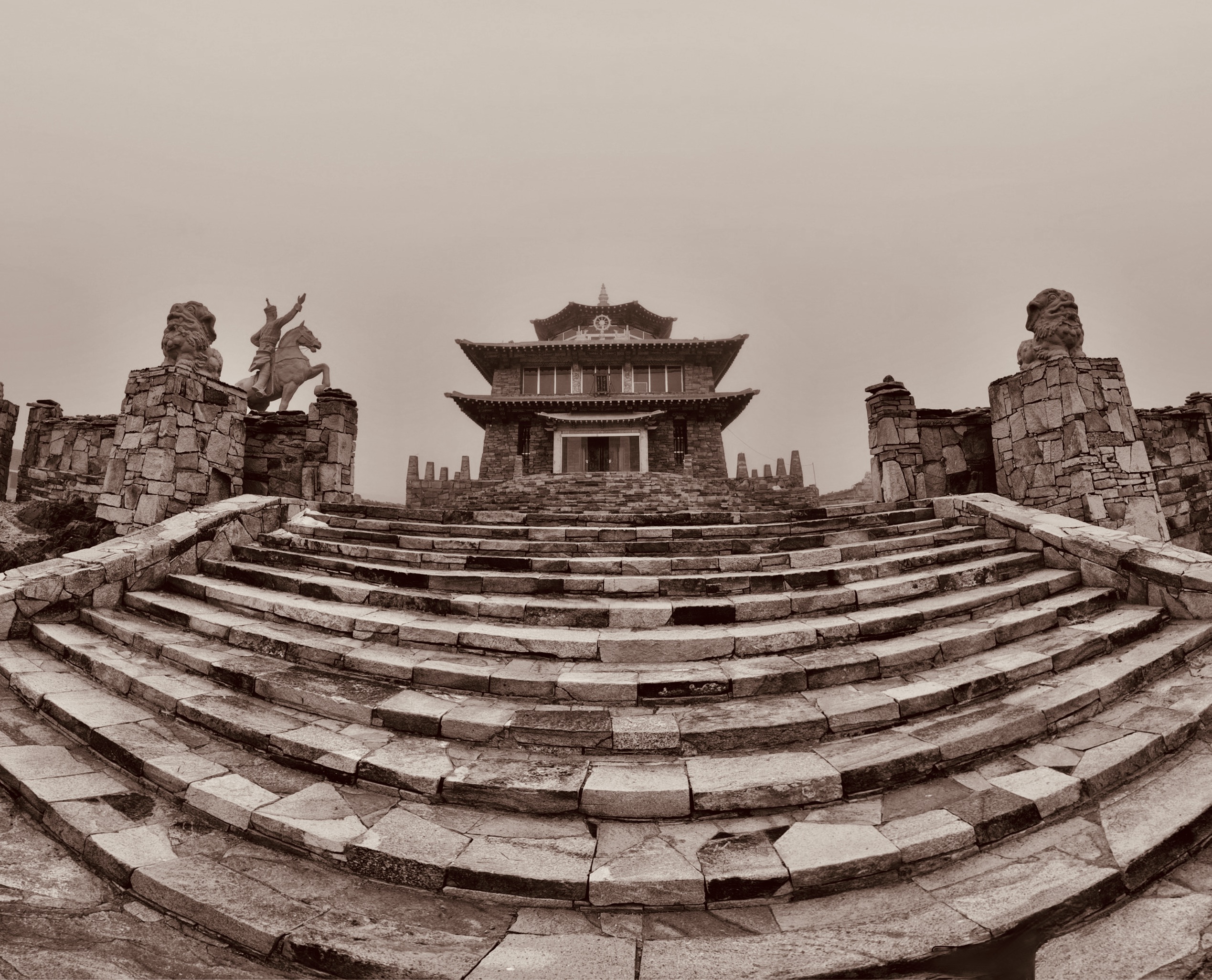
Designed by Zava Damdin (b.1976- ) and built in consultation with a Mongolian architectural firm, this third temple-library-museum is a combination of Qing Dynasty architecture and Zava Rinpoche’s other design ideas. The extensive exterior paving and walls were constructed by a team of stonemasons from local rock that had been blasted onsite. This photograph is of the main south-facing entrance way. This is the largest new temple to be constructed on the Delgeruun Choira precinct at Delgertsogt Mountain, Soyombot Oron in the Gobi Desert of Mongolia. Photograph courtesy of the Zava Damdin Sutra and Scripture Institute. 4 March 2025. Image reprinted on CPinMongolia.com with permission.
____________________________________
On the fifteenth day of the New Year, it is said that Sügjen Nyambuu khaan [see footnote], together with his ministers and the people’s assembly, gave rise to a virtuous mind and made offerings. Then the Buddha Teacher [Бурхан Багш / Burkhan Bagsh], with sacred nectar, provided for all without leaving anyone behind; from the tips of his fingers rays of pure golden light shone forth, and by compassion he caused the suffering beings of the Ayuush tam [Аюуш там / the lowest, unrelenting hell realm] to settle into peaceful fortune—revealing a miraculous display of spiritual power.
* * *
In the praise called “The Great Mother of the Two Assemblies” [Агуу Их Хоёр Чуулгант Эх / Aguu Ikh Khoyor Chuulgant Ekh], Öndör Gegeen’s [1635–1723] teacher, Panchen Luvsan Choiji Jantsan Bogd [Fourth Panchen Lama 1567-1662 or 1570-1662] in the verse for the fifteenth day:
‘On the fifteenth, Sügjen Nyambuu khaan created virtue and merit
With sacred nectar, he provided for all without leaving anyone behind.
From the tip of his compassionate hand he scattered pure golden rays
And the beings of the Ayuush tam he settled into peaceful fortune—before which I bow.’
Mongolian original:
‘Арван таван дор Сүгжэн Нямбуу хаан бээр сайн буян үүсгэж
Ариун рашаанаар бүгдийг хоцроол үгүй ханган соёрхож
Асралт мутрын үзүүрээс шижир алтан туяа сацруулснаар
Аюуш тамын амьтдыг амар заяан лугаа талбисан дор мөргөмүй’
* * *
Ah! By whatever merit arises from these fifteen days during which the Great Prayer Assembly [Их Ерөөлийн хурал / Ikh Yerööliin khural] is held, may all people and beings of this golden world dwell in peace and happiness—may every cause of adversity be calmed: war and conflict, crisis and strife, sickness and suffering, drought and dzud, fire and flood, and all such dangers. And likewise, may the countless three thousand worlds become peaceful and serene!”
__________________________________________________________
FOOTNOTE
“Sügjen Nyambuu khaan” (Mong. Сүгжэн Нямбуу хаан) appears in Mongolian Buddhist devotional/praise literature for the fifteenth day of the first lunar month, within the wider New Year “Miraculous Display” (cho ’phrul) / Great Prayer (Mönlam Chenmo) ritual cycle; accordingly, he functions as a liturgical (exemplary) royal patron rather than a securely datable historical monarch, and modern scholarship does not assign him regnal [the period a monarch rules] dates. See Mark Stevenson’s “Miraculous Display: Temporal and Collaborative Materialisations in Tibetan Buddhist Butter Art,” in Among Tibetan Materialities: Materials and Material Cultures of Tibet and the Himalayas, ed. Emma Martin, Trine Brox, and Diana Lange (Heidelberg: Heidelberg Asian Studies Publishing, 2025), 65–91.
__________________________________________________________
Translation is always an interpretation into another culture. If there are any errors of judgement in this article, they are of my own making. For these, I sincerely apologise.
__________________________________________________________
Please refer to the INDEX for other articles that may be of interest.
End of transcript.
© 2013-2026. CP in Mongolia. “Letter from Mongolia: Greetings of Peace” is licensed under the Creative Commons Attribution 4.0 International License. Documents linked from this page may be subject to other restrictions. Posted: 6 March 2026. Last updated: 6 March 2026.