This article is the next in my series on visual ethnography, the study of people and culture using images and observation to show how they live and make meaning, and how those meanings are given form in practice.
______________________________
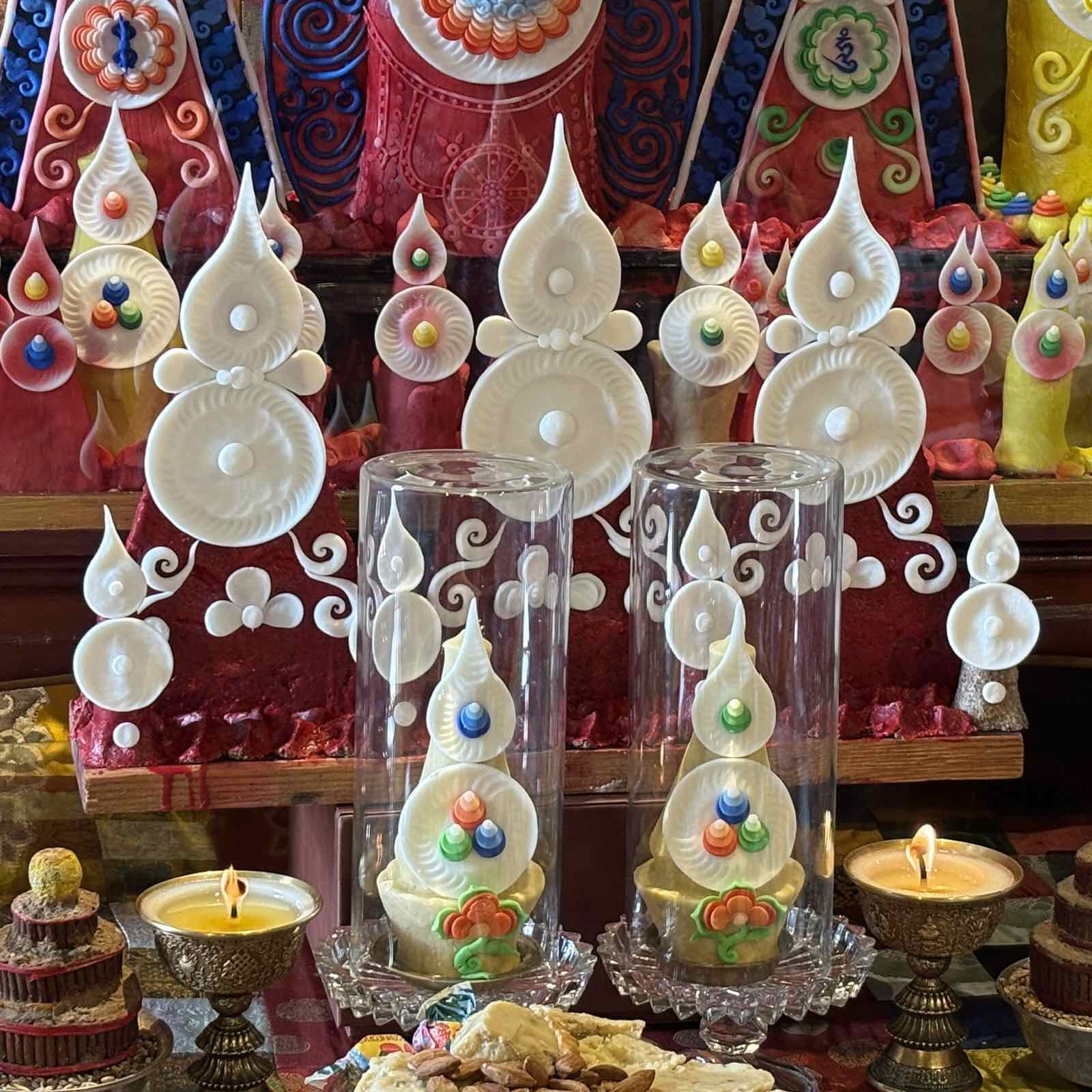
A section (detail) of the larger Lham Mam Tugan handmade balin offering-installation for the Fire Horse Year at Soyombot Oron in Delgertsoght Sum Mongolia. 7 March 2026. Photograph courtesy of Tsagaanshuhert Monhceceg. Reprinted on CPinMongolia.com with permission from The Zava Damdin Scripture and Sutra Institute of Mongolia.
______________________________
In a Mongolian temple setting such as Delgeruun Choira, balin (Mongolian: балин; Tibetan: torma), the ritual cakes offered in Mongolian Gelugpa practice are not simply decorative ritual objects laid out before the altar. They are carefully made, consecrated offerings that give material form to prayer, intention, and ritual exchange within the liturgy itself.
Mongolian scholarship and field-based studies of monastery practice make clear that balin belong to the regular ceremonial system of temples, where they are prepared, blessed, and offered as part of the ordered relationship between Lamas and lams* protectors, local deities, and the wider ritual cosmos of the monastery (Majer 2019, 329; Bareja-Starzyńska 2012, 85). In other words,
Balin are not incidental embellishments: they are among the visible means by which the puja (ritual offering ceremony) makes its intentions present.
______________________________
Within a protector rite such as Lham Mam Tugan, whose purpose is to avert hindrances and clear away obstacles for the coming period, the balin are best understood as concentrated ritual offerings directed toward pacification, protection, and the restoration of right conditions.
Mongolian monastic studies repeatedly show that such offerings are integral to rites intended to secure well-being, remove adversity, and maintain proper relations with powerful unseen beings; they belong to the practical religious work of safeguarding persons, communities, and ritual order (Norov 2019, 6–7). In the context of the Гал Морин Жил (Gal Morin Jil; Year of the Fire Horse), their function is therefore especially resonant:
The offering is not merely symbolic in a weak sense, but participates in the liturgical labour of opening the year so that one may pass through it without obstruction.
______________________________
Meeting point: artistry and efficacy
What is so striking in Mongolian Buddhist usage, is that the balin stand at the meeting point of artistry and efficacy. They are shaped, coloured, and arranged according to inherited monastic conventions, yet their purpose is never exhausted by appearance. As Zsuzsa Majer notes in relation to contemporary Mongolian ritual usage, the making and consecrating of balin remains embedded in the functioning ritual system of monasteries rather than surviving as a museum-like relic of the past (Majer 2019, 329).
Other European scholarship on Mongolian ritual practice likewise points to balin as standard offerings in rites conducted by Lamas and lams, where they operate as prepared ritual media through which blessings are offered, requests are articulated, and harmful conditions are transformed or diverted (Lindskog 2016, 14; Bristley and Tumen-Ochir 2021, 131).
______________________________
So in a Mongolian Gelugpa monastic setting, the balin of Lham Mam Tugan are best understood as offerings that embody the rite’s central intention: to feed, propitiate, and properly address the beings invoked in the puja, while at the same time drawing away hindrances and establishing auspicious conditions for the community. They materialise the prayer that the coming year should unfold without blockage, misfortune, or spiritual interference. Seen in that light,
Balin are not peripheral objects on the altar but one of the rite’s essential working instruments, giving visible and consecrated form to the monastery’s plea for unobstructed passage into the new year (Teleki 2025, 321–22; Majer 2012, 1).
______________________________
In this article, I use Lamas to refer to socially marked religious authorities—teachers, senior clerics, or figures accorded particular status—whereas lams refers more broadly to monks or Buddhist clerics in everyday Mongolian usage. The distinction is therefore socio-cultural and editorial rather than a fixed canonical one, reflecting the differentiated status of religious specialists in contemporary Mongolian Buddhist life (Kollmar-Paulenz 2024; Abrahms-Kavunenko 2011; Abrahms-Kavunenko 2022).
In practice, however, the category of lam can also encompass highly specialised artistic and ritual expertise. Sampel Lam, for example, began training in the art of balin-making as a child monk with Zava Damdin (b. 1976), who was, at that time, responsible for monastic education at Amarbayasgalant Monastery in Selenge Aimag, before formally taking up his seat at Delgerüün Choira/Soyombot Oron in the Gobi. Over the years I have worked with this community since 2004, I have watched Sampel Lam, in the footsteps of his mentor, gradually become a true balin artiste and who is now training younger Lamas and lams of this Mongolian lineage of Gelugpa practice.
______________________________
FURTHER READING
Abrahms-Kavunenko, Saskia A. Improvising Tradition: Lay Buddhist Experiences in Cosmopolitan Ulaanbaatar. PhD diss., University of Western Australia, 2011.
Abrahms-Kavunenko, Saskia. “Mongolian Buddhism, Science and Healing: A Modernist Legacy.” Central Asian Survey41, no. 2 (2022): 271–89.
Bareja-Starzyńska, Agata. “Description of the Erdene Zuu Monastery Life (Including Čam Ritual) Based on Notes from the Kotwicz Expedition.” In In the Heart of Mongolia: 100th Anniversary of W. Kotwicz’s Expedition to Mongolia in 1912, 85. Kraków, 2012.
Bristley, Jessica, and Enkh-Ochir Tumen-Ochir. “‘Tears of Rejoicing Spirits’: Happiness and the Mediation of Human–Spirit Relations in a Mongolian Mountain Sacrifice.” Inner Asia 23, no. 1 (2021): 131–53.
Kollmar-Paulenz, Karénina. “Lamas and Shamans: Mongolian Orders of Knowledge from the Early 17th to the 21st Century: A Contribution to the Debate on Non-European Concepts of Knowledge.” AЯGOS (2024).
Lindskog, Birgitta V. “Ritual Offerings to Ovoos among Nomadic Halh Herders of West-Central Mongolia.” Études mongoles et sibériennes, centrasiatiques et tibétaines 47 (2016).
Majer, Zsuzsa. “Delgeriin Choir, the Monastery of Zawa Lam Damdin in the Gobi.” Zentralasiatische Studien 41 (2012): 1–32.
Majer, Zsuzsa. “Three Ritual Prayers by Öndör Gegeen Zanabazar.” In Sources of Mongolian Buddhism, 329–52. Leiden: Brill, 2019.
Norov, Baatar. “Mongolian Buddhist Scholars’ Works on Infectious Diseases (Late 17th Century to the Beginning of the 20th Century).” Religions 10, no. 4 (2019): 229.
Teleki, Krisztina. “Depictions and Sacred Texts of Śrīdevī Preserved in the Collections of Ulaanbaatar, Mongolia.” Acta Orientalia Academiae Scientiarum Hungaricae 78, no. 2 (2025): 321–48.
And for a comparative reading, see:
Stevenson, Mark. “Miraculous Display: Temporal and Collaborative Materialisations in Tibetan Buddhist Butter Art.” In Among Tibetan Materialities: Materials and Material Cultures of Tibet and the Himalayas, edited by Emma Martin, Trine Brox, and Diana Lange, 65–91. Heidelberg: Heidelberg Asian Studies Publishing, 2025.
Refer to the INDEX for other articles that may be of interest.
End of transcript.
© 2013-2026. CP in Mongolia. “Artscape 19: Balin for the New Year” is licensed under the Creative Commons Attribution 4.0 International License. Images and documents linked from this page may be subject to other restrictions. Posted: 8 March 2026. Last updated: 8 March 2026.