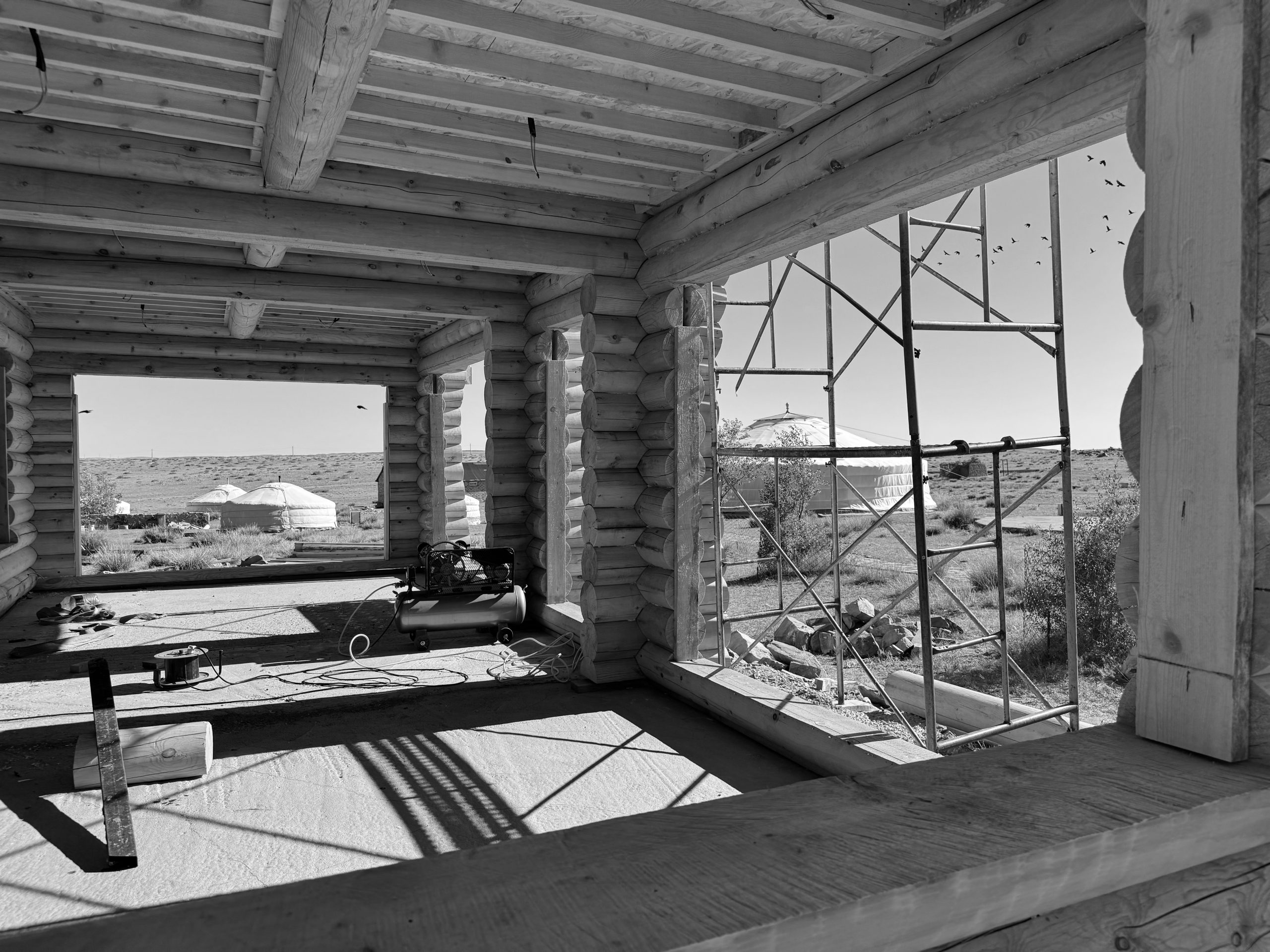
Whilst Delgeruun Choira monastery’s (D.C.) student Lamas and lams continue their studies, including the transcription and memorisation of Sakya Pandita texts (sarka and tsigched) reconstruction and revitalisation of the D.C. precinct in the Dundgobi continues unabated. Here in Mongolia, Sakya Pandita Kunga Gyeltsen (1182-1251) is regarded as a great scholar. He was proficient in the five great sciences of Buddhist philosophy, medicine, grammar, dialectics and sacred Sanskrit literature as well as the minor sciences of rhetoric, synonymies, poetry, music, dancing and astrology. Sakya Pandita first met Genghis Khan’s grandson Mongolian Prince Godan in early 1247, after which he became the main agent of the Mongols in Tibetan affairs until the Prince’s death in 1251. It was Prince Godan who commissioned Sakya Pandita to create the Mongol Phags-pa Quadratic Script. 8 September 2025. Photo: C. Pleteshner.

Whilst Delgeruun Choira monastery’s (D.C.) student Lamas and lams continue their studies, including the transcription and memorisation of Sakya Pandita texts (sarka and tsigched) reconstruction and revitalisation of the D.C. precinct in the Dundgobi continues unabated. Here in Mongolia, Sakya Pandita Kunga Gyeltsen (1182-1251) is regarded as a great scholar. He was proficient in the five great sciences of Buddhist philosophy, medicine, grammar, dialectics and sacred Sanskrit literature as well as the minor sciences of rhetoric, synonymies, poetry, music, dancing and astrology. Sakya Pandita first met Genghis Khan’s grandson Mongolian Prince Godan in early 1247, after which he became the main agent of the Mongols in Tibetan affairs until the Prince’s death in 1251. It was Prince Godan who commissioned Sakya Pandita to create the Mongol Phags-pa Quadratic Script. 8 September 2025. Photo: C. Pleteshner.

Whilst Delgeruun Choira monastery’s (D.C.) student Lamas and lams continue their studies, including the transcription and memorisation of Sakya Pandita texts (sarka and tsigched) reconstruction and revitalisation of the D.C. precinct in the Dundgobi continues unabated. Here in Mongolia, Sakya Pandita Kunga Gyeltsen (1182-1251) is regarded as a great scholar. He was proficient in the five great sciences of Buddhist philosophy, medicine, grammar, dialectics and sacred Sanskrit literature as well as the minor sciences of rhetoric, synonymies, poetry, music, dancing and astrology. Sakya Pandita first met Genghis Khan’s grandson Mongolian Prince Godan in early 1247, after which he became the main agent of the Mongols in Tibetan affairs until the Prince’s death in 1251. It was Prince Godan who commissioned Sakya Pandita to create the Mongol Phags-pa Quadratic Script. 8 September 2025. Photo: C. Pleteshner.

Whilst Delgeruun Choira monastery’s (D.C.) student Lamas and lams continue their studies, including the transcription and memorisation of Sakya Pandita texts (sarka and tsigched) reconstruction and revitalisation of the D.C. precinct in the Dundgobi continues unabated. Here in Mongolia, Sakya Pandita Kunga Gyeltsen (1182-1251) is regarded as a great scholar. He was proficient in the five great sciences of Buddhist philosophy, medicine, grammar, dialectics and sacred Sanskrit literature as well as the minor sciences of rhetoric, synonymies, poetry, music, dancing and astrology. Sakya Pandita first met Genghis Khan’s grandson Mongolian Prince Godan in early 1247, after which he became the main agent of the Mongols in Tibetan affairs until the Prince’s death in 1251. It was Prince Godan who commissioned Sakya Pandita to create the Mongol Phags-pa Quadratic Script. 8 September 2025. Photo: C. Pleteshner.